Class 11th

Get insights from 8k questions on Class 11th, answered by students, alumni, and experts. You may also ask and answer any question you like about Class 11th

Follow Ask Question
8k

Questions

0

Discussions

1

Active Users

0

Followers

New answer posted

a year ago

0 Follower 16 Views

P
Payal Gupta

Contributor-Level 10

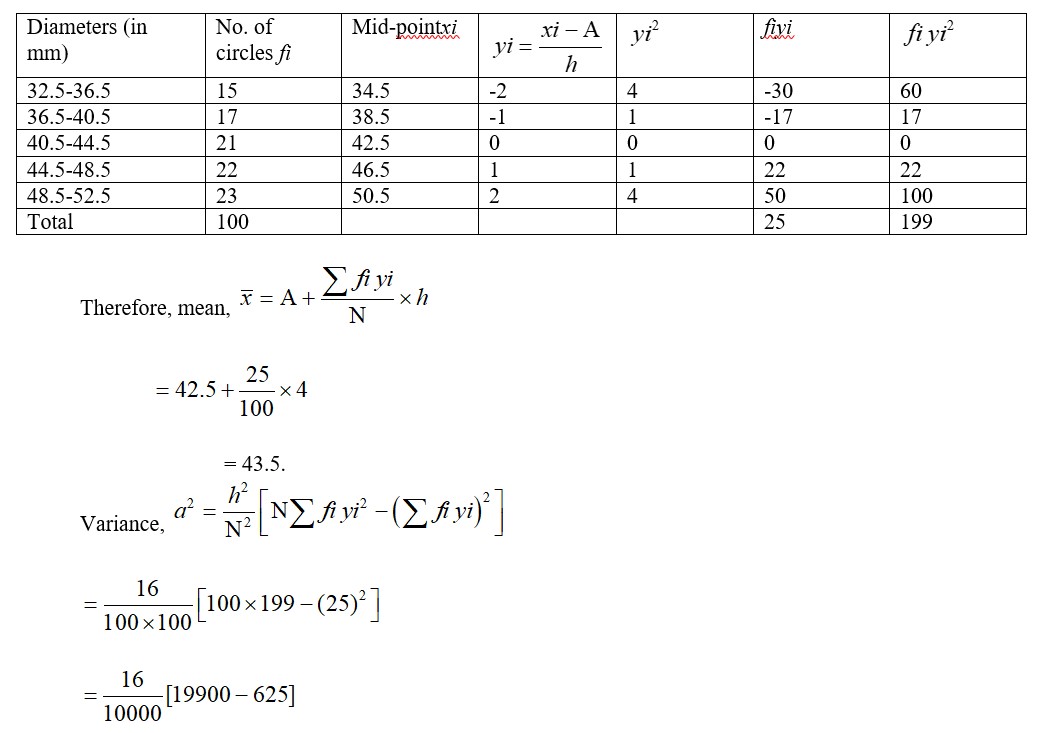
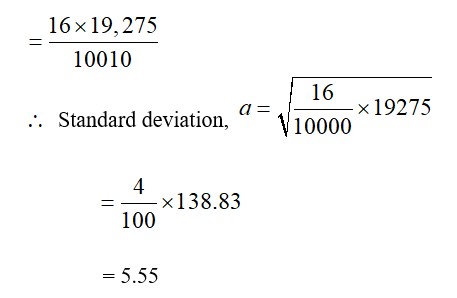
22. The given data is converted into continuous frequency duration by subtracting and adding 0.5 from lower and upper limit respectively. Lit the assumed mean be A=42.5 and h=4
New answer posted

a year ago

0 Follower 18 Views

P
Payal Gupta

Contributor-Level 10

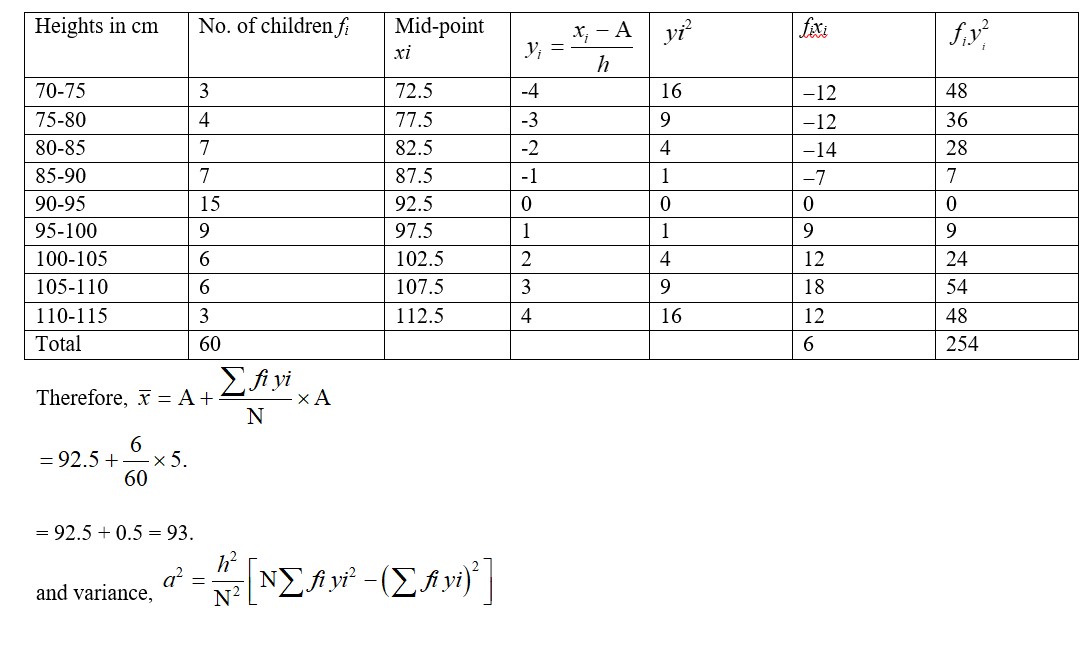
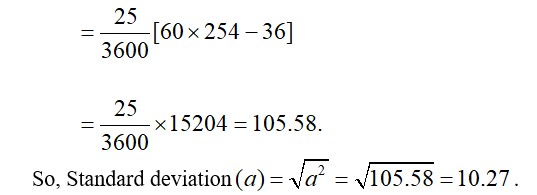
21. Let the assumed mean be A=92.5 and h=5

New answer posted

a year ago

0 Follower 22 Views

P
Payal Gupta

Contributor-Level 10

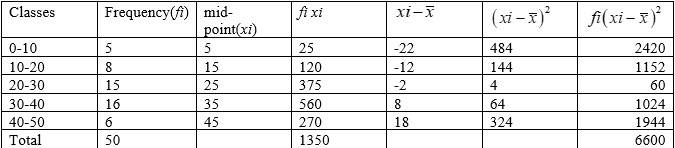
20.

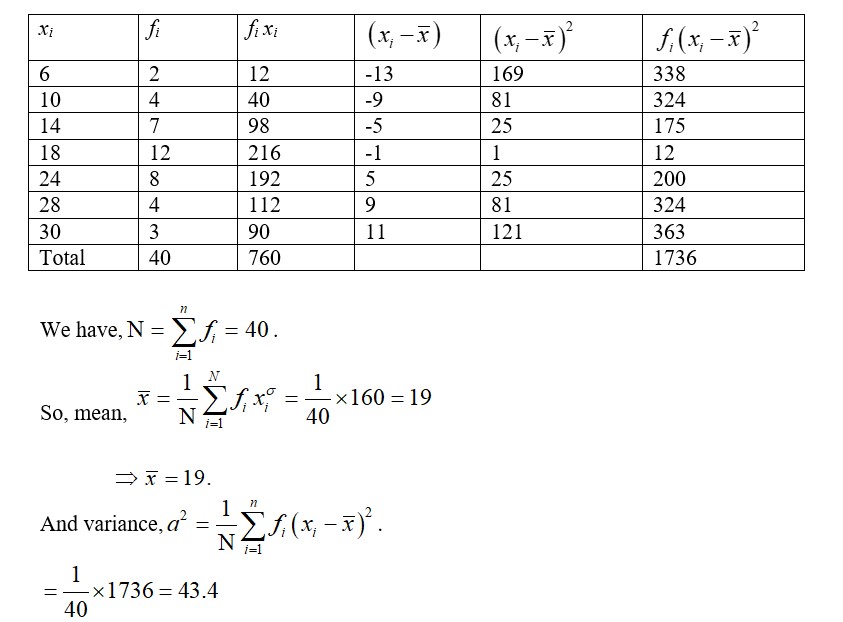
We have,  N=∑i=1nfi=50 .

So, mean,  x¯=1N*∑i=1nfi xi=13505=27.

=150*6600

= 132.

New answer posted

a year ago

0 Follower 41 Views

P
Payal Gupta

Contributor-Level 10

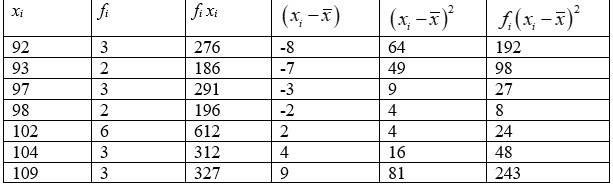
19. Let the assumed mean be A=105 and class width, h=30. The given data can be tabulated as
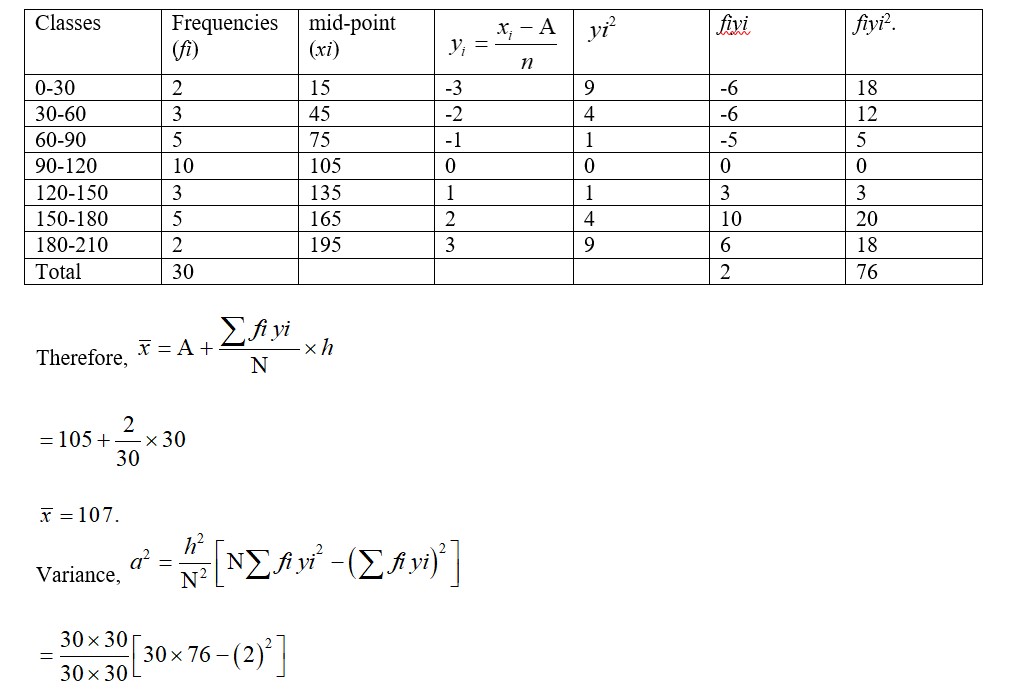
= 2280 - 4

= 2276.

New question posted

a year ago
0 Follower 2 Views

New answer posted

a year ago

0 Follower 29 Views

P
Payal Gupta

Contributor-Level 10

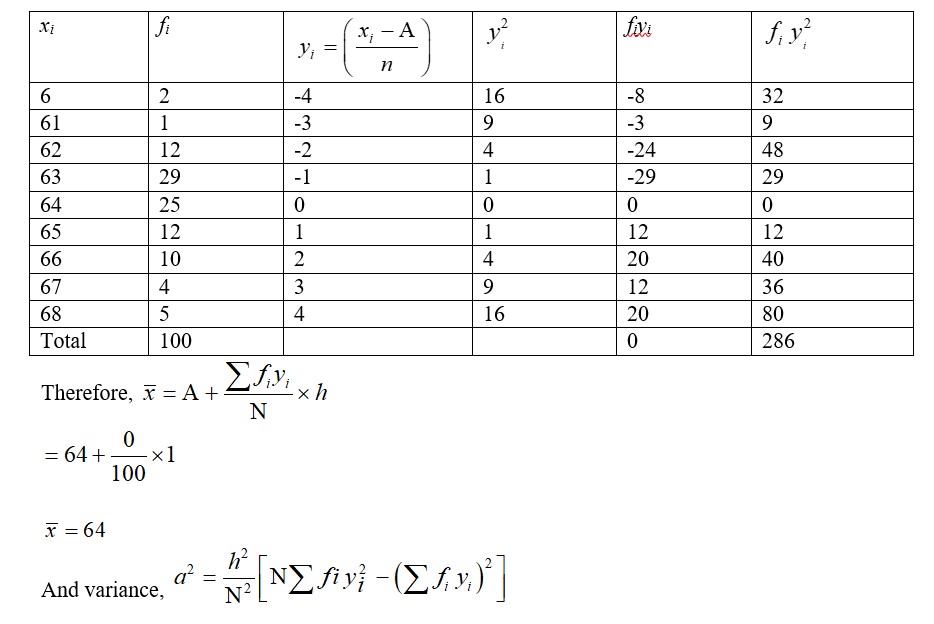
18. Let the assumed mean be A=64 and it the width, h=1.

New answer posted

a year ago

0 Follower 47 Views

P
Payal Gupta

Contributor-Level 10

17. The given data can be tabulated as follow

New answer posted

a year ago

0 Follower 16 Views

P
Payal Gupta

Contributor-Level 10

16. The given data can be tabulated as follow.


New answer posted

a year ago

0 Follower 5 Views

P
Payal Gupta

Contributor-Level 10

15. We have, first 10 multiples of 3=3,6,9,12,15,18,21,24,27,30.

So,  x¯=3+6+9+12+15+18+21+24+27+3010=16510=16.5

We can now tabulate the given data as following.
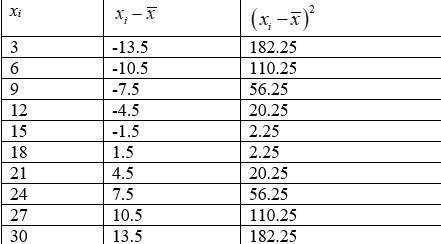
Therefore, variance,  a2=1n∑i=1n (xi−x¯)2

=110*742.5

= 74.25.

New answer posted

a year ago

0 Follower 7 Views

P
Payal Gupta

Contributor-Level 10

14. We know that,

Sum of first'n ' natural no =n(n+1)2

So, mean, x¯=  sumoffirst(n) naturalno.=n (n +1)/2 nno of observations

=n+12

So, Variance, a2=1n∑i=1n(xi−x¯)2=1n∑i=1n(xi−(n+12))2

a2=1n[∑i=1nxi2−∑i=1n2xi(n+12)+∑i=1n(n+12)2]                                                                                          _______(1)

So, ∑i=1nxi2=(1)2+(2)2+(3)2+…+(n)2=n(n+1)(2n+1)6 _____(2).


And ∑i=1n(n+12)2=(n+1)24∑i=1n1.=n(n+1)24⋅  ____(4).

Putting (2), (3) and (4) in (1) we get,

a2=1n[n(n+1)(2n+1)6−n(n+1)22+n(n+1)24]

=(n+1)(2n+1)6−(n+1)22+(n+1)24

=(n+1)(2n+1)6−(n+1)24.

=(n+1)[2n+16−(n+1)4]

=(n+1)[4n+2−3n−312]

=(n+1)(n−1)12=n2−112.

Get authentic answers from experts, students and alumni that you won't find anywhere else

Sign Up on Shiksha

On Shiksha, get access to

  • 67k Colleges
  • 1.2k Exams
  • 718k Reviews
  • 1850k Answers

Share Your College Life Experience

×

This website uses Cookies and related technologies for the site to function correctly and securely, improve & personalise your browsing experience, analyse traffic, and support our marketing efforts and serve the Core Purpose. By continuing to browse the site, you agree to Privacy Policy and Cookie Policy.