

Class 11th
Get insights from 8k questions on Class 11th, answered by students, alumni, and experts. You may also ask and answer any question you like about Class 11th
Follow Ask QuestionQuestions
Discussions
Active Users
Followers
New answer posted
a year agoContributor-Level 10
Let m and r be the mass and radius of the hollow cylinder and solid sphere.
The moment of inertia of the hollow cylinder about its standard axis, =I
The MI of the solid sphere about an axis passing through its centre, Is = (2/5) mr2
We know the relation = I , where
= angular acceleration
= torque
I = moment of inertia
For the hollow cylinder, =
For the solid sphere, =
Since the torque applied is same, = , we get
= = (mr2) /( (2/5) mr2 )) = 5/2
Hence ……(i)
Now using the relation
+ where
= initial angul
New answer posted
a year agoContributor-Level 10
(a)

The moment of Inertia of a sphere about its diameter = 2MR 2/5
According to the theorem of parallel axis, the moment of inertia of a body about any axis is equal to the sum of the moment of inertia of the body about a parallel axis passing through its centre of mass and the product of its mass and square of the distance between two parallel axes
Hence the moment of inertia about a tangent of the sphere = 2MR 2/5 + MR2 = 7MR 2/5
(b)

The moment of inertia of a disc about its diameter = MR 2/4
According to the theorem of perpendicular axis, the moment of inertia of a planar body about an axis perpendicular to its plane is equal to t
New answer posted
a year agoContributor-Level 10
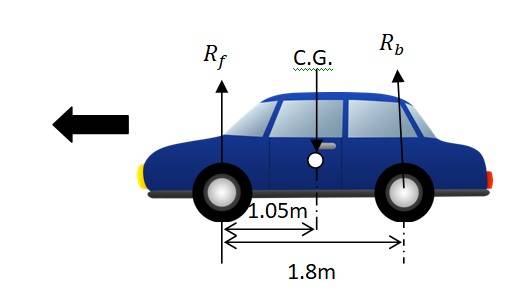
Mass of the car, m = 1800 kg
Distance between the front and rear axles, d = 1.8 m
Distance between C.G. and the front axle = 1.05 m
Let Rf and Rb be the force exerted from ground at front and rear axles respectively.
Rf + Rb = mg = 1800 x 9.8 N = 17640 N ……. (i)
For rotational equilibrium around C.G. we have Rf x 1.05 = Rb x (1.8 – 1.05)
Rf x 1.05 = Rb x 0.75
Rf/Rb = 0.75 / 1.05
Rf = 0.71 Rb ……. (ii)
From equation (i), we get
0.71 Rb + Rb = 17640
Rb = 10316 N
Rf = 7324 N
Therefore, force exerted on each front wheel = Rf/2 =7324/2 = 3662 N
Force exerted on each rear wheel, Rb/2 = 10316 / 2= 5158 N
New answer posted
a year agoContributor-Level 10
(i) A = {– 3, –2, –1, 0, 1, 2, 3, 4, 5, 6}
(ii) B = {1, 2, 3, 4, 5}
(iii) C = {17, 26, 35, 44, 53, 62, 71, 80}
(iv) x = Prime number which are divisor of 60
Factors of 60 are 1,2,3,4,5,6,10,12,15,20,30,60
Hence, x = 2, 3, 5
?D = {2, 3, 5}
(v) E = {T, R, I, G, O, N, M, E, Y}
(vi) F = {B, E, T, R}
New answer posted
a year ago
Contributor-Level 10
A free body diagram needs to be drawn.

The length of the bar, l = 2 m
T1 and T2
At translational equilibrium, we have =
(T1 / T2) = ( / = 4/3
T1 = (4/3)T2
For rotational equilibrium, on taking the torque about the centre of gravity, we have
T1 x d = T2 (2-d)
T1 x 0.8d = T2 x 0.6 (2-d)
(4/3)T2 x 0.8d = T2 x 0.6 (2-d)
(4/3) x 0.8d = 0.6 (2-d)
1.07d = 1.2 – 0.6d
d = 0.72
So the c.g. of the given bar lies at 0.72 m from its left end.
New answer posted
a year agoContributor-Level 10
Let at certain instant two particles be at points P and Q, as shown in the figure.
Angular momentum of the system about point P
= mv x 0 + mv x d = mvd ……. (i)
Angular momentum of the system about point Q
= mv x d + mv x 0 = mvd ……. (ii)
Consider a point R, which is at a distance y from point Q such that QR = y

PR = d – y
Angular momentum of the system about point R
= mv x (d – y) + mv x y = mvd – mvy + mvy = mvd ……. (iii)
Comparing equations (i), (ii) and (iii) we get
= = …… (iv)
New answer posted
a year agoContributor-Level 10
Let = , = , =
Let be a unit vector perpendicular to both b and c. Hence and a have the same direction
Now = bc
= bc = bc
Now )= a. (bc ) = abccos ? = abccos0° = abc = Volume of the parallelepiped
New answer posted
a year agoContributor-Level 10
1. (i) The collection of all months of a year with J as initial are January, June and July. Hence, it is a well-defined and is therefore a set .
(ii) The collection of ten most talented writers of India is not well-defined as it may vary from one person to another. Hence, it is not a set.
(iii) The team of 11 best-cricket batsmen of the world is not well-defined as it may vary from one parson to another as they may vary from one person to another. Hence, it is not a set.
(iv) The collection of all boys in your class is well-defined as your-class is fixed. Hence, it is a set.
(v) The collection of all natural numbersless than
New answer posted
a year agoContributor-Level 10
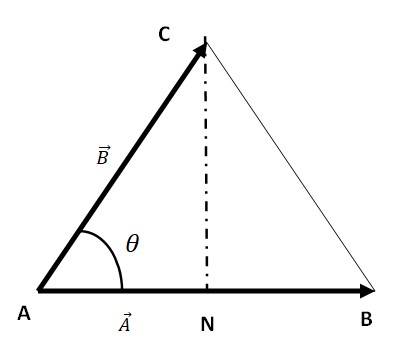
Let AB is equal to the vector a and AC be equal to the vector b.
Consider two vectors = =
= inclined at an angle
MN =
| | = | | |
The area of ΔABC, we can write the relation
Area of Δ ABC = AB =
Taking an Exam? Selecting a College?
Get authentic answers from experts, students and alumni that you won't find anywhere else
Sign Up on ShikshaOn Shiksha, get access to
- 67k Colleges
- 1.2k Exams
- 718k Reviews
- 1850k Answers