

Class 12th
Get insights from 12k questions on Class 12th, answered by students, alumni, and experts. You may also ask and answer any question you like about Class 12th
Follow Ask QuestionQuestions
Discussions
Active Users
Followers
New answer posted
a year agoContributor-Level 10
8.28 Metal ions which have valence electrons in d-orbital and in which d-d transition can take place will be coloured and the metal ions which have completely filled orbital or have d- orbital will be colourless as no d-d transition is possible in those configurations.
Element | Atomic Number | Ionic State | Electronic configuration in ionic state |
Ti | 22 | Ti3+ | [Ar] 3d1 |
V | 23 | V3+ | [Ar] 3d2 |
Cu | 29 | Cu+ | [Ar] 3d10 |
Sc | 21 | Sc3+ | [Ar] |
Mn | 25 | Mn2+ | [Ar] 3d5 |
Fe | 26 | Fe3+ | [Ar] 3d5 |
Co | 27 | Co2+ | [Ar] 3d7 |
From the above table, it can be observed that only Sc3+ and Cu+ have either completely filled d- orbital or empty d-orbital. So, all other ions except Sc3+ and Cu+ will be coloured in aqueous solution because of absorption of radiations which fall in the visible region as on obtaining energy electrons jump from one d-orbital to another.
New answer posted
a year agoContributor-Level 10
8.27 (i) Reduction potential tells us the ease with which the Metal can get reduced, As E° for Cr3+/Cr2+ is negative (–0.4 V), this means that Cr3+ ions in solution cannot be reduced to Cr2+ ions i.e., Cr3+ ions are very stable. As a further comparison of E° values show that Mn3+ ions more readily than Fe3+ ions which means that Mn3+ is least stable.
So Stability of metal ions is as follows:
Mn3+
(ii) Reduction potential tells us the ease with which the Metal can get reduced or the difficulty with which they are oxidized, As the reduction potential increases in the following order Mn2+/Mn < Cr2+/Cr< Fe2+/Fe
So oxidation of Fe is not as easy
New answer posted
a year agoContributor-Level 10
8.26 Potassium permanganate can be prepared from MnO2. It can be done by fusing the ore with KOH in presence of an oxidizing agent like atmospheric oxygen/KNO3 etc to give green coloured K2MnO4 as the product.
2MnO2 + 4KOH + O2 → 2K2MnO4 + 2H2O
The Product K2MnO4 is extracted with water and then oxidised by passing ozone/chlorine into the solution or electrolytically.
Electrolytic oxidation:
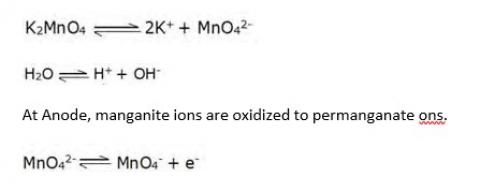
(i) Acidified KMnO4 solution oxidizes Fe(II) ions to Fe(III) ions and water as product
MnO4 - + 8H+ + 5e- → Mn2+ + 4H2O
Fe2+→ Fe3++ e- } x5
Overall: MnO4 - + 8H+ + 5Fe2+ → Mn2+ + 4H2O + 5Fe3+
(ii) Acidified potassium permanganate oxidizes SO2 to su
New answer posted
a year agoContributor-Level 10
8.25 K2Cr2O7 acts as a very strong oxidizing agent in acidic medium. K2Cr2O7 gets reduced and acts as an oxidizing agent by oxidizing Iodide to iodine
(i) K2Cr2O7 oxidizes iodide to iodine
Cr2O72-+ 14H++ 6e-→ 2Cr3+ + 7H2O
2I-→ I2 + 2e- } x3
Overall: Cr2O72-+ 14H++ 6I-→ 2Cr3+ + 7H2O+ 3I2
(ii) K2Cr2O7 oxidizes iron(II) to iron(III)
Cr2O72-+ 14H++ 6e-→ 2Cr3+ + 7H2O
Fe2+→ Fe3+ + e- } x6
Overall: Cr2O72-+ 14H++ 6Fe2+→ 2Cr3+ + 7H2O + 6Fe3+
(iii) K2Cr2O7 oxidized H2S to sulphur
Cr2O72-+ 14H++ 6e-→ 2Cr3+ + 7H2O
H2S → S + 2H+ + 2e-} x3
Overall: Cr2O72-+ 8H++ 3H2S → 2Cr3+ + 7H2O +3S
New answer posted
a year agoContributor-Level 10
8.24 Potassium dichromate is prepared from chromite ore (FeCr2O4) by the following steps:
Step1: Preparation of sodium dichromate in the reaction of Chromite ore with sodium hydroxide and oxygen gas.
4FeCr2O4 + 16NaOH + 7O2? 8Na2CrO4 + 2Fe2O3 + 8H2O
Step2: Conversion of Sodium Chromate on reaction with concentrated Sulfuric acid gives Sodium dichromate as a product.
2Na2CrO4 + conc. H2SO4? Na2Cr2O7 + Na2SO4 + H2O
Step3: Sodium dichromate on reaction with potassium chloride converts to potassium dichromate as a product.
Na2Cr2O7 + 2KCl? K2Cr2O7 + 2NaCl
As potassium dichromate is less soluble than sodium chloride so, potassium dichromate
New answer posted
a year agoContributor-Level 10
8.23 In transition metals, it can be observed that the oxidation state of the metal varies from +1 to +7 which is obtained by removing all its valence electrons. In transition elements the oxidation state differ by 1 unlike non transition elements whose oxidation state differs by 2, for example in transition metals (Cu2+, Cu3+ and Fe2+, Fe3+) and In non-transition elements, this variation is selective, always differing by 2, e.g. S exhibits +2, +4, +6 oxidation states and N exhibits +3, + 5, etc.

New answer posted
a year agoContributor-Level 10
8.22 Interstitial compounds are those compounds in which small atomic size elements like H, C, N occupy the interstitial sites of the crystal lattice of the Transition metal due to their large size.
Example, in the diagram given below:

Here, Green Balls form the Crystal lattice of transition metal and Blue balls represent elements like H/C/N which occupy the interstitial sites.
New answer posted
a year agoContributor-Level 10
8.21 (i) Transition metals and many of their compounds show paramagnetic behavior- Paramagnetic behaviour is shown by transition metals as paramagnetism is due to the presence of unpaired electrons which have a magnetic moment associated with its spin and angular momentum, as the orbital angular momentum is satisfied in the first transition series. So the paramagnetic is only due to the unpaired electrons.
(ii) The enthalpies of atomisation of the transition metals are high- Enthalpies of atomization is the enthalpy change when 1 mol of gaseous atoms is formed from its element in its defined physical state under standard cond

New answer posted
a year agoContributor-Level 10
8.20 +3 oxidation state is the most common oxidation state of lanthanides i.e., Ln (III) compounds are predominant. +2 and +4 oxidation states can also be found in the solution or in solid compounds, but are not predominant.
New answer posted
a year agoContributor-Level 10
8.19 Transition metals have a partially filled d−orbital. Therefore, the electronic configuration of transition elements is (n−1) d1-10 ns0-2 The non-transition elements either do not have a partially filled d−orbital. Therefore, the electronic configuration of non-transition elements is ns1-2 orns2 np1-6.
Taking an Exam? Selecting a College?
Get authentic answers from experts, students and alumni that you won't find anywhere else
Sign Up on ShikshaOn Shiksha, get access to
- 67k Colleges
- 1.2k Exams
- 718k Reviews
- 1850k Answers