

Class 12th
Get insights from 12k questions on Class 12th, answered by students, alumni, and experts. You may also ask and answer any question you like about Class 12th
Follow Ask QuestionQuestions
Discussions
Active Users
Followers
New question posted
a year agoNew answer posted
a year agoContributor-Level 10
1.38 We apply pythagoras theorem AC2= AB2+ BC2
(2R)2= (R+r)2 +(R+r)2 = 2(R+r)2
4R2 = 2(R+r)2
(2R)2= (R+r)2
√2(R)2= √(R+r)2 = √2r = R+r
r = √2 R – R
r = (√2-1) R
r = (1.4114-1)R
r= 0.414 R
New answer posted
a year agoContributor-Level 10
1.37 Calculation of edge length of unit cell(a)
Atomic mass of the element (M)= 93g mol−1
Number of particles in bcc type unit cell (Z) = 2
Mass of the unit cell = Z * MNA = 2 * (93 g mol−1) (6.022*1023mol−1)
=30.89*10−23g
Density of unit cell (d) =8.55 g cm−3
Volume of unit cell (a3)=Mass of unit cell
Density of unit cell=(30.89*10−23g)(8.55 g cm−3)
=36.16*10−24cm3
Edge length of unit cell (a) = (36.13*10−24cm3)13
=3.31 * 10−8cm
Step II: Calculation of radius of unit cell (r)
For bcc structure, r=√3a4
=√3*(3.31*10−8cm)4
=1.43*10−8cm
New answer posted
a year agoContributor-Level 10
1.36 It is given that the atoms of Q are present at the corners of the cube.
Therefore, number of atoms of Q in one unit cell = 8 x 1/8 = 1
It is also given that the atoms of P are present at the body-centre.
Therefore, number of atoms of P in one unit cell = 1
This means that the ratio of the number of P atoms to the number of Q atoms, P:Q = 1:1
Hence, the formula of the compound is PQ.
The coordination number of both P and Q is 8.
New answer posted
a year agoContributor-Level 10
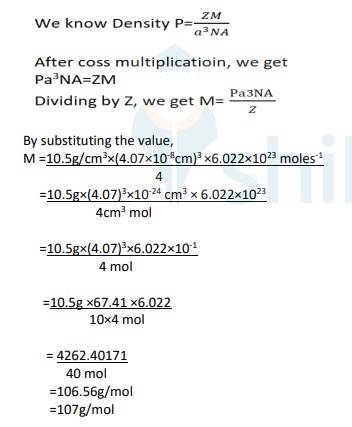
1.35 P= density
A= edge length of the cell
NA= Avogadro Number
Z= no. of atoms in F.C.C unit cell
M= mass of the metal
Edge length of the cell = d = 4.07*10-8 cm
Density = P =10.5g/cm3
No. of unit cell of face centered cubic (F.C.C) lattice is 4, Z=4
Avogadro Number (NA) = 6.022*1023
Mass of silver = M=?
New question posted
a year agoNew answer posted
a year agoContributor-Level 10
1.34 (i) The efficiency of packing in case of simple cubic unit cell is given below:
A simple cubic unit cell contains one atom per unit cell.
Also, a=2r, where a is the edge length and r is the radius of atom. Total volume of unit cell = a3
Packing efficiency = Volume of one sphere / Total volume of unit cell * 100
Packing Effieciency = 4/3πr3 / 8r3 X 100 = 52.4%
(ii) The efficiency of packing in case of body-centred cubic unit cell is given below:
A body-centred cubic unit cell containstwo atoms per unit cell.
Also, √3a = 4r,where a isthe edge length and r isthe radius of atom.
Total volume of unit cell = a3
Packing efficiency = Volu
New answer posted
a year agoContributor-Level 10
(i) Both metallic and ionic crystals have strong forces of attraction between their atoms or ions. In metallic crystals there is a strong metallic bond present between electrons and positively charged ions. In ionic crystals there are strong ionic bonds between anions and cations. Both of them conduct electricity,
but metallic crystals conduct electricity in all three states of matter while ionic crystals conduct electricity only in molten state.
(ii) The ionic solids are hard and brittle because they have strong electrostatic forces of attraction between the anions and cations .As a result the anions and cations are tightly hel
New answer posted
a year agoContributor-Level 10
1.32 Number of corner atoms per unit cell
= 8 corners atoms *18 atom per unit cell
=8 * 18 = 1 atom
Number of face face centred atoms per unit cell
= 6 face centred atoms * 12 atom per unit cell
= 6 * 12 = 3 atoms
∴ Total number of atoms (lattice point) = 1 + 3 = 4
(ii) As in (i)
No. of lattice points = 4
(iii) In bcc unit cell, number of corner atoms per unit cell
=8 corners*18 per corner atom
=8*18=1 atom
Number of atoms at body centre =1*1 = 1 atom
∴ Total number of atoms (lattice points) = 1 + 1 =
New answer posted
a year agoContributor-Level 10
1.31 (i) In hexagonal close packing (hcp), the spheres of the third layer are vertically above the spheres of the first layer. It means tetrahedral voids of the second layer are covered by the spheres of the third layer. The AB. type.In cubic close packing (ccp), the spheres of third layer cover the octahedral voids of second layer. But the spheres of the fourth layers are aligned with those of the first layer. The pattern is ABC. type.

(ii) Crystal lattice is the three dimensional arrangement of identical point in the space which represent how the constituent particles (atoms, ions, molecules) are arranged in a crystal.Unit cell is th


Taking an Exam? Selecting a College?
Get authentic answers from experts, students and alumni that you won't find anywhere else
Sign Up on ShikshaOn Shiksha, get access to
- 67k Colleges
- 1.2k Exams
- 718k Reviews
- 1850k Answers