

Class 12th
Get insights from 12k questions on Class 12th, answered by students, alumni, and experts. You may also ask and answer any question you like about Class 12th
Follow Ask QuestionQuestions
Discussions
Active Users
Followers
New answer posted
a year agoContributor-Level 10
1.48 It is given that aluminum crystallises in a cubic closed packed structure.
Its metallic radius is 125 pm.
For cubic close-packed structure
a=2√2r=2√2*125=354 pm
Here, a is the edge length of the unit cell and r is the atomic radius.
(ii) Volume of one unit cell = a3 =(354 pm)3=4.4*10−23cm3(1 pm=10−10cm)
Number of unit cells in 1.00cm3= 1.00 cm3 / 4.4*10-23 cm3
= 2.27*1022
New answer posted
a year agoContributor-Level 10
Schottky defect: Schottky defect is basically a vacancy defect shown by ionic solids. In this defect, an equal number of cations and anions are missing to maintain electrical neutrality. It decreases the density of a substance. Significant number of Schottky defects is present in ionic solids. For example, in NaCl, there are approximately 106 Schottky pairs per cm3 at room temperature. Ionic substances containing similar-sized cations and anions show this type of defect. For example: NaCl, KCl, CsCl, AgBr, etc.
Frenkel defect: Ionic solids containing large differences in the sizes of ions show this type of defect. When the smaller ion (
New answer posted
a year agoContributor-Level 10
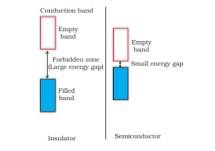
1.47 The energy gap between the valence band and conduction band in an insulator is very large while in a conductor, the energy gap is very small or there is overlapping between valence band and conduction band.
(ii) In a conductor, the valence band is practically filled or there is overlapping between valence band and conduction band while in semiconductor, there is always a small energy gap between them.
New answer posted
a year agoContributor-Level 10
1.45 For fcc unit cell, a=2√2?.
Here, a is the edge length and r is the atomic radius (0.144 nm).
a = 2√2 *0.144 = 0.407 nm
Hence, the length of a side of a cell is 0.407 nm.
New answer posted
a year agoContributor-Level 10
1.44 Ge is group 14 element and In is group 13 element. Hence an electron deficient hole is created and therefore, it is p–type.
2. B is group 13 elements and Si is group 14 elements, there will be a free electron. Hence, it is n-type
New answer posted
a year agoContributor-Level 10
1.43 There is one octahedral hole for each atom in hexagonal close packed arrangement. If the number of oxide ions (O2−) per unit cell is 1, then the number of

New answer posted
a year agoContributor-Level 10
1.42 The ratio less than 2:1 in Cu2O shows that some cuprous (Cu+) ions have been replaced by cupric (Cu+2) ions. To maintain electrical neutrality, every two Cu+ ions will be replaced by one Cu+2 ion, thereby creating a hole. As conduction will be due to the presence of these positive holes, hence it is a p -type semi conductor
New answer posted
a year agoContributor-Level 10
1.41 These solids have conductive in the intermediate range from 10−6 to 104ohm−1m−1. As there is rise in
the temperature, conductivity also increases because electrons from the valence band jump to
conduction band.
Types of semiconductors
(a) n - type semiconductor when silicon or germanium crystal is doped with group 15 element like P or
As, the dopant atom forms four covalent bonds like a Si or Ge atom but the fifth electron no used in
bonding, becomes delocalised and contribute its share towards electrical conduction. Thus, silicon or
germanium doped with P or As is called n-type semiconductor (negative
New answer posted
a year agoContributor-Level 10
Analysis shows that nickel oxide has the formula Ni0.98 O1.00. What fractions of nickel exist as Ni2+ and Ni3+ ions?
1.40 It is given that nickel oxide has the formula as Ni0.98 O1.00.
As per the formula, there are 98 Ni ions for 100 oxide ions.
Out of 98 Ni ions, let x ions be in +2 oxidation state
98−x ions will be in +3 oxidation state.
Oxide ion has −2 charge.
To maintain electrical neutrality, total positive charge on cations = total negative charge on anions.
2x+3(98−x)+100(−2)=0
x=94
Fraction of Ni2+ ions = 94/98 = 0.96
Fraction of Ni2+ ions = 98-94/98 = 0.04
Hence, the fractions of nickel that exists as Ni2+ and Ni3+ are 0.
New answer posted
a year agoContributor-Level 10
Analysis shows that nickel oxide has the formula Ni0.98 O1.00. What fractions of nickel exist as Ni2+ and Ni3+ ions?
1.41 It is given that nickel oxide has the formula as Ni0.98 O1.00.
As per the formula, there are 98 Ni ions for 100 oxide ions.
Out of 98 Ni ions, let x ions be in +2 oxidation state
98? x ions will be in +3 oxidation state.
Oxide ion has ?2 charge.
To maintain electrical neutrality, total positive charge on cations = total negative charge on anions.
2x+3 (98? x)+100 (?2)=0
x=94
Fraction of Ni2+ ions = 94/98 = 0.96
Fraction of Ni2+ ions = 98-94/98 = 0.04
Hence, the fractions of nickel that exists as Ni2+ and Ni3+ are 0.96 a
Taking an Exam? Selecting a College?
Get authentic answers from experts, students and alumni that you won't find anywhere else
Sign Up on ShikshaOn Shiksha, get access to
- 67k Colleges
- 1.2k Exams
- 718k Reviews
- 1850k Answers