

Class 12th
Get insights from 12k questions on Class 12th, answered by students, alumni, and experts. You may also ask and answer any question you like about Class 12th
Follow Ask QuestionQuestions
Discussions
Active Users
Followers
New answer posted
a year agoContributor-Level 10
Since p (x) has relative extreme at x=1 and 2
so p' (x)=0 at x=1 and 2
⇒ p' (x)=A (x-1) (x-2)
⇒ p (x)=∫A (x²-3x+2)dx
p (x)=A (x³/3 - 3x²/2 + 2x)+C
P (1)=8
From (1)
8=A (1/3-3/2+2)+C
⇒ 8=5A/6+C ⇒ 48=5A+6C
P (2)=4
⇒ 4=A (8/3-6+4)+C
⇒ 4=-2A/3+C ⇒ 12=-2A+3C
From 3 and 4, C=-12
So P (0)=C=-12
New answer posted
a year agoContributor-Level 10
f (x)=sin (|x|+5)/ (x²+1)
For domain:
-1 ≤ (|x|+5)/ (x²+1) ≤ 1
Since |x|+5 and x²+1 is always positive
So (|x|+5)/ (x²+1) ≥ 0 ∀x∈R
So for domain:
(|x|+5)/ (x²+1) ≤ 1
⇒ |x|+5 ≤ x²+1
⇒ 0 ≤ x²-|x|-4
⇒ 0 ≤ (|x|- (1+√17)/2) (|x|- (1-√17)/2)
⇒ |x| ≥ (1+√17)/2 or |x|≤ (1-√17)/2 (Rejected)
⇒ x∈ (-∞, - (1+√17)/2] ∪ [ (1+√17)/2, ∞)
So, a = (1+√17)/2
New answer posted
a year agoContributor-Level 9
Bredig's Arc Method is used for preparation of colloidal sol's of less reactive metal like Au, Ag, Pt.
New answer posted
a year agoContributor-Level 10
(2+sin x)/ (y+1) dy/dx = -cosx, y>0
⇒ dy/ (y+1) = -cosx/ (2+sinx) dx
By integrating both sides:
ln|y+1| = -ln|2+sinx|+lnK
⇒ y+1 = K/ (2+sinx) (y+1>0)
⇒ y (x) = K/ (2+sinx) - 1
Given y (0)=1 ⇒ 1=K/2-1 ⇒ K=4
So, y (x)=4/ (2+sinx)-1
a=y (π)=1
b=dy/dx|x=π = -cosx/ (y (x)+1)|x=π = 1
So, (a, b)= (1,1)
New answer posted
a year agoContributor-Level 10
Slope of tangent to the curve y=x+siny
at (a, b) is (a-2)/ (b-3)=1
⇒ dy/dx|x=a = 1
dy/dx = 1+cos y dy/dx (from equation of curve)
⇒ dy/dx|x=a and y=b = 1+cosb=1
⇒ cosb=0
⇒ sinb=±1
Now, from curve y=x+siny
b=a+sinb
⇒ |b-a|=|sinb|=1
New answer posted
a year agoContributor-Level 9
Since spin only magnetic moment is 4.90BM so number of unpaired electrons must be 4, so If the complex is octahedral, then it has to be high spin complex with configuration t? g? e²g¹ in that case
CFSE = 4* (-0.4Δ? ) + 2*0.6Δ? = -0.4Δ?
If the complex is tetrahedral then its electronic configuration will be e? ², t? g² and CFSE will be = 3* (-0.6Δ? ) + 3* (0.4Δ? ) = -0.6Δ?
New answer posted
a year agoContributor-Level 10
|A|≠0
For (P): A≠I?
So, A = [1 0; 0 1] or [1; 0 1] or [1 0; 1]
or [1; 1 0]
So (P) is false.
A = [1 0; 1 0] or [1; 0 1] or [1 0; 1]
⇒ tr (A)=2
⇒ Q is true
New answer posted
a year agoContributor-Level 10
Two points on the line (say) x/3 = y/2, z=1 are (0,0,1) and (3,2,1)
So dr's of the line is (3,2,0)
Line passing through (1,2,1), parallel to L and coplanar with given plane is r = i+2j+k + t (3i+2j), t∈R (-2,0,1) satisfies the line (for t=-1)
⇒ (-2,0,1) lies on given plane.
Answer of the question is (B)
We can check other options by finding equation of plane
Equation plane: |x-1, y-2, z-1; 1+2, 2-0, 1-1; 2+2, 1-0, 2-1| = 0
⇒ 2 (x-1)-3 (y-2)-5 (z-1)=0
⇒ 2x-3y-5z+9=0
New answer posted
a year ago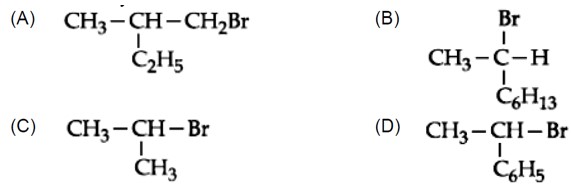
Contributor-Level 9
Reaction path is SN2 because OH? is strong nucleophile, but hydroxyl ion will not attack on chiral centres and so there is retension of configuration.
Taking an Exam? Selecting a College?
Get authentic answers from experts, students and alumni that you won't find anywhere else
Sign Up on ShikshaOn Shiksha, get access to
- 67k Colleges
- 1.2k Exams
- 717k Reviews
- 1850k Answers