

Class 12th
Get insights from 12k questions on Class 12th, answered by students, alumni, and experts. You may also ask and answer any question you like about Class 12th
Follow Ask QuestionQuestions
Discussions
Active Users
Followers
New answer posted
a year agoContributor-Level 10
(a+3b). (7a-5b) = 7|a|² - 5ab + 21ab - 15|b|² = 7|a|²+16ab-15|b|²=0.
(a-4b). (7a-2b) = 7|a|² - 2ab - 28ab + 8|b|² = 7|a|²-30ab+8|b|²=0.
Subtracting: 46ab - 23|b|² = 0 ⇒ 2ab = |b|².
Substituting: 7|a|² + 8|b|² - 15|b|² = 0 ⇒ 7|a|² = 7|b|² ⇒ |a|=|b|.
cosθ = ab/ (|a|b|) = ab/|b|² = (1/2)|b|²/|b|² = 1/2.
θ = 60°.
New answer posted
a year ago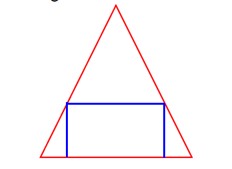
Contributor-Level 10
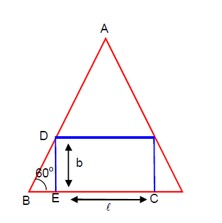
Let rectangle have dimensions l, w.
Triangle above rectangle is similar to large triangle.
(H-w)/H = l/a.
l = a (H-w)/H = a (1-w/H).
Area A = lw = aw (1-w/H).
A' (w) = a (1-2w/H) = 0 ⇒ w = H/2 = √6/2.
l = a/2 = √2.
Max Area A = √2 * √6/2 = √3.
Square of area = 3.
New answer posted
a year agoContributor-Level 10
log? (18x-x²-77)>0 ⇒ 18x-x²-77>1 ⇒ x²-18x+78<0. Roots are 93.
log? (.)>0 ⇒ log? (.)>1 ⇒ 18x-x²-77>3 ⇒ x²-18x+80<0 (x-8) (x-10)<0.
8
I = ∫? ¹? sin³x/ (sin³x+sin³ (18-x)dx. Using King's property.
I = ∫? ¹? sin³ (18-x)/ (sin³ (18-x)+sin³x)dx.
2I = ∫? ¹? dx = 2. I=1.
New answer posted
a year agoContributor-Level 10
f (1)=1.
f (4)=f (2)²=1 or 4.
f (6)=f (2)f (3).
Possible functions determined by values at primes: f (2), f (3), f (5), f (7).
f (2) can be 1 or 2. f (3) can be 1 or 3. f (5)=1,5. f (7)=1,7.
If f (m)=m, f (mn)=mn. One function. f (x)=1 is another.
What if f (2)=1, f (3)=3? f (6)=3.
New answer posted
a year agoContributor-Level 10
f (x) is discontinuous at integers x=1,2,3. P= {1,2,3}.
f (x) is not differentiable at integers and where x- [x]=1+ [x]-x ⇒ 2 (x- [x])=1 ⇒ {x}=1/2.
So at x=0.5, 1, 1.5, 2, 2.5.
Q= {0.5, 1, 1.5, 2, 2.5}. Sum of elements is not asked.
Number of elements in P=3, in Q=5. Sum = 8.
Let's check the solution. Q= {1/2, 1, 3/2, 5/2}.
The sum of number of elements: 3+5=8.
New answer posted
a year agoContributor-Level 10
Determinant of vectors must be zero. Vector between points on lines: (-1-k, -2-2, -3-3). Vector directions: (1,2,3) and (3,2,1).
| -1-k, -4, -6; 1, 2, 3; 3, 2, 1 | = 0.
(-1-k) (2-6) - (-4) (1-9) + (-6) (2-6) = 0.
4 (1+k) - 32 + 24 = 0.
4+4k - 8 = 0. 4k=4 ⇒ k=1.
New answer posted
a year agoContributor-Level 10
a*b=c ⇒ a.c=0, b.c=0.
|c|² = |a|²|b|² - (a.b)² = (3)|b|² - 1. |c|=√2. So |b|²=1, |b|=1.
Projection of b on a*c.
a*c = a* (a*b) = (a.b)a - (a.a)b = a - 3b.
|a-3b|² = |a|²+9|b|²-6 (a.b) = 3+9-6 = 6.
l = |b. (a-3b)|/|a-3b| = | (a.b)-3|b|²|/√6 = |1-3|/√6 = 2/√6.
3l² = 3 (4/6) = 2.
New answer posted
a year agoContributor-Level 10
f (x) = |sin²x, -2+cos²x, cos2x; 2+sin²x, cos²x, cos2x; sin²x, cos²x, 1+cos2x|.
R? →R? -R? , R? →R? -R?
f (x) = |sin²x, -2+cos²x, cos2x; 2, 2-2cos²x, 0; 0, 2-2cos²x, 1|.
f (x) = sin²x (2-2cos²x) - (-2+cos²x) (2) + cos2x (2 (2-2cos²x).
This seems tedious. From the solution, f (x)=4+2cos2x.
Max value when cos2x=1, f (x)=6.
New answer posted
a year agoContributor-Level 10
e? F (x) = ∫ (3t²+2t+4F' (t)dt.
e? F (x)+e? F' (x) = 3x²+2x+4F' (x).
(e? -4)F' (x) = 3x²+2x-e? F (x).
F' (4) = (48+8-e? F (4)/ (e? -4).
Also F (3)=0, F (x)= (x³+x²-36)/ (e? -4) from solution. F (4)= (64+16-36)/ (e? -4) = 44/ (e? -4).
F' (4) = (56-e? (44/ (e? -4)/ (e? -4) = (56 (e? -4)-44e? )/ (e? -4)² = (12e? -224)/ (e? -4)².
α=12, β=4. α+β=16.
New answer posted
a year agoContributor-Level 10
Vector on plane: (3-2, 7-3, -7- (-2) = (1,4, -5).
Line direction vector (-3,2,1).
Normal to plane n = (1,4, -5)* (-3,2,1) = (14,14,14) or (1,1,1).
Plane: 1 (x-3)+1 (y-7)+1 (z+7)=0 ⇒ x+y+z-3=0.
d = |-3|/√3 = √3. d²=3.
Taking an Exam? Selecting a College?
Get authentic answers from experts, students and alumni that you won't find anywhere else
Sign Up on ShikshaOn Shiksha, get access to
- 67k Colleges
- 1.2k Exams
- 717k Reviews
- 1850k Answers