Class 12th

Get insights from 12k questions on Class 12th, answered by students, alumni, and experts. You may also ask and answer any question you like about Class 12th

Follow Ask Question
12k

Questions

0

Discussions

26

Active Users

0

Followers

New answer posted

a year ago

0 Follower 8 Views

A
alok kumar singh

Contributor-Level 10

At any time  t

? = B A c o s ? π t 5 ? ω = 2 π T = 2 π 10 = π 5

d ? d t = - π 5 B A s i n ? π t 5

e = π 5 B A s i n ? π t 5

e will be maximum when π t 5  is π 2 .

t = 2.5 s e c
e will be minimum when π t 5 is π , 0

t = 0,5 s e c

So, answer will be (1).

New answer posted

a year ago
0 Follower 4 Views

P
Payal Gupta

Contributor-Level 10

2sin (π22)sin (3π22)sin (5π22)sin (7π22)sin (9π22)

=2sin32π1125sinπ11=116

New answer posted

a year ago

0 Follower 27 Views

P
Payal Gupta

Contributor-Level 10

a→=i^−j^+2k^

a→*b→=2i^−k^

a→.b→=3

|a→*b→|2+|a→.b→|2=|a→|2.|b→|2

= b → . a → − | b → | 2 | a → − b → | = 3 − 7 3 7 3 = 2 2 1

New answer posted

a year ago

0 Follower 70 Views

V
Vishal Baghel

Contributor-Level 10

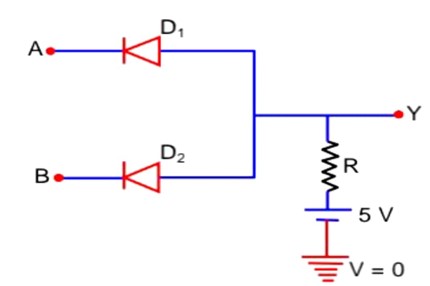
When both A and B have logical value 'l' both diode are reverse bias and current will flow in resistor hence output will be 5 volt i.e. logical value '1'.

In all other case conduction will take place hence output will be zero value i.e. logical value 'o'.

So truth table is

A            B            Y

0            0

0            1            0  (AND gate)

1  

...more

New answer posted

a year ago

0 Follower 6 Views

P
Payal Gupta

Contributor-Level 10

 A (−7i^+6j^)C (7i^+2j^+6k^)

b→=−6i^+7j^+k^ d→=−2i^+j^+k^

b→*d→=|i^j^k^−671−211|=3i^+2j^+4k^

the shortest distance between the lines

=|42−8+2429|=5829=2

New answer posted

a year ago

0 Follower 4 Views

V
Vishal Baghel

Contributor-Level 10

Kindly consider the following answer

μ → = − e 2 m L →

New answer posted

a year ago

0 Follower 2 Views

V
Vishal Baghel

Contributor-Level 10

mvr = n h 2 π

So momentum (mv) = n h 2 π r

New answer posted

a year ago

0 Follower 15 Views

P
Payal Gupta

Contributor-Level 10

First plane, P1 = 2x – 2y + z = 0,

normal vector ≡n1= (2, −2, 1)

Second plane, P2 = x – y + 2z = 4,

normal vector ≡n2= (1, −1, 2)

Plane perpendicular to P1 and P2 will have normal vector n3 where n3 = (n1 * n2)

Hence,

n3 = (3, 0)

Distance PQ

=21⇒ (PQ)2=21

New answer posted

a year ago

0 Follower 5 Views

V
Vishal Baghel

Contributor-Level 10

  K . E 1 = 1 2 3 0 8 0 0 − ? - (i)

  K . E 2 = 2 K . E 1 = 1 2 3 0 5 0 0 − ? - (ii)

from (i) & (ii)

? = 0 . 6 1 5  ev

New answer posted

a year ago

0 Follower 3 Views

A
alok kumar singh

Contributor-Level 10

1 f = μ g - 1 1 R 1 - 1 R 2

1 f l = μ g μ l - 1 1 R 1 - 1 R 2

(i) f l f = μ g - 1 μ g μ l - 1 = 1.5 - 1 1.5 1.41 - 1 = 8.875 ≈ 9

Get authentic answers from experts, students and alumni that you won't find anywhere else

Sign Up on Shiksha

On Shiksha, get access to

  • 67k Colleges
  • 1.2k Exams
  • 718k Reviews
  • 1850k Answers

Share Your College Life Experience

×

This website uses Cookies and related technologies for the site to function correctly and securely, improve & personalise your browsing experience, analyse traffic, and support our marketing efforts and serve the Core Purpose. By continuing to browse the site, you agree to Privacy Policy and Cookie Policy.