Class 12th

Get insights from 12k questions on Class 12th, answered by students, alumni, and experts. You may also ask and answer any question you like about Class 12th

Follow Ask Question
12k

Questions

0

Discussions

25

Active Users

0

Followers

New answer posted

a year ago

0 Follower 9 Views

A
alok kumar singh

Contributor-Level 10

This is a Short Answer Type Questions as classified in NCERT Exemplar

Sol:

                                                    l i m x → 2 + f ( x ) = 3 x + 5                                                                                               = l i m h → 0 3 ( 2 + h ) + 5 = 1 1                                                         l i m x → 2 f ( x ) = 3 x + 5 = 3 ( 2 ) + 5 = 1 1                                                       l i m x → 2 − f ( x ) = x 2 = l i m h → 0 ( 2 − h ) 2                                                                                                                       = l i m h → 0 ( 2 ) 2 + h 2 − 4 h = ( 2 ) 2 = 4 Since                 limx→2+f(x)=limx→2f(x)≠limx→2−f(x) H e n c e ,     f ( x )     i s     d i s c o n t i n u o u s     a t     x = 2 .

New answer posted

a year ago

0 Follower 11 Views

A
alok kumar singh

Contributor-Level 10

This is a Short Answer Type Questions as classified in NCERT Exemplar

Sol:

W e     k n o w     t h a t     y     = f ( x )     w i l l     b e     c o n t i n u o u s     a t     x = a     i f l i m x → a − f ( x ) = l i m x → a f ( x ) = l i m x → a + f ( x ) G i v e n                   f ( x ) = x 3 + 2 x 2 − 1                                 l i m x → 1 − f ( x ) = l i m h → 0 ( 1 + h ) 3 + 2 ( 1 + h ) 2 − 1 = 1 + 2 − 1 = 2                                   l i m x → 1 f ( x ) = ( 1 ) 3 + 2 ( 1 ) 2 − 1 = 1 + 2 − 1 = 2                                   l i m x → 1 + f ( x ) = l i m h → 0 ( 1 + h ) 3 + 2 ( 1 + h ) 2 − 1 = 1 + 2 − 1 = 2                                   l i m x → 1 − f ( x ) = l i m x → 1 f ( x ) = l i m x → 1 + f ( x ) = 2 . H e n c e ,     f ( x )     i s     c o n t i n u o u s     a t     x = 1 .

New answer posted

a year ago

0 Follower 5 Views

A
alok kumar singh

Contributor-Level 10

This is a Long Answer Type Questions as classified in NCERT Exemplar

Sol:

New answer posted

a year ago
0 Follower 4 Views

A
alok kumar singh

Contributor-Level 10

This is a Long Answer Type Questions as classified in NCERT Exemplar

Sol:
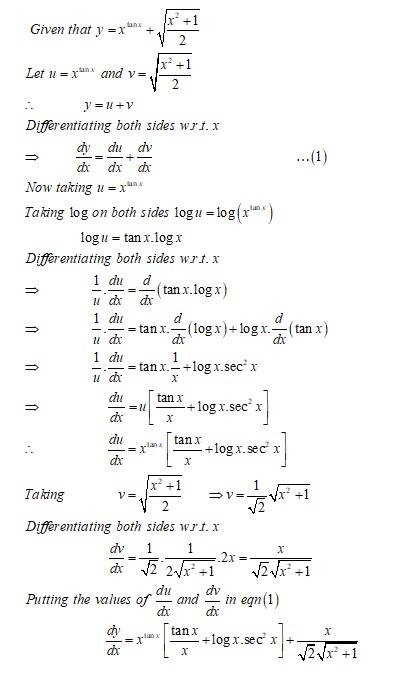
Given  that  x=sint  and  y=sinptDifferentiating  both  sides  w.r.t.  t⇒                 dxdt=cost         and        dydt=cospt.p=p.cospt⇒                 dydx=dydtdxdt=p.cosptcost⇒                 dydx=p.cosptcostAgain  differentiating  both  sides  w.r.t.  x⇒                 ddx(dydx)=p.ddx(cosptcost)⇒                           d2ydx2=p.[cost.ddx(cospt)−cospt.ddx(cost)cos2t]⇒                           d2ydx2=p.[cost.(−sinpt).pdtdx−cospt.(−sint).dtdxcos2t]⇒                           d2ydx2=p.[−pcost.sinpt+cospt.sintcos2t]dtdx⇒                           d2ydx2=p.[−pcost.sinpt+cospt.sintcos2t]1cost⇒                           d2ydx2=p.(−pcost.sinpt+cospt.sintcos3t)Now  we  have  to  prove  that      (1−x2)d2ydx2−xdydx+ p2y=0L.H.S.=(1−x2)[p.(−pcost.sinpt+cospt.sintcos3t)]−x(p.cosptcost)+ p2y⇒           =(1−sin2t)[p.(−pcost.sinpt+cospt.sintcos3t)]−p.sintcosptcost+ p2.sinpt⇒           =cos2t[−p2cost.sinpt+pcospt.sintcos3t]−p.sintcosptcost+ p2.sinpt⇒           =−p2cost.sinpt+pcospt.sintcost−p.sintcosptcost+ p2.sinpt⇒           =−p2cost.sinpt+pcospt.sint−p.sintcospt+p2.sinptcostcost⇒           =0cost=0=R.H.S.  Hence,  proved.

New answer posted

a year ago

0 Follower 9 Views

A
alok kumar singh

Contributor-Level 10

This is a Long Answer Type Questions as classified in NCERT Exemplar

Sol:

( i ) G i v e n     t h a t                             x m . y n = ( x + y ) m + n T a k i n g     l o g     o n     b o t h     s i d e s ,     w e     g e t , ⇒                                           l o g x m . y n = l o g ( x + y ) m + n [ ? l o g x y = l o g x + l o g y ] ⇒                     l o g x m + l o g y n = ( m + n ) l o g ( x + y ) ⇒                     m l o g x + n l o g y = ( m + n ) l o g ( x + y ) D i f f e r e n t i a t i n g     b o t h     s i d e s     w . r . t .     x ⇒             m . d d x l o g x + n . d d x l o g y = ( m + n ) d d x l o g ( x + y ) ⇒                                                   m . 1 x + n . 1 y . d y d x = ( m + n ) 1 x + y ( 1 + d y d x ) ⇒                                                                     m x + n y . d y d x = m + n x + y . ( 1 + d y d x ) ⇒                                                                       m x + n y . d y d x = m + n x + y + m + n x + y . d y d x ⇒                                         n y . d y d x − m + n x + y . d y d x = m + n x + y − m x ⇒                                                 ( n y − m + n x + y ) . d y d x = m + n x + y − m x ⇒                   ( n x + n y − m y − n y y ( x + y ) ) . d y d x = ( m x + n x − m x − m y x ( x + y ) ) ⇒                                                         ( n x − m y y ( x + y ) ) . d y d x = ( n x − m y x ( x + y ) ) ⇒                                                                                                                 d y d x = n x − m y x ( x + y ) * y ( x + y ) n x − m y = y x ⇒                                           d y d x = y x       H e n c e ,     p r o v e d .

( i i )     G i v e n     t h a t     d y d x = y x D i f f e r e n t i a t i n g     b o t h     s i d e s     w . r . t .     x ⇒                                   d d x ( d y d x ) = d d x ( y x ) ⇒                                   d 2 y d x 2 = x . d y d x − y . 1 x 2 ⇒                                   d 2 y d x 2 = x . y x − y x 2                                     [ ? d y d x = y x ] ⇒                                   d 2 y d x 2 = y − y x 2 = 0 x 2 = 0 H e n c e ,     d 2 y d x 2 = 0                         H e n c e ,     p r o v e d .

New answer posted

a year ago

0 Follower 11 Views

A
alok kumar singh

Contributor-Level 10

This is a Long Answer Type Questions as classified in NCERT Exemplar

Sol:

G i v e n     t h a t           f ( x ) = { x 2 + 3 x + p , x ≤ 1 q x + 2 , x > 1     a t     x = 1 . L . H . L .     f ' ( c ) = l i m x → 1 − f ( x ) − f ( c ) x − c                                   f ' ( 1 ) = l i m x → 1 − f ( x ) − f ( 1 ) x − 1                                                             = l i m x → 1 − ( x 2 + 3 x + p ) − ( 1 + 3 + p ) x − 1                                                             = l i m h → 0 [ ( 1 − h ) 2 + 3 ( 1 − h ) + p ] − ( 1 + 3 + p ) 1 − h − 1                                                             = l i m h → 0 [ 1 + h 2 − 2 h + 3 − 3 h + p ] − ( 4 + p ) − h                                                             = l i m h → 0 [ h 2 − 5 h + 4 + p ] − [ 4 + p ] − h                                                             = l i m h → 0 h 2 − 5 h + 4 + p − 4 − p − h                                                             = l i m h → 0 h 2 − 5 h − h = l i m h → 0 h [ h − 5 ] − h = 5 R . H . L .     f ' ( 1 ) = l i m x → 1 + f ( x ) − f ( 1 ) x − 1                                                           = l i m x → 1 + ( q x + 2 ) − ( 1 + 3 + p ) x − 1                                                           = l i m h → 0 [ q ( 1 + h ) + 2 ] − [ 4 + p ] 1 + h − 1                                                           = l i m h → 0 q + q h + 2 − 4 − p h = l i m h → 0 q + q h − 2 − p h For  existing  the  limit q − 2 − p = 0             ⇒ q − p = 0                                                       … ( 1 ) ⇒ l i m h → 0 q h − 0 h = q I f     L . H . L .     f ' ( 1 ) = R . H . L .     f ' ( 1 )     t h e n     q = 5 . N o w     p

New answer posted

a year ago

0 Follower 4 Views

A
alok kumar singh

Contributor-Level 10

This is a Short Answer Type Questions as classified in NCERT Exemplar

Sol:

G i v e n     t h a t     f ( x ) = | s i n x + c o s x |     a t     x = π P u t                 g ( x ) = s i n x + c o s x     a n d     h ( x ) = | x | ∴                   h [ g ( x ) ] = h ( s i n x + c o s x ) = | s i n x + c o s x | Now,  g(x)=sinx+cosx  is  a  continuous  function  since  sinx  and  cosx  are  two  continuous f u n c t i o n s     a t     x = π . We  know  that  every  modulus  function  is  a  continuous  function  everywhere. H e n c e ,     f ( x ) = | s i n x + c o s x |     i s     a     c o n t i n u o u s     f u n c t i o n     a t     x = π .

New answer posted

a year ago

0 Follower 4 Views

A
alok kumar singh

Contributor-Level 10

This is a Short Answer Type Questions as classified in NCERT Exemplar

Sol:

We  have    f(x)=1t2+t−2⇒                  f(t)=1(1x−1)2+1x−1−2[Putting  t=1x−1]                                  =11+x−1−2(x−1)2(x−1)2=(x−1)2x−2x2−2+4x                                   =(x−1)2−2x2+5x−2=(x−1)2−(2x2−5x+2)                                   =(x−1)2−[2x2−4x−x+2]=(x−1)2−[2x(x−2)−1(x−2)]                                    =(x−1)2−(x−2)(2x−1)=(x−1)2(2−x)(2x−1)So,  if  f(t)  is  discontinuous,  then  2−x=0    ∴x=2and  2x−1=0    ∴x=12Hence,  the  required    of  discontinuity  are  2  and  12.

New answer posted

a year ago

0 Follower 10 Views

A
alok kumar singh

Contributor-Level 10

This is a Short Answer Type Questions as classified in NCERT Exemplar

Sol:

        f ( x ) = 1 x + 2         f [ f ( x ) ] = 1 f ( x ) + 2 = 1 1 x + 2 + 2 = 1 1 + 2 x + 4 x + 2 = x + 2 2 x + 5 ∴ f [ f ( x ) ] = x + 2 2 x + 5 T h i s     f u n c t i o n     w i l l     n o t     b e     d e f i n e d     a n d     c o n t i n u o u s     w h e r e     2 x + 5 = 0 ⇒ x = − 5 2 . Hence,  x=−52  is  the  point  of  discontinuity.

New answer posted

a year ago

0 Follower 14 Views

A
alok kumar singh

Contributor-Level 10

This is a Short Answer Type Questions as classified in NCERT Exemplar

Sol:

                      l i m x → 4 − f ( x ) = x − 4 | x − 4 | + a = l i m h → 0 4 − h − 4 | 4 − h − 4 | + a                                                                 = l i m h → 0 − h h + a = − 1 + a                       l i m x → 4 f ( x ) = a + b                         l i m x → 4 + f ( x ) = x − 4 | x − 4 | + b = l i m h → 0 4 + h − 4 | 4 + h − 4 | + b                                                                 = l i m h → 0 h h + b = 1 + b A s     t h e     f u n c t i o n     i s     c o n t i n u o u s     a t     x = 4 . ∴       l i m x → 4 − f ( x ) = l i m x → 4 f ( x ) = l i m x → 4 + f ( x )                     − 1 + a = a + b = 1 + b ∴                 − 1 + a = a + b         ⇒         b = − 1                               1 + b = a + b         ⇒         a = 1 H e n c e ,     t h e     v a l u e     o f     a = 1     a n d     b = − 1 .

Get authentic answers from experts, students and alumni that you won't find anywhere else

Sign Up on Shiksha

On Shiksha, get access to

  • 67k Colleges
  • 1.2k Exams
  • 718k Reviews
  • 1850k Answers

Share Your College Life Experience

×
×

This website uses Cookies and related technologies for the site to function correctly and securely, improve & personalise your browsing experience, analyse traffic, and support our marketing efforts and serve the Core Purpose. By continuing to browse the site, you agree to Privacy Policy and Cookie Policy.