Dual Nature of Radiation and Matter
Get insights from 170 questions on Dual Nature of Radiation and Matter, answered by students, alumni, and experts. You may also ask and answer any question you like about Dual Nature of Radiation and Matter
- 170
Questions
- 0
Discussions
- 0
Active Users
- 1
Followers
Have a question about Dual Nature of Radiation and Matter? Ask our experts
Keep it short & simple. Type complete word. Avoid abusive language.
Numerous scientists contributed to the discovery of this concept, but the key was introduced by Albert Einstein in 1905. This concept was used to support the experiment of the photoelectric effect to prove that light could be as a wave too. Then this name photon was given 21 years later, in 1926 by
Yes, they travel in a vacuum at the speed of light and can never be in still position. This is because they do not have any mass to do so and will not exist only if not in motion.
What is the difference between a proton and a photon?
The key difference lies in not their spelling but the properties they possess. Protons are positively charged particles which revolve around the nucleus of an atom and have a specific mass. Whereas, photons don't have any mass and are responsible for carrying out electromagnetic radiation. They trav
Photocell works on photoelectric effect.
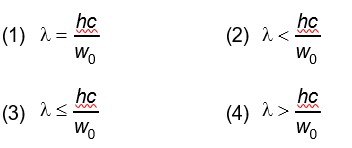
The work function of a metal is w0 and l is wavelength of incident radiation. There is no emission of photoelectron when
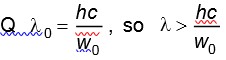
For no emission of electron
λ > λ0
Q λ0 = hc/w0, so λ > hc/w0
The work function of a metal is w0 and l is wavelength of incident radiation. There is no emission of photoelectron whenThe work function of a metal is w0 and l is wavelength of incident radiation. There is no emission of photoelectron when\
For no emission of electron
λ > λ0

Photons with energy 5 eV are incident on a cathode C in a photoelectric cell. The maximum energy of emitted photoelectrons is 2 eV When photons of energy 6 eV are incident on C, no photoelectrons will reach the anode A, if the stopping potential of A relative to C is
According to Einstein’s photoelectric equation maximum kinetic energy of photoelectrons,
or
When then,
or
or