
Dual Nature of Radiation and Matter
Get insights from 170 questions on Dual Nature of Radiation and Matter, answered by students, alumni, and experts. You may also ask and answer any question you like about Dual Nature of Radiation and Matter
- 170
Questions
- 0
Discussions
- 0
Active Users
- 1
Followers
Have a question about Dual Nature of Radiation and Matter? Ask our experts
Keep it short & simple. Type complete word. Avoid abusive language.
Variation of photoelectric current with intensity of light for a given frequency, is

Variation of photoelectric current with intensity of light for a given frequency, is

n photons of wavelength λ are absorbed by a black body of mass ‘m’. The momentum gained by the body is
n photons of wavelength λ are absorbed by a black body of mass ‘m’. The momentum gained by the body is

A photoelectric effect supports quantum nature of light because :
A. There is a minimum frequency of light below which no photoelectrons are emitted.
B. The maximum kinetic energy of photo electrons depends only on the frequency of light and not on its intensity
C. Above thresold frequency even when the metal surface is faintly illuminated, the photoelectrons leave the surface immediately
D. Electric charge of photoelectrons is quantized
In the above true statement is :-
Kindly go through the solution
Theory based
 Upvote


When light of maximum wavelength 300 nm falls on a photoelectric emitter, photoelectrons are liberated. For another emitter however light of maximum wavelength 600 nm causes photoelectric emission. The ratio of work functions of first emitter to second emitter will be
When light of maximum wavelength 300 nm falls on a photoelectric emitter, photoelectrons are liberated. For another emitter however light of maximum wavelength 600 nm causes photoelectric emission. The ratio of work functions of first emitter to second emitter will be

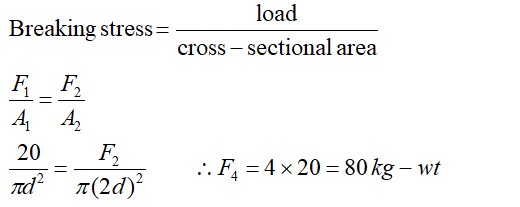
A wire can be broken by a load of 20 kg-wt. The force required to break wire of same material with twice the diameter will be
A wire can be broken by a load of 20 kg-wt. The force required to break wire of same material with twice the diameter will be
Upvote de-Broglie wavelength of a proton and an electron is same. The ratio of kinetic energy of electron to that of proton is
de-Broglie wavelength of a proton and an electron is same. The ratio of kinetic energy of electron to that of proton is
Maximum wavelength of light source such that photoelectron can be ejected from material of work function 3 eV is
Maximum wavelength of light source such that photoelectron can be ejected from material of work function 3 eV is
In a photoelectric experiment, frequency f = 1.5f0 (f0 : threshold frequency). If the frequency of light is changed to f/2, then photocurrent becomes (intensity of light has doubled)
In a photoelectric experiment, frequency f = 1.5f0 (f0 : threshold frequency). If the frequency of light is changed to f/2, then photocurrent becomes (intensity of light has doubled)
Kindly go through the solution
Since
->current = 0
Upvote Related Tags
0 Followers
0 Followers
0 Followers
0 Followers
0 Followers
0 Followers