
Dual Nature of Radiation and Matter
Get insights from 170 questions on Dual Nature of Radiation and Matter, answered by students, alumni, and experts. You may also ask and answer any question you like about Dual Nature of Radiation and Matter
- 170
Questions
- 0
Discussions
- 0
Active Users
- 1
Followers
Have a question about Dual Nature of Radiation and Matter? Ask our experts
Keep it short & simple. Type complete word. Avoid abusive language.
Photocell works on photoelectric effect.
 Upvote

The work function of a metal is w0 and is wavelength of incident radiation. There is no emission of photoelectron when
The work function of a metal is w0 and is wavelength of incident radiation. There is no emission of photoelectron when
For no emission of electron
Upvote Two stream of photons, possessing energies equal to twice and ten times the work function of metal are incident on the metal surface successively. The value of ratio of maximum velocities of the photoelectrons emitted in the two respective cases is x : y. The value of x is………
Two stream of photons, possessing energies equal to twice and ten times the work function of metal are incident on the metal surface successively. The value of ratio of maximum velocities of the photoelectrons emitted in the two respective cases is x : y. The value of x is………
Case I :-
Case II :-
-
Upvote An electron with speed and a photon with speed c have the same de-Broglie wavelength. If the kinetic energy and momentum of electron are Ee and pe and that of photon are Eph and pph respectively. Which of the following is correct?
An electron with speed and a photon with speed c have the same de-Broglie wavelength. If the kinetic energy and momentum of electron are Ee and pe and that of photon are Eph and pph respectively. Which of the following is correct?
-(1)
-(2)
A/C to question
-(3)
-(4)
= mc c
q = PPh c &nbs
Upvote The electric field at a point associated with a light wave is given by
E = 200
Given : h = 4.14 × 10⁻¹⁵ eVs
If the light fall on a metal surface having a work function of 2.50 eV, the maximum kinetic energy of the photoelectrons will be
The electric field at a point associated with a light wave is given by
E = 200
Given : h = 4.14 × 10⁻¹⁵ eVs
If the light fall on a metal surface having a work function of 2.50 eV, the maximum kinetic energy of the photoelectrons will be
The light wave contains two lights of different frequencies, so
Maximum kinetic energy of the photoelectron = 5.9-2.5 = 3.42 eV
Upvote The sketch shown below illustrates the apparatus and results for a famous experiment. The graph on the right is a polar plot of the number of electrons received in the detector. From the result, the experimenters were able to conclude that:-
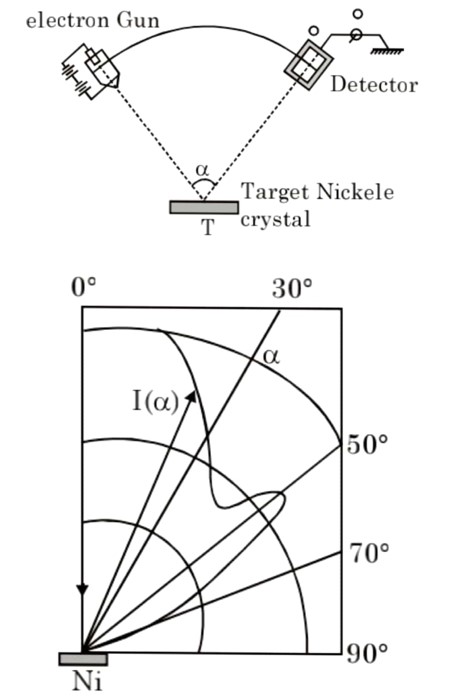
The sketch shown below illustrates the apparatus and results for a famous experiment. The graph on the right is a polar plot of the number of electrons received in the detector. From the result, the experimenters were able to conclude that:-
This experiment is the famous Davission-Germer experiment which establishes wave nature of electrons.
Upvote The de Broglie wavelength of a proton and a - particle are equal. The ratio of their velocities is:
The de Broglie wavelength of a proton and a - particle are equal. The ratio of their velocities is:
In a photoelectric experiment, increasing the intensity of incident light:
In a photoelectric experiment, increasing the intensity of incident light:
Intersity a number of photons kinetic Energy a f
Upvote