
Environmental chemistry
Get insights from 152 questions on Environmental chemistry, answered by students, alumni, and experts. You may also ask and answer any question you like about Environmental chemistry
- 152
Questions
- 0
Discussions
- 0
Active Users
- 0
Followers
Have a question about Environmental chemistry? Ask our experts
Keep it short & simple. Type complete word. Avoid abusive language.
Kindly consider the following
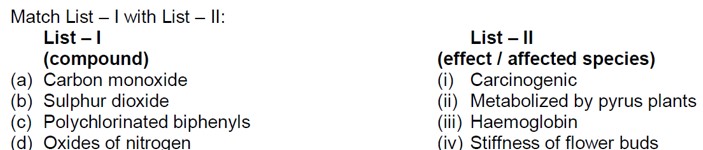
Kindly consider the following
(A) Carbon monoxide – Haemoglobin
(B) Sulphur dioxide – Stiffness of flower buds
(C) Polychlorinated biphenyls – Carcinogenic
(D) Oxides of nitrogen – Metabolized by pyrus plants
 Upvote

Some tranquilizers are listed below. Which one from the following belongs to barbiturates?
<!-- [if !supportLineBreakNewLine]-->
<!--[endif]-->
Some tranquilizers are listed below. Which one from the following belongs to barbiturates?
<!-- [if !supportLineBreakNewLine]-->
<!--[endif]-->
Veronal is a barbiturate drug and it constitutes an important class of tranquilizers.
Upvote The slope of Arrhenius Plot (ln k v/s 1/T) of first order reaction is −5 × 10³ K. The value of E? of the reaction is. Choose the correct option for your answer.
[Given R = 8.314JK-1 mol-1 ]
<!-- [if !supportLineBreakNewLine]-->
<!--[endif]-->
The slope of Arrhenius Plot (ln k v/s 1/T) of first order reaction is −5 × 10³ K. The value of E? of the reaction is. Choose the correct option for your answer.
[Given R = 8.314JK-1 mol-1 ]
<!-- [if !supportLineBreakNewLine]-->
<!--[endif]-->
ln K = ln A – (E? /R) (1/T)
In ln K v/s 1/T graph
Slope = –E? /R
–5 × 10³ = –E? /8.314
E? = 5 × 10³ × 8.314
= 41500 J mol? ¹ or 41.5 kJ mol? ¹
Upvote The pollution due to oxides of sulphur get enhanced due to the presence of:
(a) particulate matter
(b) ozone
(c) hydrocarbons
(d) hydrogen peroxide
Choose the most appropriate answer from the options given below:
<!-- [if !supportLineBreakNewLine]-->
<!--[endif]-->
The pollution due to oxides of sulphur get enhanced due to the presence of:
(a) particulate matter
(b) ozone
(c) hydrocarbons
(d) hydrogen peroxide
Choose the most appropriate answer from the options given below:
<!-- [if !supportLineBreakNewLine]-->
<!--[endif]-->
Pollution due to oxides of sulphur gets enhanced due to hydrocarbons and oxidizing agents like O? & H? O?
Upvote The type of pollution that gets increased during the day time and in the presence of O3 is:
The type of pollution that gets increased during the day time and in the presence of O3 is:
Formation of photochemical smog, which is also known as oxidizing smog, takes place in the presence of sunlight and O?
Upvote The green house gas/es is (are) :
(A) Carbon dioxide
(B) Oxygen
(C) Water vapour
(D) Methane
Choose the most appropriate answer from the options given below:
<!-- [if !supportLineBreakNewLine]-->
<!--[endif]-->
The green house gas/es is (are) :
(A) Carbon dioxide
(B) Oxygen
(C) Water vapour
(D) Methane
Choose the most appropriate answer from the options given below:
<!-- [if !supportLineBreakNewLine]-->
<!--[endif]-->
Oxygen gas (O? ) is not considered a greenhouse gas.
Upvote The condition that indicates a polluted environment is:
The condition that indicates a polluted environment is:
Excess of nitrogen and phosphorus is primarily responsible for eutrophication and hence an indicator of polluted environment.
Upvote Thermal power plants can lead to:
<!-- [if !supportLineBreakNewLine]-->
<!--[endif]-->
Thermal power plants can lead to:
<!-- [if !supportLineBreakNewLine]-->
<!--[endif]-->
Burning of fossil fuels (which contain sulphur and nitrogenous matter) such as coal and oil in power stations and furnaces produce sulphur dioxide and nitrogen oxides which causes acid rain.
Upvote In presence of sunlight CFC's molecule divides & release chlorine free radical, which react with ozone give chlorine monoxide radical (CIO°) and oxygen.
CF? Cl? (g) → C (g) + C? Cl (g)
Cl° (g) + O? (g) → ClO° (g) + O? (g)
ClO° (g) + O (g) → Cl° (g) + O? (g)
Upvote Which one of the following statements is NOT correct?
Which one of the following statements is NOT correct?
It is process in which nutrient enriched water bodies support a dense plant population which kills animal life by depriving it of oxygen and result in subsequent loss of biodiversity is known as Eutrophication.
Upvote