
Laws of Motion
Get insights from 109 questions on Laws of Motion, answered by students, alumni, and experts. You may also ask and answer any question you like about Laws of Motion
- 109
Questions
- 0
Discussions
- 0
Active Users
- 0
Followers
Have a question about Laws of Motion? Ask our experts
Keep it short & simple. Type complete word. Avoid abusive language.
A body of mass ‘m’ is launched up on a rough inclined plane making an angle of 30° with the horizontal. The coefficient of friction between the body and plane is <!-- [if gte mso 9]><xml>
A body of mass ‘m’ is launched up on a rough inclined plane making an angle of 30° with the horizontal. The coefficient of friction between the body and plane is <!-- [if gte mso 9]><xml>
For ascent
For descent
According question, we can write
 Upvote

The normal reaction ‘N’ for a vehicle of 800kg mass, negotiating a turn on a 30° banked road at maximum possible speed without skidding is_________× 103 kg m/s2.
[Given cos30° = 0.87, <!-- [if gte mso 9]><xml>
The normal reaction ‘N’ for a vehicle of 800kg mass, negotiating a turn on a 30° banked road at maximum possible speed without skidding is_________× 103 kg m/s2.
[Given cos30° = 0.87, <!-- [if gte mso 9]><xml>
In the frame of vehicle, vehicle is in equilibrium under the influence of pseudo force FP
N = mg cos 30° + FP sin 30°
, and
By doing (1) × cos 3
Upvote The temperature of an ideal gas in 3-dimensions is 300K. The corresponding de-Broglie wavelength of the electron approximately at 300 K, is:
[me = mass of electron = 9 × 10-31kg
h = Planck constant = 6.6 × 10⁻³⁴ Js
kB = Boltzmann constant = 1.38 × 10⁻²³ JK-1]
The temperature of an ideal gas in 3-dimensions is 300K. The corresponding de-Broglie wavelength of the electron approximately at 300 K, is:
[me = mass of electron = 9 × 10-31kg
h = Planck constant = 6.6 × 10⁻³⁴ Js
kB = Boltzmann constant = 1.38 × 10⁻²³ JK-1]
De Broglie wavelength
KT for gas
Upvote A block of mass m slides on the wooden wedge, which in turn slides backward on the horizontal surface. The acceleration of the block with respect to the wedge is: Given m = 8 kg, M = 16kg. Assume all the surfaces shown in the figure to be frictionless.
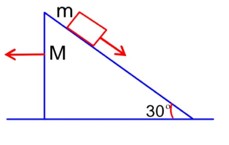
A block of mass m slides on the wooden wedge, which in turn slides backward on the horizontal surface. The acceleration of the block with respect to the wedge is: Given m = 8 kg, M = 16kg. Assume all the surfaces shown in the figure to be frictionless.
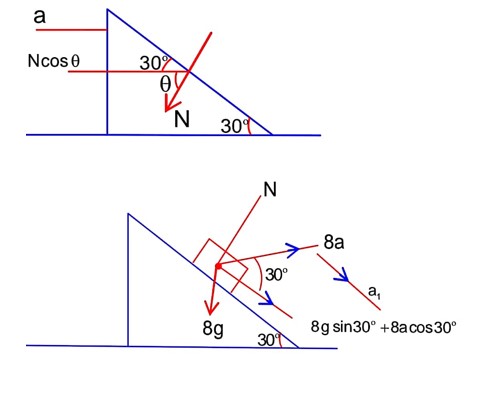
Suppose acceleration of wedge is a and acceleration of block w. r.t. wedge is a1 then N cos60° = Ma = 16 a -> N = 32 a
For block w.r.t. wedge
N + 8a sin 30° = 8g cos 30°
N = 8g cos 30° - 8a sin 30°
->32a = 8g cos 30° - 8a sin 30°
->a =
Now for 8 kg,
Upvote The boxes of masses 2kg and 8kg are connected by a massless string passing over smooth pulleys. Calculate the time taken by box of mass 8kg to strike the ground starting from rest. (use g = 10 m/s2)

The boxes of masses 2kg and 8kg are connected by a massless string passing over smooth pulleys. Calculate the time taken by box of mass 8kg to strike the ground starting from rest. (use g = 10 m/s2)
For 8 kg block,
8g – 2T = 8a . (i)
For 2kg block,
T – 2g = 2 × 2a . (ii)
Solving equations (i) and (ii),
Upvote 
A disc with a flat small bottom beaker placed on it at a distance R from its center is revolving about an axis passing through the center and perpendicular to its plane with an angular velocity <!-- [if gte mso 9]><xml>
A disc with a flat small bottom beaker placed on it at a distance R from its center is revolving about an axis passing through the center and perpendicular to its plane with an angular velocity <!-- [if gte mso 9]><xml>

A bag is gently dropped on a conveyor belt moving at a speed of 2 m/s. The coefficient of friction between the conveyor belt and bag is 0.4. Initially, the bag slips on the belt before it stops due to friction. The distance travelled by the bag on the belt during slipping motion, is:
[Take g = 10m/s-2]
Slipping stops when Vbag = Vconveyar
-> 0 + at = 2
-> t =
So, x =

Upvote