
Laws of Motion
Get insights from 109 questions on Laws of Motion, answered by students, alumni, and experts. You may also ask and answer any question you like about Laws of Motion
- 109
Questions
- 0
Discussions
- 0
Active Users
- 0
Followers
Have a question about Laws of Motion? Ask our experts
Keep it short & simple. Type complete word. Avoid abusive language.
A ball of mass 0.5 kg is dropped from the height of 10m. The height, at which the magnitude of velocity becomes equal to the magnitude of acceleration due to gravity, is __________m.
[Use g = 10m/s2]
A ball of mass 0.5 kg is dropped from the height of 10m. The height, at which the magnitude of velocity becomes equal to the magnitude of acceleration due to gravity, is __________m.
[Use g = 10m/s2]
Let ‘h’ be the height at which velocity becomes equal to magnitude of Acceleration
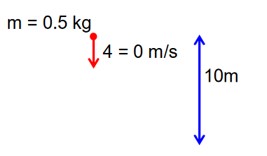
v = g = 10
v = u + at
10 = 0 + 10t
t = 1 sec
= 5m
 Upvote

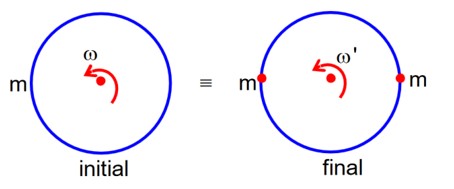
A thin circular ring of mass M and radius R is rotating with a constant angular velocity 2 rads-1 in a horizontal plane about an axis vertical to its plane and passing through the centre of the ring. If two objects each of mass m be attached gently to the opposite ends of a diameter of ring, the will then rotate with an angular velocity (in rads-1).
A thin circular ring of mass M and radius R is rotating with a constant angular velocity 2 rads-1 in a horizontal plane about an axis vertical to its plane and passing through the centre of the ring. If two objects each of mass m be attached gently to the opposite ends of a diameter of ring, the will then rotate with an angular velocity (in rads-1).
By conservation of Angular momentum
Li = Lf
Upvote 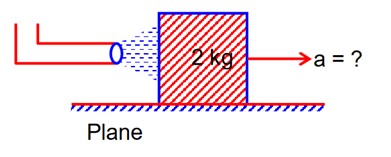
A body of mass M at rest explodes into pieces, in the ratio of masses 1 : 1: 2. Two smaller pieces fly off perpendicular to each other with velocities of 30 ms-1 and 40 ms-1 respectively. The velocity of the third piece will be:
A body of mass M at rest explodes into pieces, in the ratio of masses 1 : 1: 2. Two smaller pieces fly off perpendicular to each other with velocities of 30 ms-1 and 40 ms-1 respectively. The velocity of the third piece will be:
Let ‘v’ be the velocity of third piece
com along x-axis
Upvote A body of mass M at rest explodes into pieces, in the ratio of masses 1 : 1: 2. Two smaller pieces fly off perpendicular to each other with velocities of 30 ms-1 and 40 ms-1 respectively. The velocity of the third piece will be
A body of mass M at rest explodes into pieces, in the ratio of masses 1 : 1: 2. Two smaller pieces fly off perpendicular to each other with velocities of 30 ms-1 and 40 ms-1 respectively. The velocity of the third piece will be
Let ‘v’ be the velocity of third piece
com along x-axis
M × 0 = M1vx + M3v’x
=
Com along y-axis
M × 0 = M2vy + M3v’y
vy =
vy =
vy = 20m/sec
v =
Upvote <p><strong>A body of mass M at rest explodes into pieces, in the ratio of masses 1 : 1: 2. Two smaller pieces fly off perpendicular to each other with velocities of 30 ms<sup>-1</sup> and 40 ms<sup>-1</sup> respectively. The velocity of the third piece will be</strong></p>
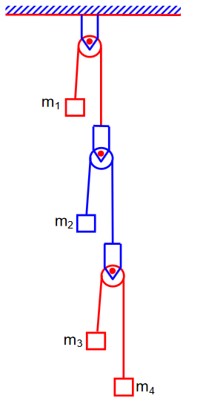
Two masses M1 and M2 are tied together at the two ends of a light inextensible string that passes over a frictionless pulley. When the mass M2 is twice that of M1. The acceleration of the system is a1. When the mass M2 is thrice that of M1 the acceleration of the system is a2. The ratio will be:
![]()
Two masses M1 and M2 are tied together at the two ends of a light inextensible string that passes over a frictionless pulley. When the mass M2 is twice that of M1. The acceleration of the system is a1. When the mass M2 is thrice that of M1 the acceleration of the system is a2. The ratio will be:
A monkey of mass 50kg climbs on a rope which can withstand the tension (T) of 350 N. If monkey initially climbs down with an acceleration of 4 m/s2 and then climbs up with an acceleration of 5 m/s2. Choose the correct option (g = 10 m/s2).
A monkey of mass 50kg climbs on a rope which can withstand the tension (T) of 350 N. If monkey initially climbs down with an acceleration of 4 m/s2 and then climbs up with an acceleration of 5 m/s2. Choose the correct option (g = 10 m/s2).
For climbing downward
50 g – T = 50a
T = 500 – 50 * 4
= 300 N < 350 N
for climbing upwards
T – 50 g = 50 a
T – 500 = 50 * 5
T = 750 N > 350 N
Upvote Three masses M = 100kg, m1 = 10kg and M2 = 20kg are arranged in a system as shown in figure. All the surface are frictionless and strings are inextensible and weightless. The pulleys are also weightless and frictionless. A force F is applied on the system so that the mass m2 moves upward with an acceleration of 2ms-2. The value of F is:

(Take g = 10ms-2)
Three masses M = 100kg, m1 = 10kg and M2 = 20kg are arranged in a system as shown in figure. All the surface are frictionless and strings are inextensible and weightless. The pulleys are also weightless and frictionless. A force F is applied on the system so that the mass m2 moves upward with an acceleration of 2ms-2. The value of F is:
(Take g = 10ms-2)
Given Acceleration of m2 is 2m/s2
(upward)
N = 20a T – m2g = m2a
T – 20g = 20a
T = 200 + 20 × 2
T = 240 N
T = m1 a1
240 = 10a1
a1 = 24 m/s2
Upvote