Laws of Motion
Get insights from 109 questions on Laws of Motion, answered by students, alumni, and experts. You may also ask and answer any question you like about Laws of Motion
- 109
Questions
- 0
Discussions
- 0
Active Users
- 0
Followers
Have a question about Laws of Motion? Ask our experts
Keep it short & simple. Type complete word. Avoid abusive language.
A ball of mass 0.15 kg hits the wall with its initial speed of 12 ms-1and bounces back without changing its initial speed. If the force applied by the wall on the ball during the contact is 100 N, calculate the time during of the contact of ball with the wall.
A ball of mass 0.15 kg hits the wall with its initial speed of 12 ms-1and bounces back without changing its initial speed. If the force applied by the wall on the ball during the contact is 100 N, calculate the time during of the contact of ball with the wall.
Two masses A and B, each of mass M are fixed together by a massless spring. A force acts on the mass B as shown in figure. If the mass A starts moving away from mass B with acceleration ‘a’, then the acceleration of mass B will be
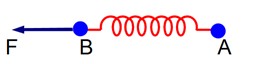
Two masses A and B, each of mass M are fixed together by a massless spring. A force acts on the mass B as shown in figure. If the mass A starts moving away from mass B with acceleration ‘a’, then the acceleration of mass B will be
Let the spring is in extension state and
Hence we can say that block moves away from block B in the frame of B
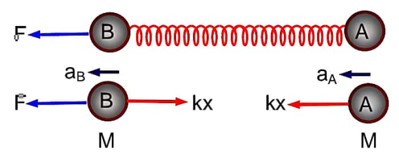
F – kx = MaB . (1)
kx = Ma &nbs
 Upvote

Blocks of masses and are arranged in a line on a frictionless floor. Another block of mass , moving with speed along the same line (see figure) collides with mass in perfectly inelastic manner. All the subsequent collisions are also perfectly inelastic. By the time the last block of mass starts moving the total energy loss is of the original energy. Value of ' ' is close to:
![]()
Blocks of masses and are arranged in a line on a frictionless floor. Another block of mass , moving with speed along the same line (see figure) collides with mass in perfectly inelastic manner. All the subsequent collisions are also perfectly inelastic. By the time the last block of mass starts moving the total energy loss is of the original energy. Value of ' ' is close to:
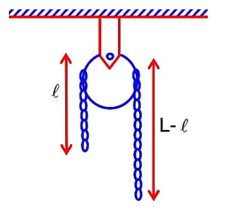
A uniform metal chain of mass m length ‘L’ passes over a massless and frictionless pulley. It is released from rest with a part of its length is hanging on one side and rest of its length is hanging on the other side of the pully. At a certain point of time, when the acceleration of the chain is The value of x is__________.
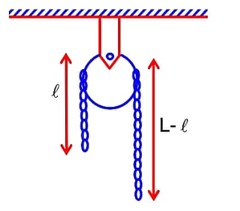
A uniform metal chain of mass m length ‘L’ passes over a massless and frictionless pulley. It is released from rest with a part of its length is hanging on one side and rest of its length is hanging on the other side of the pully. At a certain point of time, when the acceleration of the chain is The value of x is__________.
A hanging mass M is connected to a four times bigger mass by using a string-pulley arrangement, as shown in the figure. The bigger mass is placed on a horizontal ice-slab and being pulled by 2 Mg force. In this situation, tension in the string is <!-- [if gte mso 9]><xml>
A hanging mass M is connected to a four times bigger mass by using a string-pulley arrangement, as shown in the figure. The bigger mass is placed on a horizontal ice-slab and being pulled by 2 Mg force. In this situation, tension in the string is <!-- [if gte mso 9]><xml>
Using newton’s law:
2mg – T = 4ma - (1)
T – mg = ma - (2)
From (1) & (2) :
Upvote A particle of mass m is moving in a circular path of constant radius r such that its centripetal acceleration (a) is varying with time t as a = k2 rt2, where k is a constant. The power delivered to the particle by the force acting on it is given as
A particle of mass m is moving in a circular path of constant radius r such that its centripetal acceleration (a) is varying with time t as a = k2 rt2, where k is a constant. The power delivered to the particle by the force acting on it is given as
a = k2rt2
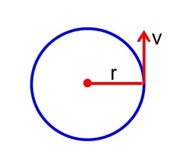
⇒ tangential force, Ft = mat = mkr
Upvote A smooth circular groove has a smooth vertical wall as shown in figure. A block of mass m moves against the wall with a speed v. Which of the following curve represents the correct relation between the normal reaction on the block by the wall (N) and speed of the block (v)?
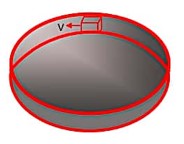
A smooth circular groove has a smooth vertical wall as shown in figure. A block of mass m moves against the wall with a speed v. Which of the following curve represents the correct relation between the normal reaction on the block by the wall (N) and speed of the block (v)?
A small ball of mass is thrown upward with velocity from the ground. The ball experiences a resistive force where is it speed. The maximum height attained by the ball is:
<!-- [if !supportLineBreakNewLine]-->
<!--[endif]-->
A small ball of mass is thrown upward with velocity from the ground. The ball experiences a resistive force where is it speed. The maximum height attained by the ball is:
<!-- [if !supportLineBreakNewLine]-->
<!--[endif]-->
Sol. Sol.  Electric field due to infinite sheet is uniform
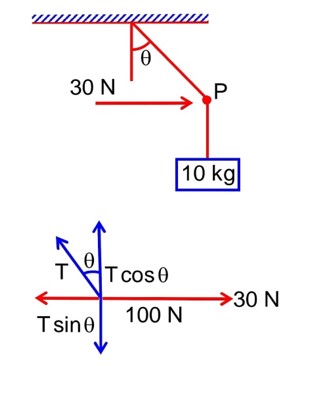
Upvote A mass of 10kg is suspended vertically by a rope of length 5m from the roof. A force of 30 N is applied at the middle point of rope in horizontal direction. The angle made by upper half of the rope with vertical is q = tan-1 (x × 10-1). The value of x is…………….
(Given, g = 10 m/s2)
A mass of 10kg is suspended vertically by a rope of length 5m from the roof. A force of 30 N is applied at the middle point of rope in horizontal direction. The angle made by upper half of the rope with vertical is q = tan-1 (x × 10-1). The value of x is…………….
(Given, g = 10 m/s2)