Maths Integrals
Get insights from 376 questions on Maths Integrals, answered by students, alumni, and experts. You may also ask and answer any question you like about Maths Integrals
- 376
Questions
- 0
Discussions
- 0
Active Users
- 0
Followers
Have a question about Maths Integrals? Ask our experts
Keep it short & simple. Type complete word. Avoid abusive language.
The value of ∫?(π/2)^(π/2) (1/(1+e^(sin x))) dx is:
The value of ∫?(π/2)^(π/2) (1/(1+e^(sin x))) dx is:
I = ∫ from -π/2 to π/2 (1 / (1+e^ (sin x) dx
I = ∫ from -π/2 to π/2 (e^ (sin x) / (1+e^ (sin x) dx
2I = ∫ from -π/2 to π/2 1dx ⇒ I = 1/2 ∫ from -π/2 to π/2 dx
I = 1/2 [x] from -π/2 to π/2 ⇒ I = π/2
 Upvote

If ∫ (e²x + 2eˣ – e⁻ˣ – 1)e^(eˣ+e⁻ˣ)dx = g(x)e^(eˣ+e⁻ˣ) + c where c is a constant of integration, then g(0) is equal to:
If ∫ (e²x + 2eˣ – e⁻ˣ – 1)e^(eˣ+e⁻ˣ)dx = g(x)e^(eˣ+e⁻ˣ) + c where c is a constant of integration, then g(0) is equal to:
I = ∫ (e²? + 2e? - e? - 1)e^ (e? +e? ) dx
I = ∫ (e²? + e? - 1)e^ (e? +e? ) dx + ∫ (e? - e? )e^ (e? +e? ) dx
I = ∫ (e? + 1 - e? )e^ (e? +e? ) dx + e^ (e? +e? )
(e? - e? + 1)dx = du
I = e^ (e? +e? ) + e^ (e? +e? ) = e^ (e? +e? ) (e? + 1) then g (x) = e? + 1
g (0) = 2
Upvote Let {x} and [x] denote the fractional part of x and the greatest integer ≤ x respectively of a real number x. if ∫(from 0 to n){x}dx, ∫(from 0 to n)[x]dx and 10(n² – n), (n ∈ N, n > 1) are three consecutive terms of a G.P. then n is equal to
Let {x} and [x] denote the fractional part of x and the greatest integer ≤ x respectively of a real number x. if ∫(from 0 to n){x}dx, ∫(from 0 to n)[x]dx and 10(n² – n), (n ∈ N, n > 1) are three consecutive terms of a G.P. then n is equal to
Clearly, ∫ [0 to n] {x}dx = n/2
∫ [0 to n] [x]dx = 1 + 2 + 3 . . . n − 1
= n (n-1)/2
∴ (n (n-1)/2)² = n/2 {10n (n-1)}
Solving, n = 21
Upvote The integral ∫(from π/6 to π/3) tan³x · sin²3x(2sec²x · sin²3x + 3tanx · sin6x)dx is
The integral ∫(from π/6 to π/3) tan³x · sin²3x(2sec²x · sin²3x + 3tanx · sin6x)dx is
∫ [π/6 to π/3] (d/dx (tan? x) * sin³3x + tan? x * d/dx (sin³3x) dx
= 1/2 ∫ [π/6 to π/3] d/dx (tan? x * sin?3x) dx
= 1/2 [tan? x · sin?3x] from π/6 to π/3
= 1/2 [ (√3)? · 0 - 1/ (√3)? )]
= -1/18
Upvote Let f(x) = ∫(√x / (1+x)²)dx(x ≥ 0). Then f(3) − f(1) is equal to:
<!-- [if !supportLineBreakNewLine]-->
<!--[endif]-->
Let f(x) = ∫(√x / (1+x)²)dx(x ≥ 0). Then f(3) − f(1) is equal to:
<!-- [if !supportLineBreakNewLine]-->
<!--[endif]-->
f (x) = ∫ (from 1 to 3) (√x dx)/ (1+x)² = ∫ (from 1 to √3) (t⋅2tdt)/ (1+t²)² (put √x = t)
= [ (-t/ (1+t²)] (from 1 to √3) + [tan? ¹t] (from 1 to √3) [Applying by parts]
= (-√3/4 + 1/2) + (π/3 - π/4)
= (-√3+2)/4 + π/12
Upvote The integral ∫(x/(xsinx+cosx))² dx is equal to (where C is constant of integration):
The integral ∫(x/(xsinx+cosx))² dx is equal to (where C is constant of integration):
∫ (x/ (xsinx+cosx)²dx = ∫ (xcosx⋅xcosx)/ (xsinx+cosx)² dx
= x/cosx (-1/ (xsinx+cosx) + ∫ (cosx-xsinx)/cosx² (1/ (xsinx+cosx) dx
= -xsecx/ (xsinx+cosx) + ∫sec²xdx
= -xsecx/ (xsinx+cosx) + tanx + C
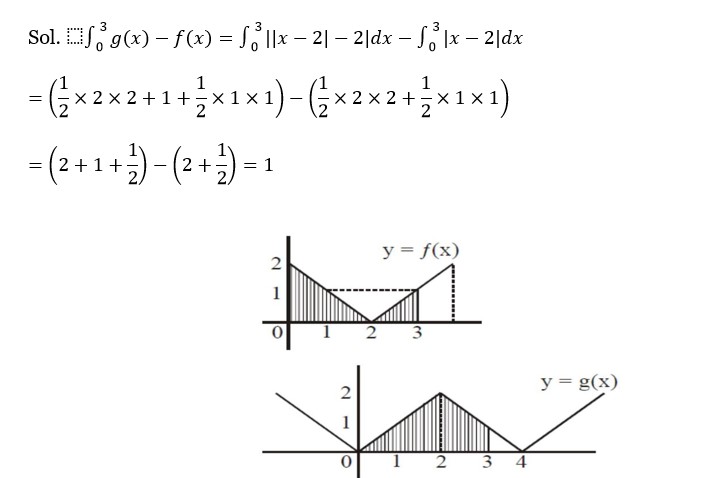
Upvote Let f(x) = |x − 2| and g(x) = f(f(x)), x ∈. Then ∫?³ (g(x) – f(x))dx is equal to:
Let f(x) = |x − 2| and g(x) = f(f(x)), x ∈. Then ∫?³ (g(x) – f(x))dx is equal to: