Maths Integrals

Get insights from 376 questions on Maths Integrals, answered by students, alumni, and experts. You may also ask and answer any question you like about Maths Integrals

  • 376

    Questions

  • 0

    Discussions

  • 0

    Active Users

  • 0

    Followers

Have a question about Maths Integrals? Ask our experts

Ask Your Question

Keep it short & simple. Type complete word. Avoid abusive language.

New answer posted•a year ago
S
a year ago

∴ ∫ − 6 0 f ( x ) d x = 2 × 1 2 ( 2 + 5 ) × 3 = 2 1


Thumbs Up IconUpvote Thumbs Down Icon
New answer posted•a year ago
S
a year ago

Given a > b

Area common to x2 + y2 ≤ a 2     a n d     x 2 a 2 + y 2 b 2 ≤ 1  

is π a 2 − π a b = 3 0 π     . . . . . . . . . . . . . . ( i )  

Similarly π a b − π b 2 = 1 8 π . . . . . . . . . . . . . . . . . ( i i )  

Equation (i) and equation (ii)  a b = 5 3  

Equation (i) + equation (ii) a 2 − b 2 = 4 8  

a2 = 75, b2 = 27

...Read more

Thumbs Up IconUpvote Thumbs Down Icon
New answer posted•a year ago
S
a year ago

x 4 − 2 x 3 + 2 x − 1 = ( x − 1 ) 2 ( x 2 − 1 )

s i n π x = s i n ( π ( 1 − x )

= − s i n ( s i n π ( x − 1 ) )

l i m x → 1 ( x 2 − 1 ) ⋅ s i n 2 π x ( x 2 − 1 ) ( x − 1 ) 2 = l i m x → 1 s i n 2 ( π ( x − 1 ) ) ( x − 1 ) 2

= l i m x → 1 s i n 2 ( π ( x − 1 ) ) ( π ( x − 1 ) ) 2 ⋅ π 2

=2

Thumbs Up IconUpvote Thumbs Down Icon
New answer posted•a year ago
S
a year ago

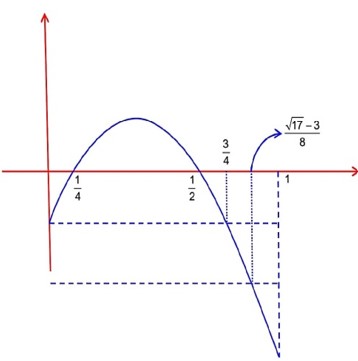
∫ 0 1 [ − 8 x 2 + 6 x − 1 ] d x  

Let f (x) = -8x2 + 6x – 1

f (0) = -1, f (1) = -3

max f (x) =  − D 4 a = − 3 6 − 3 2 − 3 2 = 1 8  

= − 1 4 − 1 ( 3 4 − λ 2 ) − 2 ( 1 7 − 3 8 − 3 4 ) − 3 ( 1 − 1 7 − 3 8 )  

= 1 7 − 1 3 8  

Thumbs Up IconUpvote Thumbs Down Icon
New answer posted•a year ago
S
a year ago

∫ 3 x f ( x ) d x = ( f ( x ) x ) 3 ⇒ x 3 ∫ 3 x f ( x ) d x = f 3 ( x ) , differentiating w.r.to x

x 3 f ( x ) + 3 x 2 f 3 ( x ) x 3 = 3 f 2 ( x ) f ' ( x ) ⇒ 3 y 2 d y d x = x 3 y = 3 y 3 x ⇒ 3 x y d y d x = x 4 + 3 y 2  

After solving we get  y 2 = x 4 3 + c x 2  also curve passes through (3, 3) Þ c = -2


∴ y 2 = x 4 3 − 2 x 2
which passes through ( α , 6 1 0 ) ∴ α 4 − 6 α 2 3 = 3 6 0 ⇒ α = 6  

Thumbs Up IconUpvote Thumbs Down Icon
New answer posted•a year ago
S
a year ago

∫ 0 1 1 . ( 1 − x n ) 2 n + 1 d x using by parts we get

( 2 n 2 + n + 1 ) ∫ 0 1 ( 1 − x n ) 2 n + 1 d x = 1 1 7 7 ∫ 0 1 ( 1 − x n ) 2 n + 1 d x

⇒ 2 n 2 + n + 1 = 1 1 7 7 ⇒ n = 2 4     o r     − 4 9 2 ∴ n = 2 4

Thumbs Up IconUpvote Thumbs Down Icon
New answer posted•a year ago
S
a year ago

t a n ( 2 t a n − 1 1 5 + s e c − 1 5 2 + 2 t a n − 1 1 8 ) t a n ( 2 t a n − 1 1 5 + 1 8 1 − 1 5 × 1 8 + s e c − 1 5 2 )

= t a n ( t a n − 1 3 4 + t a n − 1 1 2 ) = t a n ( t a n − 1 3 4 + 1 2 1 − 3 8 )

= t a n ( t a n − 1 5 4 5 8 ) = 2

Thumbs Up IconUpvote Thumbs Down Icon
New answer posted•a year ago
S
a year ago

S = { θ ∈ [ 0 , 2 π ] : 8 2 s i n 2 x + 8 2 c o s 2 x = 1 6 }

Now apply AM ≥ G M for 8 2 s i n 2 x + 8 2 c o s 2 x 2 ≤ ( 8 2 s i n 2 x + 2 c o s 2 x ) 1 2 ⇒ 8 2 s i n 2 x = 8 2 c o s 2 x  

Þ s i n 2 θ = c o s 2 θ               ∴ θ = π 4 , 3 π 4 , 5 π 4 , 7 π 4

= 4 + [ c o s e c ( π 2 + π ) + c o s e c ( π 2 + 3 π ) + c o s e c ( π 2 + 5 π ) + c o s e c ( π 2 + 7 π ) ]

= 4 − 2 ( 4 ) = − 4  

Thumbs Up IconUpvote Thumbs Down Icon
New answer posted•a year ago
S
a year ago

Since a is a odd natural number then | ∫ 1 3 y a d y | = 3 6 4 3 ⇒ | ( y a + 1 a + 1 ) 1 3 | = 3 6 4 3 ⇒ 3 a + 1 a + 1 = 3 6 4 3  

 Þ a = 5

Thumbs Up IconUpvote Thumbs Down Icon