
Maths Matrices
Get insights from 117 questions on Maths Matrices, answered by students, alumni, and experts. You may also ask and answer any question you like about Maths Matrices
- 117
Questions
- 0
Discussions
- 0
Active Users
- 7
Followers
Have a question about Maths Matrices? Ask our experts
Keep it short & simple. Type complete word. Avoid abusive language.
Let M be any 3 × 3 matrix with entires from the set {0, 1, 2}. The maximum number of such matrices, for which the sum of diagonal elements MTM is seven is____________.
Let M be any 3 × 3 matrix with entires from the set {0, 1, 2}. The maximum number of such matrices, for which the sum of diagonal elements MTM is seven is____________.
all i = 1, 2, 3
Case 1 7 one’s and two zeroes which can occur in 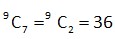
Case 2 One 2 three 1’s five zeroes =
total such matrices = 504 + 36 = 540
 Upvote

If M is a 3 x 3 matrix such that M2 = O, then det ((I + M)50 – 50M) where I is an identity matrix of order 3, is equal to :
<!-- [if !supportLineBreakNewLine]-->
<!--[endif]-->
If M is a 3 x 3 matrix such that M2 = O, then det ((I + M)50 – 50M) where I is an identity matrix of order 3, is equal to :
<!-- [if !supportLineBreakNewLine]-->
<!--[endif]-->
(I + M)² = (I + M) (I + M) = I + 2M + M² = (I + 2M)
(I + M)³ = (I + 2M) (I + M) = I + 3M + 2M² = (I + 3M)
(I + M)? = I + 50M
det (I + M)? - 50M) = det (I) = 1
Upvote If A = [1 1; 0 1], then A2011 is equal to
<!-- [if !supportLineBreakNewLine]-->
<!--[endif]-->
If A = [1 1; 0 1], then A2011 is equal to
<!-- [if !supportLineBreakNewLine]-->
<!--[endif]-->
A = [1]
[0 1]
Now A² = [1] [1] = [1 2]
[0 1] [0 1] [0 1]
A³ = A².A = [1 2] [1] = [1 3]
[0 1] [0 1] [0 1]
Similarly A²? ¹¹ = [1 2011]
[0 1]
Upvote If A = [1 1 1; 0 1 1; 0 0 1] and M = A + A² + A³ + . + A²?, then the sum of all the elements of the matrix M is equal to………
If A = [1 1 1; 0 1 1; 0 0 1] and M = A + A² + A³ + . + A²?, then the sum of all the elements of the matrix M is equal to………
A² = [1 2 3; 0 1 2; 0 1]
A³=A².A= [1 3 6; 0 1 3; 0 1]
A²? = [1 20 1+2+3.20; 0 1 20; 0 1] = [1 20 210; 0 1 20; 0 1]
M= [20 210 520; 0 20 210; 0 20]
M (a? )=T? =n (n+1)/2
S? = 1/2 [ n (n+1) (2n+1)/6 + n (n+1)/2 ]
⇒S? =1540
⇒M=2020
Upvote Let A and B be two 3 x 3 real matrices such that (A² - B²) is invertible matrix. If A⁵ = B⁵ and A³B² = A²B³, then the value of the determinant of the matrix A³ + B³ is equal to :
Let A and B be two 3 x 3 real matrices such that (A² - B²) is invertible matrix. If A⁵ = B⁵ and A³B² = A²B³, then the value of the determinant of the matrix A³ + B³ is equal to :
A? =B? (i)
A³B²=A²B³. (ii)
Subtract (i) & (ii)
⇒A³ (A²−B²)=B³ (B²−A²)
⇒ (A²−B²) (A³+B³)=0
A²−B² is invertible matrix
∴A²−B²≠0
⇒A³+B³=0
∴? A³+B³? =0
Upvote Let the system of linear equations x + 2y + z = 2, ax + 3y - z = a, -ax + y + 2z = -a be inconsistent. Then α is equal to:
Let the system of linear equations x + 2y + z = 2, ax + 3y - z = a, -ax + y + 2z = -a be inconsistent. Then α is equal to:
x + 2y + z = 2
αx + 3y – z = α
–αx + y + 2z = –α
Δ = | (1, 2, 1), (α, 3, -1), (-α, 1, 2) | = 1 (6+1) – 2 (2α–α) + 1 (α+3α) = 7+2α
α = –7/2
Upvote