
Maths Matrices
Get insights from 117 questions on Maths Matrices, answered by students, alumni, and experts. You may also ask and answer any question you like about Maths Matrices
- 117
Questions
- 0
Discussions
- 0
Active Users
- 7
Followers
Have a question about Maths Matrices? Ask our experts
Keep it short & simple. Type complete word. Avoid abusive language.
Let If then the sum of all elements of the matrix B is
Let If then the sum of all elements of the matrix B is
Kindly consider the following figure
B = (I – adjA)5
 Upvote

Let If then the sum of all elements of the matrix B is
Let If then the sum of all elements of the matrix B is
Kindly consider the following figure
B = (I – adjA)5
Upvote Let If then the sum of all elements of the matrix B is
Let If then the sum of all elements of the matrix B is
Kindly go through the solution
B = (I – adjA)5
Upvote <p><strong>Let </strong><span class="mathml" contenteditable="false"> <math> <mrow> <mi>A</mi> <mo>=</mo> <mrow> <mo>(</mo> <mrow> <mtable> <mtr columnalign="center"> <mtd columnalign="center"> <mn>2</mn> </mtd> <mtd columnalign="center"> <mo>−</mo> <mn>1</mn> </mtd> </mtr> <mtr columnalign="center"> <mtd columnalign="center"> <mn>0</mn> </mtd> <mtd columnalign="center"> <mn>2</mn> </mtd> </mtr> </mtable> </mrow> <mo>)</mo> </mrow> <mo>.</mo> </mrow> </math> </span><strong> If </strong><span class="mathml" contenteditable="false"> <math> <mrow> <mi>B</mi> <mo>=</mo> <mi>I</mi> <msup> <mrow> <mo>−</mo> </mrow> <mrow> <mn>5</mn> </mrow> </msup> <mtext>?</mtext> <msub> <mrow> <mi>C</mi> </mrow> <mrow> <mn>1</mn> </mrow> </msub> <mrow> <mo>(</mo> <mrow> <mi>a</mi> <mi>d</mi> <mi>j</mi> <mi>A</mi> </mrow> <mo>)</mo> </mrow> <msup> <mrow> <mo>+</mo> </mrow> <mrow> <mn>5</mn> </mrow> </msup> <mtext>?</mtext> <msub> <mrow> <mi>C</mi> </mrow> <mrow> <mn>2</mn> </mrow> </msub> <msup> <mrow> <mrow> <mo>(</mo> <mrow> <mi>a</mi> <mi>d</mi> <mi>j</mi> <mi>A</mi> </mrow> <mo>)</mo> </mrow> </mrow> <mrow> <mn>2</mn> </mrow> </msup> <mo>−</mo> <mo>.</mo> <mo>.</mo> <msup> <mrow> <mo>.</mo> </mrow> <mrow> <mn>5</mn> </mrow> </msup> <mtext>?</mtext> <msub> <mrow> <mi>C</mi> </mrow> <mrow> <mn>5</mn> </mrow> </msub> <msup> <mrow> <mrow> <mo>(</mo> <mrow> <mi>a</mi> <mi>d</mi> <mi>j</mi> <mi>A</mi> </mrow> <mo>)</mo> </mrow> </mrow> <mrow> <mn>5</mn> </mrow> </msup> <mo>,</mo> </mrow> </math> </span><strong> then the sum of all elements of the matrix B is</strong></p>
Let where a is a non-zero real number an If (I – M2)N = -2I, then the positive integral value of a is…………….
Let where a is a non-zero real number an If (I – M2)N = -2I, then the positive integral value of a is…………….
N =
N =
Now
-> a100 + a2 = 2
->a =
Upvote If the system of equations
x + 6y + 6z =
4x – y + 4z =
has non-trivial solution then the value of equals (where R)
If the system of equations
x + 6y + 6z =
4x – y + 4z =
has non-trivial solution then the value of equals (where R)
Let S = where A is a matrix defined as A = then n(S) equals (where n(A) denotes number of elements in set A)
Let S = where A is a matrix defined as A = then n(S) equals (where n(A) denotes number of elements in set A)
from Cayley – Hamilton Theorem
Upvote 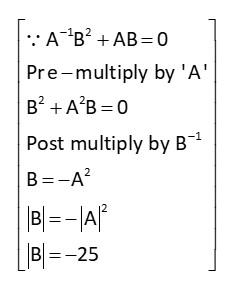
Let A be a square matrix of order 2 such that A² – 4A + 4I = 0, where I is an identity matrix of order 2. If B = A? + 4A? + 6A³ + 4A² + A – 162 I, then det(B) is equal to
Let A be a square matrix of order 2 such that A² – 4A + 4I = 0, where I is an identity matrix of order 2. If B = A? + 4A? + 6A³ + 4A² + A – 162 I, then det(B) is equal to
A² - 4A + 4I = 0
(A - 2I)² = 0 ⇒ A-2I ≠ 0
B = 297A - 594I
= 297 (A - 2I)
Upvote