

Maths
Get insights from 6.5k questions on Maths, answered by students, alumni, and experts. You may also ask and answer any question you like about Maths
Follow Ask QuestionQuestions
Discussions
Active Users
Followers
New answer posted
a year agoContributor-Level 10
6. Let the given statement be P (n) i.e.,
P (n)=1.2+2.3+3.4+ … +2 (n+1)=
For n=1,
P (1)=1.2=2= = =2.
Which is true.
considerP (k) be true for some positive integer k
1.2 + 2.3 + 3.4 + … + k (k + 1) = - (1)
Now, let us prove that P (k+1) is true.
Here, 1.2 + 2.3 + 3.4 + … + k (k + 1) + (k+1) (k+2)
By using (1), we get
=
= (k+1) (k+2)
=
By further simplification;
P (k+1) is true whenever P (k) is true.
Therefore, by the principle of mathematical induction, statement P (n) is true for all natural no. i.e., n.
New answer posted
a year agoContributor-Level 10
In the given D.E,
is a trigonometric function of derivative . So it is not a polynomial equation so its derivative is not defined.
Hence, Degree of the given D.E. is not defined.
Option (D) is correct.
New answer posted
a year agoContributor-Level 10
The highest order derivative present in the D.E. is so its order is 2.
As the given D.E. is polynomial equation in its derivative, its degree is 1.
New answer posted
a year agoContributor-Level 10
The highest order derivative present in the D.E. is so its order is 2.
As the given D.E. is a polynomial equation in its derivative, its degree is 1.
New answer posted
a year agoContributor-Level 10
5. Let the given statement be P(n) i.e.,
P(n)= 1.3 + 2.32 + 3.33 + … + n.3n =
If n=1, we get
P(1) = 1.3=3= = = =3
which is true.
Consider P(k) be true for some positive integer k
1.3 + 2.32 + 3.33 + … + k3k = ------------------(1)
Now, let us prove P(k+1) is true.
Here,
1.3 + 2.32 + 3.33 + … + k3k + (k + 1)3k + 1
By using eqn. (1)
L.C.M
=
=
=
=
= = ?P(k+1) is true whenever P(k) is true.
Therefore, by the principle of mathematical induction statement P(n) is true for all natural numbers i.e., n.
New answer posted
a year ago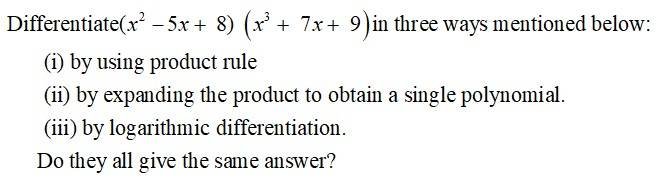
Contributor-Level 10
(i) by product rule
3x4 + 7x2- 15x3- 35x + 24x2 + 56 + 2x4- 5x3 + 14x2- 35x 18x-45
= 5x4- 20x3 + 45x2- 52x + 11
(ii)
Taking log in eqn (1)
Now, Differe(iii) ntiating w r t 'x' we get,
2x4 + 14x4 + 18x- 35x- 45 + 3x1- 15x3 + 24x2 + 7x2- 35x + 56]
= 5x4- 20x3 + 45x2- 52x + 11
We observed that all the methods give the same result.
New answer posted
a year agoContributor-Level 10
The given order derivative present in the D.E. is so its order is 1.
As the given D.E. is a polynomial equation in its derivative, its degree is 1.
New answer posted
a year agoContributor-Level 10
The highest order present in the D.E. is so its order is 3.
As the given D.E. is a polynomial equation in its derivative, its degree is 1.
New answer posted
a year agoContributor-Level 10
84. Given, f(x) = (1 + x)(1 + x 4)(1 + x 8)
Taking log,
logf(x) = log (1 + x) + log (1 + x) + log (1 + x 4) + log (1 + x 8)
Now, Differentiating w r t 'x' we get,
Putting x = 1
f'(x) = (1 +1)(1 + 14)(1 +18)
New answer posted
a year agoContributor-Level 10
The highest order derivative present in the D.E. is so its order is 3.
As the given D.E. is a polynomial equation in its derivation, its degree is 2.
Taking an Exam? Selecting a College?
Get authentic answers from experts, students and alumni that you won't find anywhere else
Sign Up on ShikshaOn Shiksha, get access to
- 66k Colleges
- 1.2k Exams
- 711k Reviews
- 1850k Answers