

Maths
Get insights from 6.5k questions on Maths, answered by students, alumni, and experts. You may also ask and answer any question you like about Maths
Follow Ask QuestionQuestions
Discussions
Active Users
Followers
New answer posted
a year agoContributor-Level 10
Maximise
Subject to the constraints:
The corresponding equation of the above inequality are
The graph of the given inequalities.

The shaded region OAB is the feasible region which is bounded.
The corresponding of the corner point of the feasible region are O (0,0), A (4,0), and B (0,4).
The value of Z at these points are as follows,
Corner point
O (0,0) 0
A (4,0) 12
B (0,4) 16
Therefore the maximum value of Z is 16 at the point B (0,4).
New answer posted
a year agoContributor-Level 10
Let, be angle between two vector . Then, without loss of generality, are non-zero vectors, so that are positive. Therefore, the correct answer is B. |
New answer posted
a year agoContributor-Level 10
Let, be two unit vectors and be the angle between them.
Then,
Now, is a unit vector if
[ is unit vector.]
Therefore, the correct answer is (D)
New answer posted
a year agoContributor-Level 10
Let, in triangle between two vector
Then, without loss of generality, are non-zero vector so that
are positive.
We know,
So,
Therefore, , when
Hence, the correct answer is B.
New answer posted
a year agoContributor-Level 10
( Distributive of scalar product over addition )
( Scalar product is commutative , )
Therefore, are perpendicular.
New answer posted
a year agoContributor-Level 10
Given that are mutually perpendicular vectors, we have
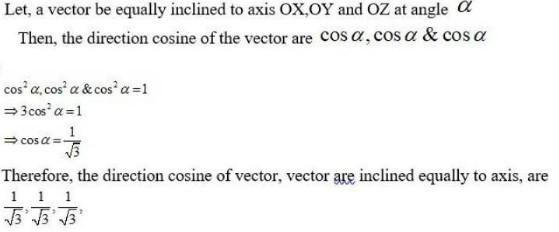
Let, vector be inclined to at angles, respectively.
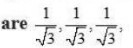
Therefore, the vector are equally inclined to
New answer posted
a year agoContributor-Level 10
The unit vector along is given as;

By Q.uestion, scalar product of with this unit vector is 1.

New answer posted
a year agoContributor-Level 10
Given,
Let,
Since, is perpendicular to both
We know,
Putting this value in (3) we get
Putting value in (2), we get
The reQ.uired vector is
Taking an Exam? Selecting a College?
Get authentic answers from experts, students and alumni that you won't find anywhere else
Sign Up on ShikshaOn Shiksha, get access to
- 66k Colleges
- 1.2k Exams
- 711k Reviews
- 1850k Answers