

Maths
Get insights from 6.5k questions on Maths, answered by students, alumni, and experts. You may also ask and answer any question you like about Maths
Follow Ask QuestionQuestions
Discussions
Active Users
Followers
New answer posted
a year agoContributor-Level 10
21. There are 11 letters of which M appears 1 time, I appears 4 times, S appears 4 times and P appears 2 times.
The required number of arrangements =
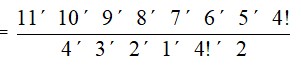
= 11 * 10 * 9 * 5
= 34650
When the four I occurs together we treat them as single object IIII. This single object together with 7 remaining object will account for 8 object which have 1-M. 2-P and 4-S.
So, required number of permutation =
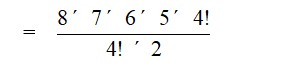
= 840
Therefore, total no. of permutation in which 4-I's do not come together
= 34650 – 840
= 33810
New answer posted
a year agoContributor-Level 10
20. i. The permutation of 6 letters in MONDAY taken 4 at a time without repetition is

ii. The permutation of 6 letters in MONDAY when all letters are taken at a time is
6P6 = = = 6! = 6 * 5 * 4 * 3 * 2 * 1 = 720
iii. The permutation of having one of the two vowels (O, A) as first letter from the word MONDAY when all letters are taken at a time is
2P1 = = 2
After fixing one of the vowel as first letter we can rearrange the remaining 5 letters taking 5 at a time
5P5 = = = 5! = 5 * 4 * 3 * 2 * 1 = 120
Therefore, total permutation when all letters are used but first letter is vowel from the word MONDAY = 2
New question posted
a year agoNew question posted
a year agoNew answer posted
a year agoContributor-Level 10
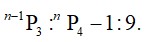
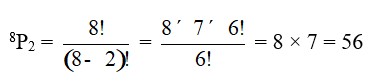
19. Since no letter is repeated in the word EQUATION.
The permutation of 8 letters taken all at a time
= 8P8
=
=
= 8! [since, 0! = 1]
= 8 * 7 * 6 * 5 * 4 * 3 * 2 * 1
= 40320
New answer posted
a year agoContributor-Level 10
15. The permutation of 5 different digits namely 1, 2, 3, 4, 5 taken 4 at a time is
5P4 = = = 5 * 4 * 3 * 2 * 1 = 120
The permutation of having 2 or 4 at ones place is
2P1 = = = 1 * 2 = 2
After fixing one of the even number at last digit we can rearrange the remaining four digits taking 3 at a time. i.e.
4P3 = = = 4 * 3 * 2 * 1 = 24
Therefore, total permutation of 4 digit even number using 1, 2, 3, 4, 5
= 24 * 2
= 48
New answer posted
a year agoContributor-Level 10
14. The permutation of having even number at the last digit from the given 6 different digits namely 1, 2, 3, 4, 5, 6 to form a 3-digit number is
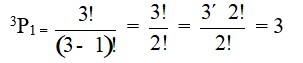
After taking one of the even number as last digit we can rearrange the remaining 5 digits taking 2 at a time. i.e.

Therefore, The required number = 20 * 3 = 60
Taking an Exam? Selecting a College?
Get authentic answers from experts, students and alumni that you won't find anywhere else
Sign Up on ShikshaOn Shiksha, get access to
- 66k Colleges
- 1.2k Exams
- 712k Reviews
- 1850k Answers