Mechanical Properties of Fluids

Get insights from 90 questions on Mechanical Properties of Fluids, answered by students, alumni, and experts. You may also ask and answer any question you like about Mechanical Properties of Fluids

Follow Ask Question
90

Questions

0

Discussions

4

Active Users

0

Followers

New answer posted

4 months ago

0 Follower 4 Views

V
Vishal Baghel

Contributor-Level 10

√2gh = (2r²g/9η) (ρ_t - ρ)
⇒ h = (2/81) (r? g (ρ_t - ρ)²/η²)
⇒ h ∝ r?
After falling through h, the velocity be equal to terminal velocity.

New answer posted

4 months ago

0 Follower 4 Views

V
Vishal Baghel

Contributor-Level 10

Range R = v*t = √ (2gh) * √ (2 (H-h)/g) = 2√ (h (H-h).
For R to be max, dR/dh = 0.
h (H-h) must be max. d/dh (Hh-h²)=H-2h=0.
h=H/2 = 12/2=6m.

New answer posted

4 months ago

0 Follower 6 Views

V
Vishal Baghel

Contributor-Level 10

At terminal speed
Mg = Fv = 6πηRv
⇒ V = mg / 6πηR
V = (4/3)πR³ρg / 6πηR
⇒ V = (2/9) * (ρR²g/η)
= (2/9) * (1000 * (0.2 * 10? ³)² * 10) / (1.8 * 10? )
= 4.94 m/s

New answer posted

4 months ago

0 Follower 6 Views

V
Vishal Baghel

Contributor-Level 10

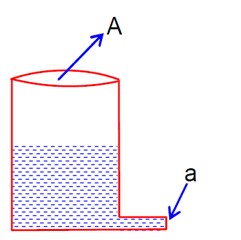
v = √2gh velocity of efflux.
F = v ( dm/dt ) = v (aρv) = aρv² = 2aρgh
fr = µR = µAhρg
For just sliding, for = F
µAhρg = 2aρgh
or µ = 2a/A

New answer posted

4 months ago

0 Follower 2 Views

V
Vishal Baghel

Contributor-Level 10

Thermal stress is developed on heating when expansion of rod is hindered.

New answer posted

4 months ago

0 Follower 2 Views

V
Vishal Baghel

Contributor-Level 10

Total surface energy before coalesce = U i = 2 * 4 π R 2 * σ = 8 π R 2 σ . . . . . . . . . . ( i )

Let new radius becomes r, so according to conservation energy we can write

2 * 4 π R 3 3 = 4 π r 3 3 r = 2 1 3 R

Total surface energy after coalesce = U f = 4 π r 2 * σ = 2 2 3 * 4 π R 2 σ . . . . . . . . . . ( i i )

U i U f = 8 π R 2 σ 2 2 3 * 4 π R 2 σ = 2 1 3 : 1

New answer posted

4 months ago

0 Follower 3 Views

V
Vishal Baghel

Contributor-Level 10

PB – PA = ρ g h

( P 0 2 T r 2 ) ( P 0 2 T r 1 ) = ρ g h

h = 2 T ( 1 r 1 1 r 2 ) ρ g

= 2 * 7 . 3 * 1 0 2 * ( 1 2 . 5 * 1 0 3 1 4 * 1 0 3 ) 1 0 0 0 * 1 0

= 2 . 1 9 * 1 0 3 m = 2 . 1 9 m m  

New answer posted

4 months ago

0 Follower 2 Views

V
Vishal Baghel

Contributor-Level 10

Let, Rain drop moving with terminal velocity vt in the air Fb (Bnoyancy force) = 4 3 π r 3 ρ a i r g

m g = 4 3 π r 3 ρ a i r g

F v = ( v i s c o n s f o r c e ) = 6 π η r v T

F b + F v = m g

4 3 π r 3 ρ a i r g + 6 π η r v T = 4 3 π r 3 ρ g

v T = 2 9 r 2 η ( ρ ρ a i r )

v T r 2

New answer posted

5 months ago

0 Follower 3 Views

V
Vishal Baghel

Contributor-Level 10

Bernoulli's equation between (1) & (2)

P 1 ρ g + v 1 2 2 g + z 1 = P 2 ρ g + v 2 2 z g + z 2

P a t m + m g / A ρ g + 0 + 4 0 + 1 0 2

P a t m ρ g + v 2 2 2 g + 0 [ v 1 0 ]

m g A ρ g + 4 0 * 1 0 2 = v 2 2 2 g

m A ρ + 4 0 * 1 0 2 = v 2 2 2 g

2 5 0 . 5 * 1 0 3 + 4 0 * 1 0 2 = V 2 2 2 * 1 0

V 2 2 = ( 5 * 1 0 2 + 4 0 * 1 0 2 ) 2 0

V 2 2 = 4 5 * 1 0 2 * 2 0

V 2 2 = 9 0 * 1 0 1

V 2 = 3 m / s e c

= 3 0 0 c m / s e c

New answer posted

5 months ago

0 Follower 2 Views

V
Vishal Baghel

Contributor-Level 10

mg = pvg

mg = d1vg           ……. (i)

Fb = weight of fluid displaced = d2vg         …… (ii)

by NLM 1            Fb + Fv = mg

FV = mg - Fb

F v = m g ( 1 d 2 d 1 )

Get authentic answers from experts, students and alumni that you won't find anywhere else

Sign Up on Shiksha

On Shiksha, get access to

  • 66k Colleges
  • 1.2k Exams
  • 681k Reviews
  • 1800k Answers

Share Your College Life Experience

×
×

This website uses Cookies and related technologies for the site to function correctly and securely, improve & personalise your browsing experience, analyse traffic, and support our marketing efforts and serve the Core Purpose. By continuing to browse the site, you agree to Privacy Policy and Cookie Policy.