
Mechanical Properties of Fluids
Get insights from 90 questions on Mechanical Properties of Fluids, answered by students, alumni, and experts. You may also ask and answer any question you like about Mechanical Properties of Fluids
- 90
Questions
- 0
Discussions
- 0
Active Users
- 0
Followers
Have a question about Mechanical Properties of Fluids? Ask our experts
Keep it short & simple. Type complete word. Avoid abusive language.
10.30 Two narrow bores of diameters 3.0 mm and 6.0 mm are joined together to form a U-tube open at both ends. If the U-tube contains water, what is the difference in its levels in the two limbs of the tube? Surface tension of water at the temperature of the experiment is 7.3 × 10⁻² N m–1. Take the angle of contact to be zero and density of water to be 1.0 × 10³ kg m–3 (g = 9.8 m s–2)
10.30 Two narrow bores of diameters 3.0 mm and 6.0 mm are joined together to form a U-tube open at both ends. If the U-tube contains water, what is the difference in its levels in the two limbs of the tube? Surface tension of water at the temperature of the experiment is 7.3 × 10⁻² N m–1. Take the angle of contact to be zero and density of water to be 1.0 × 10³ kg m–3 (g = 9.8 m s–2)
Diameter of the 1st bore, = 3 mm = 3 m
Radius of the first bore, = 1.5 mm = 1.5 m
Diameter of the 2nd bore, = 6 mm = 6 m
Radius of the 2nd bore, = 3.0 mm = 3 m
Surface tension of water, s= 7.3 N/m
Angle of
 Upvote

10.29 Mercury has an angle of contact equal to 140° with soda lime glass. A narrow tube of radius 1.00 mm made of this glass is dipped in a trough containing mercury. By what amount does the mercury dip down in the tube relative to the liquid surface outside? Surface tension of mercury at the temperature of the experiment is 0.465 N m–1. Density of mercury = 13.6 × 10³ kg m–3.
10.29 Mercury has an angle of contact equal to 140° with soda lime glass. A narrow tube of radius 1.00 mm made of this glass is dipped in a trough containing mercury. By what amount does the mercury dip down in the tube relative to the liquid surface outside? Surface tension of mercury at the temperature of the experiment is 0.465 N m–1. Density of mercury = 13.6 × 10³ kg m–3.
Radius of the narrow tube, r = 1 mm= 1 m
Surface tension of mercury at the given temperature, s= 0.465 N/m
Density of mercury kg/
Dipping depth = h
Acceleration due to gravity, g = 9.8 m/
Surface tension related with angle of contact and dipping depth is given by:
s =&nbs
Upvote 10.28 In Millikan’s oil drop experiment, what is the terminal speed of an uncharged drop of radius 2.0 × 10⁻⁵ m and density 1.2 × 10³ kg m–3. Take the viscosity of air at the temperature of the experiment to be 1.8 × 10⁻⁵ Pa s. How much is the viscous force on the drop at that speed ? Neglect buoyancy of the drop due to air.
10.28 In Millikan’s oil drop experiment, what is the terminal speed of an uncharged drop of radius 2.0 × 10⁻⁵ m and density 1.2 × 10³ kg m–3. Take the viscosity of air at the temperature of the experiment to be 1.8 × 10⁻⁵ Pa s. How much is the viscous force on the drop at that speed ? Neglect buoyancy of the drop due to air.
Radius of the uncharged drop, r = 2.0 m
Density of the uncharged drop, = 1.2 kg/
Viscosity of air, = 1.8 Pas
Density of air , can be taken as zero in order to neglect the buoyancy of air
Acceleration due to gravity, g = 9.8 m/
Upvote 10.27 A plane is in level flight at constant speed and each of its two wings has an area of 25 m2. If the speed of the air is 180 km/h over the lower wing and 234 km/h over the upper wing surface, determine the plane’s mass. (Take air density to be 1 kg m–3).
10.27 A plane is in level flight at constant speed and each of its two wings has an area of 25 m2. If the speed of the air is 180 km/h over the lower wing and 234 km/h over the upper wing surface, determine the plane’s mass. (Take air density to be 1 kg m–3).
The area of the wing of the plane, A = 2 = 50
Speed of air over the lower wing, = 180 km/h = 50 m/s
Speed of air over the upper wing, = 234 km/h = 65 m/s
Density of air, = 1 kg/
Let us assume, pressure over the lower wing = and pressure
Upvote 10.26 (a) What is the largest average velocity of blood flow in an artery of radius 2×10⁻³m if the flow must remain laminar? (b) What is the corresponding flow rate? (Take viscosity of blood to be 2.084 × 10⁻³ Pa s).
10.26 (a) What is the largest average velocity of blood flow in an artery of radius 2×10⁻³m if the flow must remain laminar? (b) What is the corresponding flow rate? (Take viscosity of blood to be 2.084 × 10⁻³ Pa s).
Radius of the artery, r = 2 m
Diameter of the artery, d = 4 m
Viscosity of blood, = 2.084 Pa-s
Density of the blood, = 1.06 kg/
Reynolds’s number for laminar flow, = 2000
The largest velocity is given by the relation:
Upvote 10.25 In deriving Bernoulli’s equation, we equated the work done on the fluid in the tube to its change in the potential and kinetic energy. (a) What is the largest average velocity of blood flow in an artery of diameter 2 × 10⁻³ m if the flow must remain laminar? (b) Do the dissipative forces become more important as the fluid velocity increases? Discuss qualitatively.
10.25 In deriving Bernoulli’s equation, we equated the work done on the fluid in the tube to its change in the potential and kinetic energy. (a) What is the largest average velocity of blood flow in an artery of diameter 2 × 10⁻³ m if the flow must remain laminar? (b) Do the dissipative forces become more important as the fluid velocity increases? Discuss qualitatively.
Diameter of the artery, d = 2 m
Viscosity of the blood, = 2.084 Pa-s
Density of the blood, = 1.06 kg/
Reynolds’s number for laminar flow, = 2000
= = = 1.966 m/s
As the fluid velocity increases, the diss
Upvote 10.24 During blood transfusion the needle is inserted in a vein where the gauge pressure is 2000 Pa. At what height must the blood container be placed so that blood may just enter the vein? [Use the density of whole blood from Table 10.1].
10.24 During blood transfusion the needle is inserted in a vein where the gauge pressure is 2000 Pa. At what height must the blood container be placed so that blood may just enter the vein? [Use the density of whole blood from Table 10.1].
Gauge pressure, P = 2000 Pa
Density of whole blood, = 1.06 kg/
Acceleration due to gravity, g = 9.8 m/s
Let the height of the blood container = h
Pressure on the blood container P =
By equating, we get h = (2000)/ ( 1.06 = 0.1925m
Upvote 10.23 Two vessels have the same base area but different shapes. The first vessel takes twice the volume of water that the second vessel requires to fill up to a particular common height. Is the force exerted by the water on the base of the vessel the same in the two cases? If so, why do the vessels filled with water to that same height give different readings on a weighing scale?
10.23 Two vessels have the same base area but different shapes. The first vessel takes twice the volume of water that the second vessel requires to fill up to a particular common height. Is the force exerted by the water on the base of the vessel the same in the two cases? If so, why do the vessels filled with water to that same height give different readings on a weighing scale?
Two vessels, having the same base area, will have identical force and equal pressure acting on their common base area. Since the shapes of the two vessels are different, the force exerted on the sides of the vessels has non-zero vertical components.
When these vertical components are added, the total
Upvote 10.22 A manometer reads the pressure of a gas in an enclosure as shown in Fig. 10.25 (a) When a pump removes some of the gas, the manometer reads as in Fig. 10.25 (b) .The liquid used in the manometers is mercury and the atmospheric pressure is 76 cm of mercury.
(a) Give the absolute and gauge pressure of the gas in the enclosure for cases (a) and (b), in units of cm of mercury
(b) How would the levels change in case (b) if 13.6 cm of water (immiscible with mercury) are poured into the right limb of the manometer? (Ignore the small change in the volume of the gas)
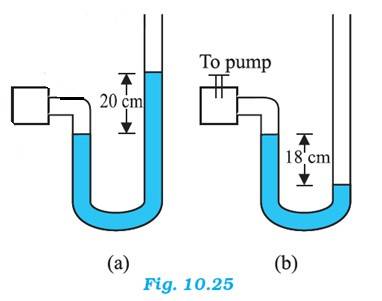
10.22 A manometer reads the pressure of a gas in an enclosure as shown in Fig. 10.25 (a) When a pump removes some of the gas, the manometer reads as in Fig. 10.25 (b) .The liquid used in the manometers is mercury and the atmospheric pressure is 76 cm of mercury.
(a) Give the absolute and gauge pressure of the gas in the enclosure for cases (a) and (b), in units of cm of mercury
(b) How would the levels change in case (b) if 13.6 cm of water (immiscible with mercury) are poured into the right limb of the manometer? (Ignore the small change in the volume of the gas)

Atmospheric pressure, = 76 cm of Hg
For figure (a)
Difference between the levels of mercury in the two limbs gives gauge pressure
Hence, gauge pressure = 20 cm of Hg
Absolute pressure = Atmospheric pressure + Gauge pressure = 76 + 20 = 96 cm of Hg
For figure (b),
Difference between the levels
Upvote 10.21 A tank with a square base of area 1.0 m2 is divided by a vertical partition in the middle. The bottom of the partition has a small-hinged door of area 20 cm2. The tank is filled with water in one compartment, and an acid (of relative density 1.7) in the other, both to a height of 4.0 m. compute the force necessary to keep the door close.
10.21 A tank with a square base of area 1.0 m2 is divided by a vertical partition in the middle. The bottom of the partition has a small-hinged door of area 20 cm2. The tank is filled with water in one compartment, and an acid (of relative density 1.7) in the other, both to a height of 4.0 m. compute the force necessary to keep the door close.
Base area of the given tank, A = 1.0
Area of the hinged door, a = 20 = 20
Density of water, = kg/
Density of acid, = 1.7 kg/
Height of the water column, = 4 m
Height of the acid column, = 4 m
Acceler
Upvote