

Mechanical Properties of Fluids
Get insights from 90 questions on Mechanical Properties of Fluids, answered by students, alumni, and experts. You may also ask and answer any question you like about Mechanical Properties of Fluids
Follow Ask QuestionQuestions
Discussions
Active Users
Followers
New answer posted
a year agoContributor-Level 10
This is a multiple choice answer as classified in NCERT Exemplar
(a) d1= diameter at 1st point is 2.5

d2= diameter at 2nd point is 3.75
Applying equation of continuity for cross section A1 and A2
A1V1=A2V2
2
= =
New answer posted
a year agoContributor-Level 10
This is a multiple choice answer as classified in NCERT Exemplar
(b) As we know for a streamline flow of a liquid velocity of each particle at a particular cross-section is constant, because Av = constant (law of continuity) between two cross-section of a tube of flow.
New question posted
a year agoNew answer posted
a year ago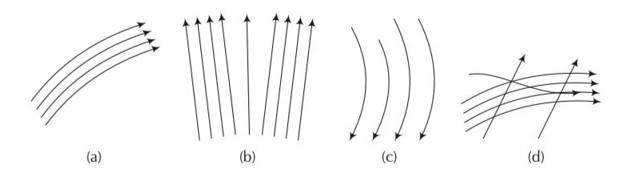
Contributor-Level 10
This is a multiple choice answer as classified in NCERT Exemplar
(d) In a streamline flow at any given point, the velocity of each passing fluid particles remains constant. If we consider a cross-sectional area, then a point on the area cannot have different velocities at the same time, hence two streamlines of flow cannot cross each other.
New answer posted
a year ago
Contributor-Level 10
This is a multiple choice answer as classified in NCERT Exemplar
(c) When the pebble is falling through the viscous oil the viscous force is
F=6
where r is radius of the pebble, v is instantaneous speed, his coefficient of viscosity. As the force is variable, hence acceleration is also variable so v-t graph will not be straight line. First velocity increases and then becomes constant known as terminal velocity.
New answer posted
a year agoContributor-Level 10
This is a short answer type question as classified in NCERT Exemplar
Surface tension of water S= 7.28*10-2 Nm-1
Vapour pressure p= 2.33*103 Pa
The drop will evaporate, if the water pressure is greater than the vapour pressure.
Let a water droplet or radius R can be formed without evaporating.
Vapour pressure= Excess pressure in drop.
P=2S/R
R= 2S/P=
New answer posted
a year agoContributor-Level 10
This is a short answer type question as classified in NCERT Exemplar
When a big drop of radius R, breaks into N droplets each of radius r, the volume remains constant.
Volume of big drop = N volume of each small drop
R3 =Nr3
N=R3/r3
Now change in surface area = 4 -N4 r2
= 4
Energy released = T = S
Due to releasing of this energy , the temperature is lowered.
If is the density and s is specific heat of liquid and its temperature is lowered by , then energy released = ms
T ( )=
=
=
=
New answer posted
a year agoContributor-Level 10
This is a short answer type question as classified in NCERT Exemplar
Consider the diagram
Radii of mercury droplets r1=0.1cm = 1
r2=0.2cm=2

Surface tension T= 435.5 * 10-3 Nm-1
Let the radius of the big drop formed by collapsing be R
Therefore,
volume of big drop = volume of small droplets
4/3 R3=4/3 4/3
R3=
= 0.13+0.23
= 0.001+0.008
=0.009
R= 0.21 cm = 2.1
Change in surface area = 4
=4
Energy released =T
= T
= 435.5 2-(1 )
= 435.5
= -32.23
Therefore -3.22 energy will be absorbed.
New answer posted
a year agoContributor-Level 10
This is a short answer type question as classified in NCERT Exemplar
Consider the diagram where a tanker is accelerating with acceleration a.

Consider an elementary particle of the fluid of mass dm.
The acting forces on the particle with respect to the tanker are shown above.
Now, balancing forces (as the particle is in equilibrium) along the inclined direction
component of weight= component of pseudo force dmg sin =dma cos (we have assumed that the surface is inclined at an angle q) where, dma is pseudo force
g sin =acos
a=g tan
tan = a/g = slope
New answer posted
a year agoContributor-Level 10
This is a short answer type question as classified in NCERT Exemplar
Given radius r= 2.5
Surface tension S= 7.28
Angle of contact = 00
The maximum height to which SAP can rise in trees through capillarity action is given by
h = where S = surface tension, = density, r= radius
h=
This is the maximum height to which the SAP can rise due to surface tension. Since, many trees have heights much more than this, capillary action alone cannot account for the rise of water in all trees.
Taking an Exam? Selecting a College?
Get authentic answers from experts, students and alumni that you won't find anywhere else
Sign Up on ShikshaOn Shiksha, get access to
- 67k Colleges
- 1.2k Exams
- 718k Reviews
- 1850k Answers