
Mechanical Properties of Fluids
Get insights from 90 questions on Mechanical Properties of Fluids, answered by students, alumni, and experts. You may also ask and answer any question you like about Mechanical Properties of Fluids
- 90
Questions
- 0
Discussions
- 0
Active Users
- 0
Followers
Have a question about Mechanical Properties of Fluids? Ask our experts
Keep it short & simple. Type complete word. Avoid abusive language.
10.20 What is the excess pressure inside a bubble of soap solution of radius 5.00 mm, given that the surface tension of soap solution at the temperature (20 °C) is 2.50 × 10⁻² N m–1 ? If an air bubble of the same dimension were formed at depth of 40.0 cm inside a container containing the soap solution (of relative density 1.20), what would be the pressure inside the bubble ? (1 atmospheric pressure is 1.01 × 10⁵ Pa).
10.20 What is the excess pressure inside a bubble of soap solution of radius 5.00 mm, given that the surface tension of soap solution at the temperature (20 °C) is 2.50 × 10⁻² N m–1 ? If an air bubble of the same dimension were formed at depth of 40.0 cm inside a container containing the soap solution (of relative density 1.20), what would be the pressure inside the bubble ? (1 atmospheric pressure is 1.01 × 10⁵ Pa).
Soap bubble radius, r = 5.0 mm = 5 m
Surface tension of the soap bubble, S = 2.50 N/m
Relative density of soap solution = 1.20, hence density of soap solution, = 1.2 Kg/
Air bubble formed at a depth, h = 40 cm = 0.4 m
1 atmospheric pressure = 1.01
 Upvote

10.19 What is the pressure inside the drop of mercury of radius 3.00 mm at room temperature? Surface tension of mercury at that temperature (20 °C) is 4.65 × 10⁻¹ N m–1. The atmospheric pressure is 1.01 × 10⁵ Pa. Also give the excess pressure inside the drop.
10.19 What is the pressure inside the drop of mercury of radius 3.00 mm at room temperature? Surface tension of mercury at that temperature (20 °C) is 4.65 × 10⁻¹ N m–1. The atmospheric pressure is 1.01 × 10⁵ Pa. Also give the excess pressure inside the drop.
Radius of the mercury droplet, r = 3.00 mm = 3 m
Surface tension, S = 4.65 N/m
Atmospheric pressure, = 1.01 Pa
Total pressure inside the mercury drop = Excess pressure inside mercury + Atmospheric pressure
= + = + 1.01 &n
Upvote 10.18 Figure 10.24 (a) shows a thin liquid film supporting a small weight = 4.5 × 10⁻² N. What is the weight supported by a film of the same liquid at the same temperature in Fig. (b) and (c)? Explain your answer physically.
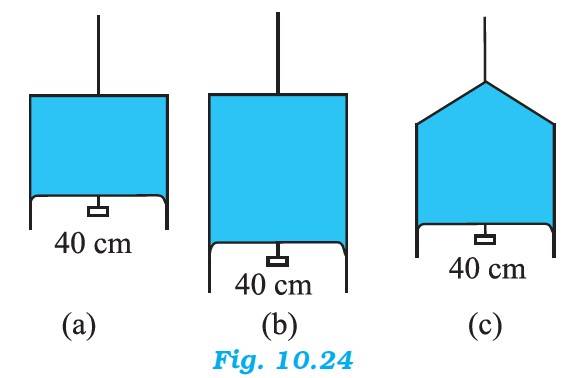
10.18 Figure 10.24 (a) shows a thin liquid film supporting a small weight = 4.5 × 10⁻² N. What is the weight supported by a film of the same liquid at the same temperature in Fig. (b) and (c)? Explain your answer physically.

The length of the liquid film supported by the weight, l = 40 cm = 0.4 m
The weight supported by the film, W = 4.5 N
Since a liquid film has two free surfaces,
Surface tension = = = 5.625 N/m
In all 3 figures, the liquid is the same,
Upvote 10.17 A U-shaped wire is dipped in a soap solution, and removed. The thin soap film formed between the wire and the light slider supports a weight of 1.5 × 10⁻² N (which includes the small weight of the slider). The length of the slider is 30 cm. What is the surface tension of the film?
10.17 A U-shaped wire is dipped in a soap solution, and removed. The thin soap film formed between the wire and the light slider supports a weight of 1.5 × 10⁻² N (which includes the small weight of the slider). The length of the slider is 30 cm. What is the surface tension of the film?
The weight that the soap film supports, W = 1.5 N
Length of the slider, l = 30 cm = 0.3 m
A soap film has two free surfaces, hence total length = 2l = 0.6 m
Surface tension, S= = = 2.5 N/m
Upvote 10.16 The cylindrical tube of a spray pump has a cross-section of 8.0 cm2 one end of which has 40 fine holes each of diameter 1.0 mm. If the liquid flow inside the tube is 1.5 m min–1, what is the speed of ejection of the liquid through the holes?
10.16 The cylindrical tube of a spray pump has a cross-section of 8.0 cm2 one end of which has 40 fine holes each of diameter 1.0 mm. If the liquid flow inside the tube is 1.5 m min–1, what is the speed of ejection of the liquid through the holes?
Area of cross-section of the spray pump, = 8 = 8
Number of holes, n = 40
Diameter of each hole, d = 1 mm = 1 m
Radius of each hole, r = d/2 = 0.5 m
Area of cross-section of each hole, a = =
Total area of 40 holes, = 40&nb
Upvote 10.15 Figures 10.23(a) and (b) refer to the steady flow of a (non-viscous) liquid. Which of the two figures is incorrect ? Why ?
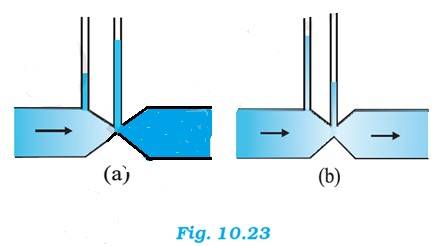
10.15 Figures 10.23(a) and (b) refer to the steady flow of a (non-viscous) liquid. Which of the two figures is incorrect ? Why ?

Take the case given in figure (b)

= Area of pipe 1, = Area of pipe 2, = Speed of fluid in pipe 1, = Speed of fluid in pipe 2
From the law of continuity, we have
=
When the area of cross-section in the middle of the venturimeter is small, the speed of
Upvote 10.14 In a test experiment on a model aeroplane in a wind tunnel, the flow speeds on the upper and lower surfaces of the wing are 70 m s–1and 63 m s-1 respectively. What is the lift on the wing if its area is 2.5 m2? Take the density of air to be 1.3 kg m–3.
10.14 In a test experiment on a model aeroplane in a wind tunnel, the flow speeds on the upper and lower surfaces of the wing are 70 m s–1and 63 m s-1 respectively. What is the lift on the wing if its area is 2.5 m2? Take the density of air to be 1.3 kg m–3.
Speed of the wind on the upper surface of the wing, = 70 m/s
Speed of the wind on the lower surface of the wing, = 63 m/s
Area of the wing, A = 2.5
Density of air, = 1.3 kg/
According to Bernoulli’s theorem, we have the relation:
+ = &nbs
Upvote 10.13 Glycerin flows steadily through a horizontal tube of length 1.5 m and radius 1.0 cm. If the amount of glycerin collected per second at one end is 4.0 × 10⁻³ kg s–1, what is the pressure difference between the two ends of the tube? (Density of glycerin = 1.3 × 10³ kg m–3 and viscosity of glycerin = 0.83 Pa s). [You may also like to check if the assumption of laminar flow in the tube is correct].
10.13 Glycerin flows steadily through a horizontal tube of length 1.5 m and radius 1.0 cm. If the amount of glycerin collected per second at one end is 4.0 × 10⁻³ kg s–1, what is the pressure difference between the two ends of the tube? (Density of glycerin = 1.3 × 10³ kg m–3 and viscosity of glycerin = 0.83 Pa s). [You may also like to check if the assumption of laminar flow in the tube is correct].
Length of the horizontal tube, l = 1.5 m
Radius of the tube, r = 1 cm = 0.01 m
Diameter of the tube, d = 2r = 0.02m
Glycerine mass flow rate, M = 4 kg/s
Density of glycerine, = 1.3 kg
Viscosity of glycerine, = 0.83 Pa-s
Now, volume of glycerine flowing per sec V
Upvote 10.12 Does it matter if one uses gauge instead of absolute pressures in applying Bernoulli’s equation? Explain.
10.12 Does it matter if one uses gauge instead of absolute pressures in applying Bernoulli’s equation? Explain.
It does not matter if one uses gauge pressure, instead of absolute pressure while applying Bernoulli's equation. There should be significantly different atmospheric pressures, where Bernoulli's equation is applied.
Upvote 10.11 Can Bernoulli’s equation be used to describe the flow of water through a rapid in a river? Explain.
10.11 Can Bernoulli’s equation be used to describe the flow of water through a rapid in a river? Explain.
No, Bernoulli's equation cannot be used to describe the flow of water through a rapid in a river. In rapid, the flow is turbulent whereas Bernoulli's equation is applicable for laminar flow only.
Upvote