

Mechanical Properties of Fluids
Get insights from 90 questions on Mechanical Properties of Fluids, answered by students, alumni, and experts. You may also ask and answer any question you like about Mechanical Properties of Fluids
Follow Ask QuestionQuestions
Discussions
Active Users
Followers
New answer posted
a year agoContributor-Level 10
Height of the spirit column, = 12.5 + 15 cm = 27.5 cm
Height of the water column, = 10 + 15 cm = 25 cm
Density of spirit, = 0.8 gm/
Density of water, = 1 gm/
Density of mercury, = 13.6 gm/
Let h be the difference between the levels of mercury in two limbs
Pressure exerted by mercury column of h height= h = 13.6hg …. (i)
Difference between pressure exerted by water and spirit columns:
= 3g ……. (ii)
Equating equations (i) and (ii), we get
13.6hg = 3g
h = 3/13.6 = 0.221 cm
New answer posted
a year agoContributor-Level 10
Height of the spirit column, = 12.5 cm = 0.125 m
Height of the water column, = 10 cm = 0.1m
= atmospheric pressure
= density of spirit, = density of water

Pressure at point B = +
Pressure at point D = +
But pressure at point B and D are same. Hence
+ = + or =
= = = 0.8
So the specific gravity of spirit is 0.8
New answer posted
a year agoContributor-Level 10
The maximum mass of the car can be lifted, m = 3000 kg
Area of cross-section of the load carrying piston, A = 425 = 425
Maximum force exerted by the load, F = mg = 3000 N = 29400 N
Maximum pressure exerted, P = F/A = (29400 / 425 ) Pa = 6.917 Pa
New answer posted
a year agoContributor-Level 10
The maximum allowable stress for the structure, P = Pa
Depth of the ocean, d = 3 km = 3 m
Density of water = kg/
Acceleration due to gravity, g = 9.8 m/s
The pressure exerted because of sea water at the depth d = = 3 Pa
= 2.94 Pa
The maximum allowable stress is more than the pressure, hence the structure is suitable.
New answer posted
a year agoContributor-Level 10
Density of mercury, = 13.6 kg/
Density of wine, = 9.84 kg/
Height of the mercury column for atmospheric pressure, = 760 mm = 0.76 m
Height of the mercury column for atmospheric pressure =
From the relation, P = , since the pressure on both the system are equal
= , we get = = = 10.5 m
New answer posted
a year agoContributor-Level 10
Mass of the girl, m = 50 kg
Diameter of the heel, d = 1.0 cm = 0.01 m, Radius of the heel, r = d/2 = 0.005m
Area of the heel, = 7.85
Force exerted by heel on the floor, F = mg = 50 N = 490 N
Pressure exerted by heel on the ground, p = F/A = 490/ (7.85 N/
= 6.24 N/
New answer posted
a year agoContributor-Level 10
When air is blown under a paper, the velocity of air is more than the upper portion of the paper. As per Bernoulli's principle, atmospheric pressure reduces under the paper and makes it fall. To keep the paper horizontal, the air needs to be blown on the upper surface of the paper.
For a smaller opening, the flow of fluid is more than when it is bigger. When we try to close the tap with our fingers, water gushes through the small openings. Area and velocity are inversely proportional to each other.
Small opening of a syringe needle controls the velocity of the blood oozing out. At the constriction point of the syringe system, the flow ra
New answer posted
a year agoContributor-Level 10
The surface tension of a liquid is inversely proportional to temperature. Decreases
Most fluids offer resistance to their motion. It is like internal mechanical friction, known as viscosity. Gas viscosity increases with temperature, whereas liquid viscosity decreases with temperature. Because, intermolecular forces weaken with temperature increase, viscosity decreases.
With reference to the elastic modulus of rigidity for solids, the shearing force is proportional to the shear strain. With reference to elastic modulus of rigidity for fluids, the shearing force is proportional to the rate of shear strain.
For a steady-flowing fluid, an inc
New answer posted
a year agoContributor-Level 10
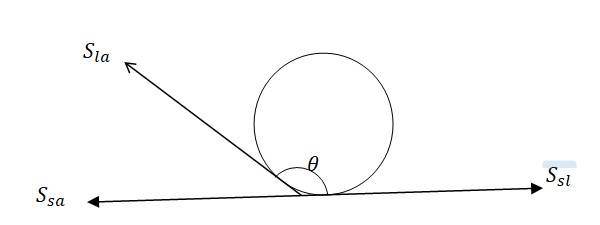
The angle between the tangent to the liquid surface at the point of contact and the surface inside the liquid is called the angle of contact ( , as shown in the diagram
= Interfacial tension between liquid-air interface
= Interfacial tension between solid -liquid interface
= Interfacial tension between solid-air interface
At the line of contact of contact, the surface forces between the three media must be in equilibrium. Hence
=
The angle of contact is obtuse, if , as in the case of mercury on glass

This angle is acute if , as in the case of water on glass
Mercury molecules (which mak
New answer posted
a year agoContributor-Level 10
The pressure of a liquid is given by the following relation:
P = h g, where P = Pressure, h = height of the liquid column, = is the density of the liquid and g= acceleration due to gravity
From the above relation, because of the h factor (height of the human body), the pressure is more at the feet and less at the brain
The said phenomenon is due to the factor. Density of air is maximum at the sea level. At height, density decreases and pressure also decreases. At 6 km height, the density of air is nearly half of that of a t sea level
When pressure is applied on the liquid, the pressure is transmitted in all dir
Taking an Exam? Selecting a College?
Get authentic answers from experts, students and alumni that you won't find anywhere else
Sign Up on ShikshaOn Shiksha, get access to
- 67k Colleges
- 1.2k Exams
- 718k Reviews
- 1850k Answers