
Ncert Solutions Maths class 11th
Get insights from 1.6k questions on Ncert Solutions Maths class 11th, answered by students, alumni, and experts. You may also ask and answer any question you like about Ncert Solutions Maths class 11th
- 1.6k
Questions
- 0
Discussions
- 0
Active Users
- 83
Followers
Have a question about Ncert Solutions Maths class 11th? Ask our experts
Keep it short & simple. Type complete word. Avoid abusive language.
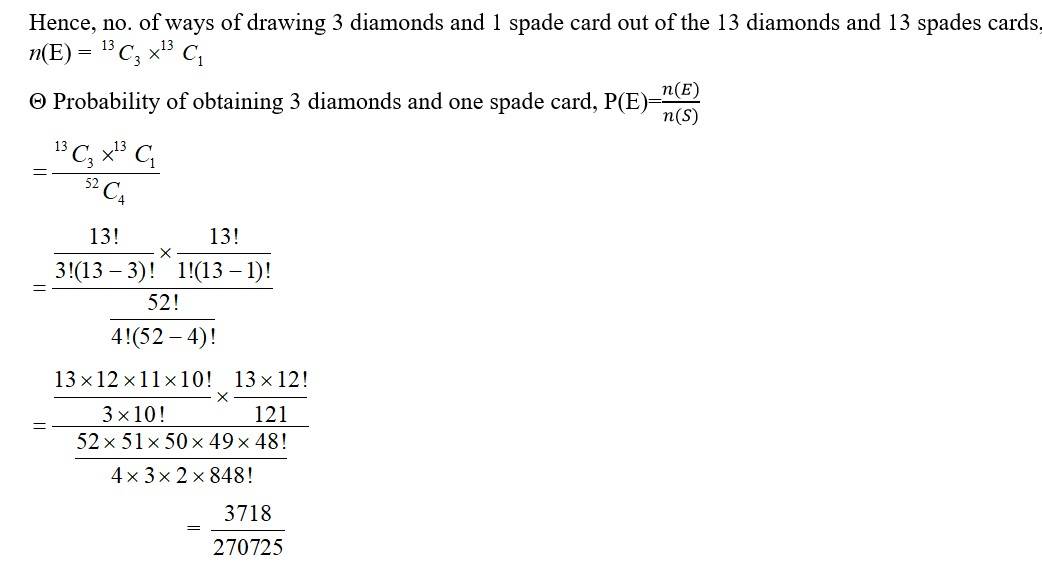
46. 4 cards are drawn from a well – shuffled deck of 52 cards. What is the probability of obtaining 3 diamonds and one spade?
46. 4 cards are drawn from a well – shuffled deck of 52 cards. What is the probability of obtaining 3 diamonds and one spade?
46. Total number of ways of drawing 4 cards from a duck of 52 cards, n (s) = 52C4
Total no. of diamond cards = 13
Similarly, total. no. of spades cards = 13
 Upvote

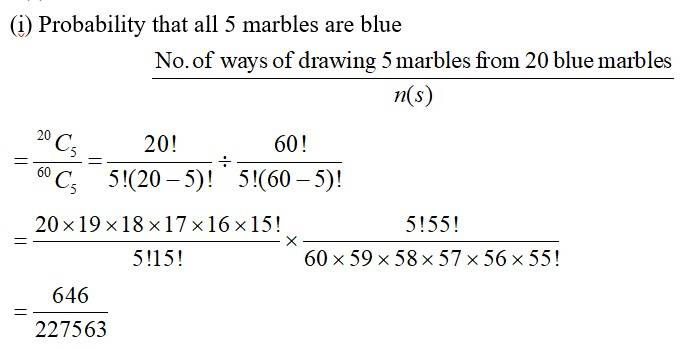
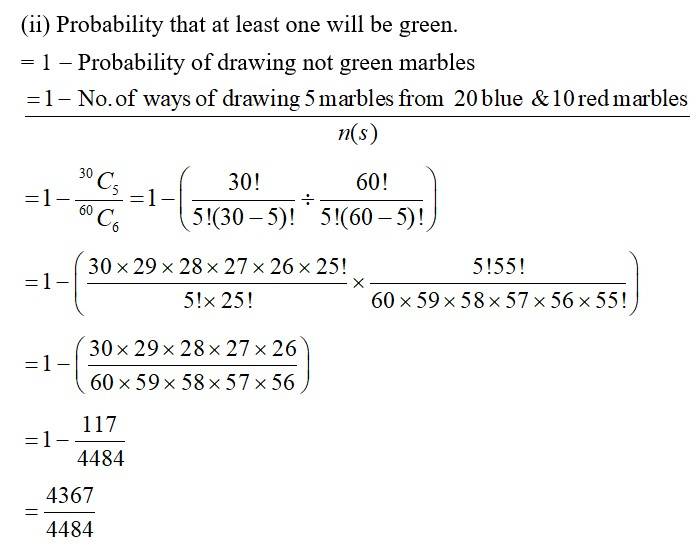
45. A box contains 10 red marbles, 20 blue marbles and 30 green marbles. 5 marbles are drawn from the box, what is the probability that
(i) All will be blue? (ii) Atleast one will be green?
45. A box contains 10 red marbles, 20 blue marbles and 30 green marbles. 5 marbles are drawn from the box, what is the probability that
(i) All will be blue? (ii) Atleast one will be green?
45. Given,
No. of red marbles= 10
No. of blue marbles = 20
No. of green marbles = 30.
So, total no. of marbles = 10 + 20 + 30 = 60
Now, we are to select 5 marbles from the given 60 marbles.
So the sample space is:
n (s) = 60c5.
Upvote 44. In a class of 60 students, 30 opted for NCC, 32 opted for NSS and 24 opted fo rboth NCC and NSS. If one of these students is selected at random, find the probability that
(i) The student opted for NCC or NSS.
(ii) The student has opted neither NCC nor NSS.
(iii) The student has opted NSS but not NCC.
44. In a class of 60 students, 30 opted for NCC, 32 opted for NSS and 24 opted fo rboth NCC and NSS. If one of these students is selected at random, find the probability that
(i) The student opted for NCC or NSS.
(ii) The student has opted neither NCC nor NSS.
(iii) The student has opted NSS but not NCC.
44. Given that, total number of student, n (S) = 60
Let A: student opted for NCC
n (A) = 30
B: student opted for NSS
n (B) = 32
And student who opted both NCC and NSS, n (A∩B) = 24
(i) Probability that student opted for NCC or NSS,
P (A∪B) = P (A) + P (B) – P (A∩B)
(ii) Probability that student opted nei
Upvote 43. The probability that a student will pass the final examination in both English and Hindi is 0.5 and the probability of passing neither is 0.1. If the probability of passing the English examination is 0.75, what is the probability of passing the Hindi examination?
43. The probability that a student will pass the final examination in both English and Hindi is 0.5 and the probability of passing neither is 0.1. If the probability of passing the English examination is 0.75, what is the probability of passing the Hindi examination?
43. Let A: student passing in Hindi
B: student passing in English
Given, P (B) = 0.75
P (A∩B) = 0.5, passing both subject
And P (A'∩B') = 0.1, i.e., passing neither subject
P (A∪B)' = 0.1
1 – P (A∪B) = 0.1
P (A∪B) = 1 – 0.1
P (A∪B) = 0.9
Hence, P (A∪B) = P (A) + P (B) – P (A∩B)
P (A) = P (A∪B) + P (A∩B) – P (
Upvote 42. In an entrance test that is graded on the basis of two examinations, the probability of a randomly chosen student passing the first examination is 0.8 and the probability of passing the second examination is 0.7. The probability of passing atleast one of them is 0.95. What is the probability of passing both?
42. In an entrance test that is graded on the basis of two examinations, the probability of a randomly chosen student passing the first examination is 0.8 and the probability of passing the second examination is 0.7. The probability of passing atleast one of them is 0.95. What is the probability of passing both?
42. Let A: Student passes 1st examination
So, P (A) = 0.8
And B: Student passes 2nd examination
So, P (B) = 0.7
Also probability of passing at least one examination is P (A∪B) = 0.95
Therefore, P (A∪B) = P (A) + P (B) – P (A∩B)
0.95 = 0.8 + 0.7 – P (A∩B)
P (A∩B) = 0.8 + 0.7 – 0.95
P (A∩B) = 0.55
Hence,
Upvote 41. In Class XI of a school 40% of the students study Mathematics and 30% study Biology. 10% of the class study both Mathematics and Biology. If a student is selected at random from the class, find the probability that he will be studying Mathematics or Biology.
41. In Class XI of a school 40% of the students study Mathematics and 30% study Biology. 10% of the class study both Mathematics and Biology. If a student is selected at random from the class, find the probability that he will be studying Mathematics or Biology.
41. Given that, 40% study Mathematics, 30% study Biology and 10% study both Mathematics and Biology.
Let A: Students study Mathematics.
P (A) = 40% = .
Let B: Students study Biology.
P (B) = 30% = .
So, P (A∩B) i.e. probability of student studying both Mathematics and Biology is
P
Upvote 40. A and B are events such that P(A) = 0.42, P(B) = 0.48 and P(A and B) = 0.16.Determine
(i) P(not A), (ii) P(not B) and (iii) P(A or B)
40. A and B are events such that P(A) = 0.42, P(B) = 0.48 and P(A and B) = 0.16.Determine
(i) P(not A), (ii) P(not B) and (iii) P(A or B)
40. Given P (A) = 0.42
P (B) = 0.48
P (A∩B) = 0.16
(i) P (not A) = P (A') = 1 – P (A) = 1 – 0.42 = 0.58
(ii) P (not B) = P (B') = 1 – P (B) = 1 – 0.48 = 0.52
(iii) P (A or B) = P (A∪B) = P (A) + P (B) – P (A∩B)
= 0.42 + 0.48 – 0.16
= 0.74
Upvote 39. Events E and F are such that P(not E or not F) = 0.25, State whether E and F aremutually exclusive.
39. Events E and F are such that P(not E or not F) = 0.25, State whether E and F aremutually exclusive.
39. Given, P (not E or not F) = 0.25
P (E'∪F') = 0.25
P (E∩F)' = 0.25
1 – P (E∩F) = 0.25
P (E∩F) = 1 – 0.25
P (E∩F) = 0.75≠ 0
Hence, E and F are not mutually exclusive events.
Upvote 38. If E and F are events such that P(E) = , P(F) = and P(E and F) = , find
(i) P(E or F), (ii) P(not E and not F).
38. If E and F are events such that P(E) = , P(F) = and P(E and F) = , find
(i) P(E or F), (ii) P(not E and not F).
38. Given, P (E) =
P (F) =
P (E and F) = P (E∩F) =
(i) P (E or F) = P (E∪F) = P (E) + P (F) – P (E∩F)
(ii) P (not E and not F) = P (E'∩F') = P (E∪F)' = 1 – P (E∪F)
Upvote 37. Given P(A) = and P(B) = . Find P(A or B), if A and B are mutually exclusive events.
37. Given P(A) = and P(B) = . Find P(A or B), if A and B are mutually exclusive events.
37.
Given P (A) =
P (B) =
As A and B are mutually exclusive events,
P (A∩B) = 0
Hence, P (A∪B) = P (A) + P (B) – P (A∩B)
Upvote