
Ncert Solutions Maths class 11th
Get insights from 1.6k questions on Ncert Solutions Maths class 11th, answered by students, alumni, and experts. You may also ask and answer any question you like about Ncert Solutions Maths class 11th
- 1.6k
Questions
- 0
Discussions
- 0
Active Users
- 83
Followers
Have a question about Ncert Solutions Maths class 11th? Ask our experts
Keep it short & simple. Type complete word. Avoid abusive language.
10. The Cartesian product A × A has 9 elements among which are found (–1, 0) and (0,1). Find the set A and the remaining elements of A × A.
10. The Cartesian product A × A has 9 elements among which are found (–1, 0) and (0,1). Find the set A and the remaining elements of A × A.
10. Given, n (A × A)=9
n (A) ×n (A) = 9.
n (A)2 = 32.
n (A) = 3 .
And (–1,0), (0,1) A × A i.e., A × A = { (x, y), x A, y B}
? A= {–1,0,1}
And A × A= {–1,0,1} × {–1,0,1}
= { (–1, –1), ( –1,0), ( –1,1), (0, –1), (0,0), (0,1), (1, –1), (1,0), (1,1)}
 Upvote

9. Let A and B be two sets such that n(A) = 3 and n(B) = 2. If (x, 1), (y, 2), (z, 1) are in A × B, find A and B, where x, y and z are distinct elements.
9. Let A and B be two sets such that n(A) = 3 and n(B) = 2. If (x, 1), (y, 2), (z, 1) are in A × B, find A and B, where x, y and z are distinct elements.
9. Given, n (A)=3
n (B)= 2
So, n (Ax B)=n (A).n (B)=3x 2=6
as (x, 1), (y, 2), (z, 1) ∈Ax B= { (x, y), x∈Aand y∈B}.
A= {x, y, z} and B= {1,2}
As n (A) = 3as n (B) = 2
Upvote 36. By using the concept of equation of a line, prove that the three points (3, 0), (– 2, – 2) and (8, 2) are collinear.
36. By using the concept of equation of a line, prove that the three points (3, 0), (– 2, – 2) and (8, 2) are collinear.
36.
Let the given points be A (3, 0), B (–2, –2) and C (8, 2). Then by two point form we can write equation of line passing point A (3, 0) and B (–2, –2) as
If the three points A, B and C are co-linear, C will also lieonm the line formed by AB or satisfies equation (1).
Hence, putting x = 8 an
Upvote 8. Let A = {1, 2} and B = {3, 4}. Write A × B. How many subsets will A × B have? List them.
8. Let A = {1, 2} and B = {3, 4}. Write A × B. How many subsets will A × B have? List them.
8. A Given, A= {1,2}
B= {3,4}
So, A× B= { (1,3), (1,4), (2,3), (2, 4)}
i.e., n (A ×B)=4
A ×B will have subset =24=16.They are,
Φ, { (1,3)}, { (1,4)}, { (2, 3)}, { (2,4)}, { (1,3), (1,4)}, { (1,3), (2,3)},
{ (1,3), (2, 4)}, { (1,4), (2, 3)}, { (1,4), (2, 4)}, { (2,3), (2, 4)},
{ (1,3), (1,4), (2,
Upvote 7. Let A = {1, 2}, B = {1, 2, 3, 4}, C = {5, 6} and D = {5, 6, 7, 8}. Verify that (i) A × (B∩ C) = (A × B)∩ (A × C). (ii) A × C is a subset of B × D.
7. Let A = {1, 2}, B = {1, 2, 3, 4}, C = {5, 6} and D = {5, 6, 7, 8}. Verify that (i) A × (B∩ C) = (A × B)∩ (A × C). (ii) A × C is a subset of B × D.
7. Given,
A= {1, 2}, B = {1,2,3,4}, C= {5,6} and D= {5,6,7,8}
(i) L.H. S = A × (B∩ C) = {1,2} [ {1,2,3,4} ∩ {5,6}]
= {1,2}×
= .
R.H.S = (A× B)∩ (A ×C)= [ {1,2}× {1,2,3,4}]∩ [ {1,2} {5,6}]
= [ { (1, 1), (1, 2), (1, 3), (1, 4), (2, 1), (2, 2), (2, 3), (2, 4)]∩ [ {1,5), (1,6), (2,5), (
Upvote 35. Point R (h, k) divides a line segment between the axes in the ratio 1: 2. Find equation of the line.
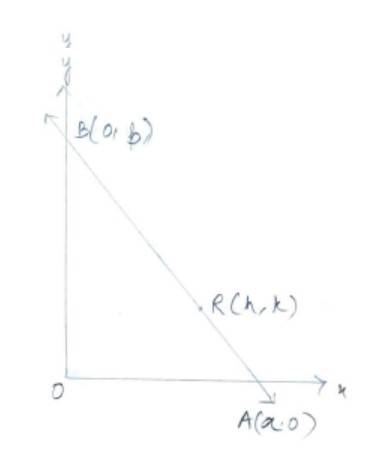
35. Point R (h, k) divides a line segment between the axes in the ratio 1: 2. Find equation of the line.
35. Equation of line with intercept form is
As R (h, x) divides line segment joining point A (a, 0) and B (0, b) in the ratio 1 : 2 we can write,
So,
Hence, putting value of a and b in equation (1) we get,
Upvote 6. If A × B = {(a, x),(a , y), (b, x), (b, y)}. Find A and B.
6. If A × B = {(a, x),(a , y), (b, x), (b, y)}. Find A and B.
6. Given,
A ×B = { (a, x), (a, y), (b, x), (b, y)}
We know that,
A ×B = { (p, q); p ∈ A and q ∈ B}
So, A = {a, b} and B = {x, y}.
Upvote 34. P (a, b) is the mid-point of a line segment between axes. Show that equation of the line is .
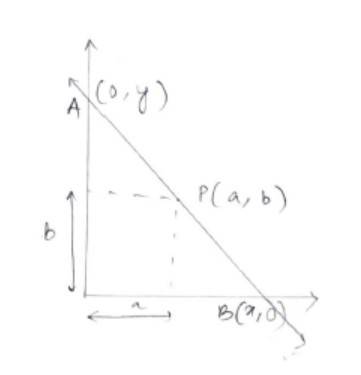
34. P (a, b) is the mid-point of a line segment between axes. Show that equation of the line is .
34.
Since P (a, b) is the mid-point of the line segment say AB with points A (0, y) and B (x, 0) we can write,
So, the equation of line with x and y intercept 2a and 2b using intercept form is
Hence, proved
Upvote 5. Given, A = {1,1}
So, A* A = { (1,1), (1,1), (1,1), (1,1)}
A *A *A = { (1,1), (1,1), (1,1), (1,1)} * {1,1}
= { (1,1.1), (1, 1), (1, ), (1,1,1), (1,1,1), (1,1), (1,1), (1,1,1)}
Upvote 4. State whether each of the following statements are true or false. If the statement is false, rewrite the given statement correctly.
(i) If P = {m, n} and Q = { n, m}, then P × Q = {(m, n),(n, m)}.
(ii) If A and B are non-empty sets, then A × B is a non-empty set of ordered pairs (x, y) such that x A and y B.
(iii) If A = {1, 2}, B = {3, 4}, then A × .
4. State whether each of the following statements are true or false. If the statement is false, rewrite the given statement correctly.
(i) If P = {m, n} and Q = { n, m}, then P × Q = {(m, n),(n, m)}.
(ii) If A and B are non-empty sets, then A × B is a non-empty set of ordered pairs (x, y) such that x A and y B.
(iii) If A = {1, 2}, B = {3, 4}, then A × .
4. (i) False. Here P = {m, n}, n (p)=2
Q = {n, m}, n (Q)=2
n (P× Q) = n (P)× n (Q) = 2× 2 = 4.
So, P ×Q = { (m, n), (m, m), (n, n), (n, m)}
(ii) True.
(iii) True. { A × (B ∩ ?) = A× ? . {∴ B ∩ ? = ? }
= n (A) ×0 {? is empty set}
= ?
Upvote