
Ncert Solutions Maths class 11th
Get insights from 1.6k questions on Ncert Solutions Maths class 11th, answered by students, alumni, and experts. You may also ask and answer any question you like about Ncert Solutions Maths class 11th
- 1.6k
Questions
- 0
Discussions
- 0
Active Users
- 83
Followers
Have a question about Ncert Solutions Maths class 11th? Ask our experts
Keep it short & simple. Type complete word. Avoid abusive language.
16. Determine the domain and range of the relation R defined by R = {(x, x + 5) : x {0, 1, 2, 3, 4, 5}}.
16. Determine the domain and range of the relation R defined by R = {(x, x + 5) : x {0, 1, 2, 3, 4, 5}}.
16. Given, R = { (x, x+5): x {0,1,2,3,4,5}
= { (0,0+5), (1,1+5), (2,2+5), (3,3+5), (4,4+5), (5,5+5)}
= { (0,5), (1,6), (2,7), (3,8), (4,9), (5,10)}
So, domain of R= {0,1,2,3,4,5}
range of R= {5,6,7,8,9,10}
 Upvote

15. Let A = {1, 2, 3, 4, 6}. Let R be the relation on A defined by {(a, b): a , b A, b is exactly divisible by a}.
(i) Write R in roster form
(ii) Find the domain of R
(iii) Find the range of R.
15. Let A = {1, 2, 3, 4, 6}. Let R be the relation on A defined by {(a, b): a , b A, b is exactly divisible by a}.
(i) Write R in roster form
(ii) Find the domain of R
(iii) Find the range of R.
15. Given, A= {1,2,3,4,6}
R= { (a, b): a, b A, b is exactly divisible by a}
(i) R= { (1,1), (1,2), (1,3), (1,4), (1,6), (2,2), (2,4), (2,6), (3,3), (3,6), (4,4), (6,6)}
(ii) Domain of R= {1,2,3,4,6}
(iii) Range of R= {1,2,3,4,6}
Upvote 39. Reduce the following equations into normal form. Find their perpendicular distances from the origin and angle between perpendicular and the positive x-axis.
(i) x – √3y + 8 = 0, (ii) y – 2 = 0, (iii) x – y = 4.
39. Reduce the following equations into normal form. Find their perpendicular distances from the origin and angle between perpendicular and the positive x-axis.
(i) x – √3y + 8 = 0, (ii) y – 2 = 0, (iii) x – y = 4.
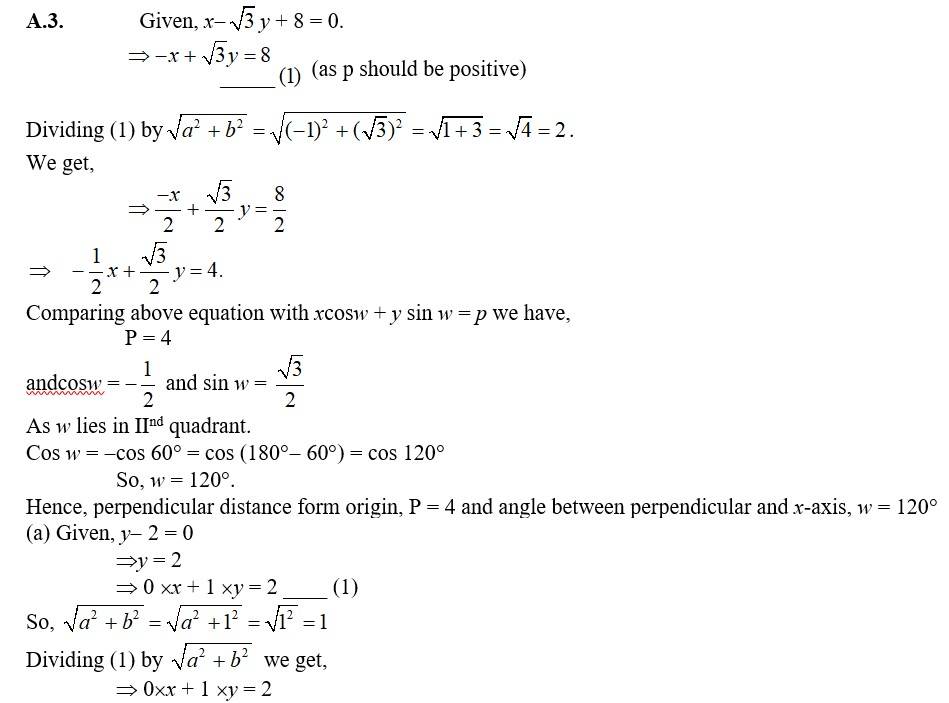
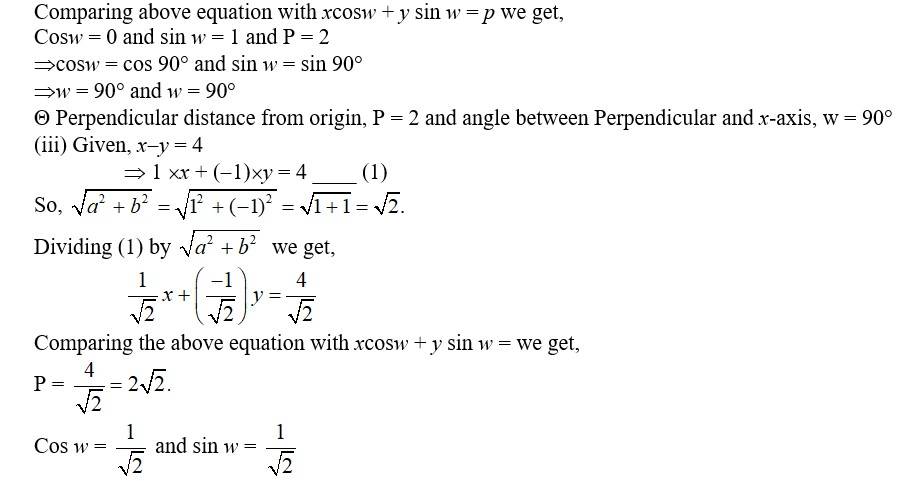
As w lies in IVth quadrant
Cos w = cos 45° and sin w = - sin 45°
= cos (360°- 45°) &nb
Upvote 14. The Fig 2.7 shows a relationship between the sets P and Q. Write this relation (i) in set-builder form (ii) roster form. What is its domain and range?
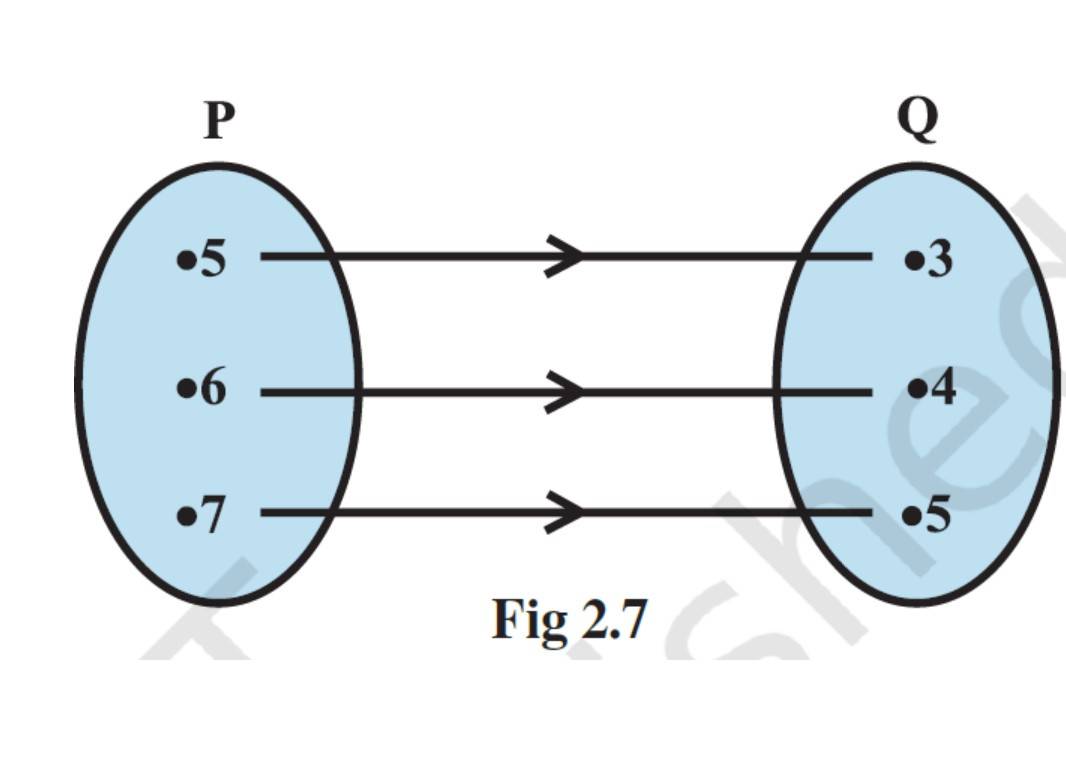
14. The Fig 2.7 shows a relationship between the sets P and Q. Write this relation (i) in set-builder form (ii) roster form. What is its domain and range?
14. As R is a relation from set P to Q.
(i) R = { (x, y): x – 2 = y ; 5 ≤ x ≤ 7}
(ii) R = { (5,3), (6,4), (7,5)}
Domain of R= {5,6,7}
range of R= {3,4,5}
Upvote 38. Reduce the following equations into intercept form and find their intercepts onthe axes.
(i) 3x + 2y – 12 = 0, (ii) 4x – 3y = 6, (iii) 3y + 2 = 0.
38. Reduce the following equations into intercept form and find their intercepts onthe axes.
(i) 3x + 2y – 12 = 0, (ii) 4x – 3y = 6, (iii) 3y + 2 = 0.
38. (i) Given, 3x + 2y 12 = 0.
3x + 2y = 12
Dividing both sides by 12 we get,
Comparing the above equation with = we get, x-intercept, a = 4 and y-intercept b = 6.
(ii) Given, 4x - 3y = 6
Dividing the both sides by 6.
Comparing above equation by we get, x-intercept a = and
Upvote 13. A = {1, 2, 3, 5} and B = {4, 6, 9}. Define a relation R from A to B by R = {(x, y): the difference between x and y is odd; x A, y B}. Write R in roster form.
13. A = {1, 2, 3, 5} and B = {4, 6, 9}. Define a relation R from A to B by R = {(x, y): the difference between x and y is odd; x A, y B}. Write R in roster form.
13. Given, A= {1,2,3,5}
B= {4,6,9}
R= { (x, y) : the difference of x & y is odd; x A, y B}.
= { (x, y):|x – y| is odd and x A, y B}
= { (1,4), (1,6), (2,9), (3,4), (3,6), (5,4), (5,6)}.
 Upvote
12. Define a relation R on the set N of natural numbers by R = {(x, y) : y = x + 5, x is a natural number less than 4; x, y N}. Depict this relationship using roster form. Write down the domain and the range.
12. Define a relation R on the set N of natural numbers by R = {(x, y) : y = x + 5, x is a natural number less than 4; x, y N}. Depict this relationship using roster form. Write down the domain and the range.
12. Given, R = { (x, y): y = x + 5, x is a natural number less than 4; x, y N}
= { (x, y): y = x + 5; x, y N and x < 4}.
= { (1,1+5), (2,2+5), (3,3+5)}
= { (1,6), (2,7), (3,8)}
So, domain of R = {1,2,3}
range of R = {6,7,8}
Upvote Class 11 Math Chapter 2 Relation and Function Exercise 2.2
11. Let A = {1, 2, 3,.,14}. Define a relation R from A to A by R = {(x, y) : 3x – y = 0, where x, y A}. Write down its domain, co-domain and range.
Class 11 Math Chapter 2 Relation and Function Exercise 2.2
11. Let A = {1, 2, 3,.,14}. Define a relation R from A to A by R = {(x, y) : 3x – y = 0, where x, y A}. Write down its domain, co-domain and range.
11. Given, A = {1,2,3, …, 14}
R = { (x, y): 3x – y = 0; x, y A}
= { (x, y): 3x = y; x, y A}.
= { (1,3), (2,6), (3,9), (4,12)}
Domain of R is the set of all the first elements of the ordered pairs in R
So, domain of R= {1,2,3,4}
Codomain of R is the whole set A.
So, codomain of R= {1,
Upvote 37. Reduce the following equations into slope - intercept form and find their slopes and the y - intercepts.
(i) x + 7y = 0, (ii) 6x + 3y – 5 = 0, (iii) y = 0.
37. Reduce the following equations into slope - intercept form and find their slopes and the y - intercepts.
(i) x + 7y = 0, (ii) 6x + 3y – 5 = 0, (iii) y = 0.
Exercise 9.3
37. (i) Given, x + 7y = 0.
7y = -x
y = x + 0.
Comparing the above equation with y = mx + c we get, slope, m = - and c = 0, y-intercept
(ii) Given, 6x + 3y - 5 = 0
3y = -6x + 5
y = - x + = -2x +
Comparing the above equation with y = mx + c we get, slope
Upvote