
Ncert Solutions Maths class 11th
Get insights from 1.6k questions on Ncert Solutions Maths class 11th, answered by students, alumni, and experts. You may also ask and answer any question you like about Ncert Solutions Maths class 11th
- 1.6k
Questions
- 0
Discussions
- 0
Active Users
- 83
Followers
Have a question about Ncert Solutions Maths class 11th? Ask our experts
Keep it short & simple. Type complete word. Avoid abusive language.
The value of ((1+sin(2π/9)+icos(2π/9))/(1+sin(2π/9)-icos(2π/9)))³ is
<!-- [if !supportLineBreakNewLine]-->
<!--[endif]-->
The value of ((1+sin(2π/9)+icos(2π/9))/(1+sin(2π/9)-icos(2π/9)))³ is
<!-- [if !supportLineBreakNewLine]-->
<!--[endif]-->
The value of (1+sin (2π/9)+icos (2π/9)/ (1+sin (2π/9)-icos (2π/9)³
= (1+cos (5π/18)+isin (5π/18)/ (1+cos (5π/18)-isin (5π/18)³
= (2cos² (5π/36)+2isin (5π/36)cos (5π/36)/ (2cos² (5π/36)-2isin (5π/36)cos (5π/36)³
= (cos (5π/36)+isin (5π/36)/ (cos (5π/36)-isin (5π/36)³
= (e^ (i5π/36)/e^ (-i5π/36)³ = (e^ (i
 Upvote

Let P(h,k) be a point on the curve y = x² + 7x + 2, nearest to the line, y = 3x - 3. Then the equation of the normal to the curve at P is
<!-- [if !supportLineBreakNewLine]-->
<!--[endif]-->
Let P(h,k) be a point on the curve y = x² + 7x + 2, nearest to the line, y = 3x - 3. Then the equation of the normal to the curve at P is
<!-- [if !supportLineBreakNewLine]-->
<!--[endif]-->
Let L be the common normal to parabola
y = x²+7x+2 and line y = 3x-3
⇒ slope of tangent of y=x²+7x+2 at P=3
⇒ dy/dx|for p = 3
⇒ 2x+7=3 ⇒ x=-2 ⇒ y=-8
So P (-2, -8)
Normal at P: x+3y+C=0
⇒ C=26 (satisfies the line)
Normal: x+3y+26=0
Upvote 
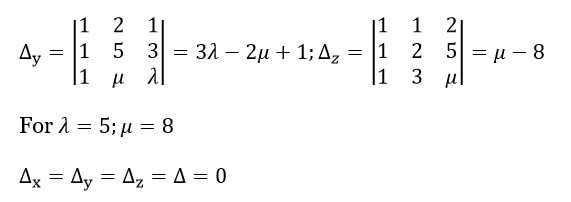
Let m and M be respectively the minimum and maximum values of |cosx, 1+sin²x, sin2x; 1+cos²x, sin²x, sin2x; cos²x, sin²x, 1+sin2x|. Then the ordered pair (m,M) is equal to:
<!-- [if !supportLineBreakNewLine]-->
<!--[endif]-->
Let m and M be respectively the minimum and maximum values of |cosx, 1+sin²x, sin2x; 1+cos²x, sin²x, sin2x; cos²x, sin²x, 1+sin2x|. Then the ordered pair (m,M) is equal to:
<!-- [if !supportLineBreakNewLine]-->
<!--[endif]-->
Determinant = -2-sin2x. Max -1, min -3. (m, M)= (-3, -1).
Upvote Two families with three members each and one family with four members are to be seated in a row. In how many ways can they be seated so that the same family members are not separated?
<!-- [if !supportLineBreakNewLine]-->
<!--[endif]-->
Two families with three members each and one family with four members are to be seated in a row. In how many ways can they be seated so that the same family members are not separated?
<!-- [if !supportLineBreakNewLine]-->
<!--[endif]-->
Kindly go through the solution
(3!)³ (4!)
Upvote The shortest distance between the lines (x-1)/0 = (y+1)/-1 = z/1 and x+y+z+1=0, 2x-y+z+3=0 is:
<!-- [if !supportLineBreakNewLine]-->
<!--[endif]-->
The shortest distance between the lines (x-1)/0 = (y+1)/-1 = z/1 and x+y+z+1=0, 2x-y+z+3=0 is:
<!-- [if !supportLineBreakNewLine]-->
<!--[endif]-->
Family of planes: x+y+z+1+? (2x-y+z+3)=0. Parallel to line means dot product of normals is zero.
Upvote The position of a moving car at time t is given by f(t)=at²+bt+c, t>0, where a,b and c are real numbers greater than 1. Then the average speed of the car over the time interval [t?,t?] is attained at the point:
<!-- [if !supportLineBreakNewLine]-->
<!--[endif]-->
The position of a moving car at time t is given by f(t)=at²+bt+c, t>0, where a,b and c are real numbers greater than 1. Then the average speed of the car over the time interval [t?,t?] is attained at the point:
<!-- [if !supportLineBreakNewLine]-->
<!--[endif]-->
Average speed = (f (t? )-f (t? )/ (t? -t? ) = a (t? +t? )+b.
Instantaneous speed = f' (t)=2at+b.
2at+b=a (t? +t? ) ⇒ t= (t? +t? )/2.
Upvote If α, β are roots of the equation x² + 5√2x + 10 = 0, α > β and P? = α? - β? for each positive integer n, then the value of (P?P? + 5√2P?P?)/(P?P? + 5√2P?²) is equal to……….
If α, β are roots of the equation x² + 5√2x + 10 = 0, α > β and P? = α? - β? for each positive integer n, then the value of (P?P? + 5√2P?P?)/(P?P? + 5√2P?²) is equal to……….
α, β are roots of x²+5√2x+10=0. α+β=-5√2, αβ=10.
P? + 5√2P? + 10P? = 0.
So P? +5√2P? =-10P? P? +5√2P? =-10P?
Expression = P? (-10P? )/P? (-10P? ) = 1.
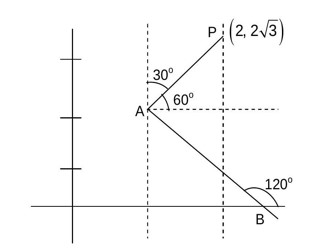
Upvote A ray of light coming from the point (2,2√3) is incident at an angle 30° on the line x=1 at the point A. The ray gets reflected on the line x=1 and meets x-axis at the point B. Then, the line AB passes through the point:
A ray of light coming from the point (2,2√3) is incident at an angle 30° on the line x=1 at the point A. The ray gets reflected on the line x=1 and meets x-axis at the point B. Then, the line AB passes through the point:
m (AP)=tan60°=√3. y-2√3=√3 (x-2). At x=1, y=√3. A= (1, √3).
m (AB)=tan120°=-√3. y-√3=-√3 (x-1) ⇒ √3x+y=2√3. (3, -√3) satisfies
Upvote There are 5 students in class 10, 6 students in class 11 and 8 students in class 12. If the number of ways, in which 10 students can be selected from them so as to include at least 2 students from each class and at most 5 students from the total 11 students of class 10 and 11 is 100k, then k is equal to…….
There are 5 students in class 10, 6 students in class 11 and 8 students in class 12. If the number of ways, in which 10 students can be selected from them so as to include at least 2 students from each class and at most 5 students from the total 11 students of class 10 and 11 is 100k, then k is equal to…….
| Class | No. of students | Number of possible cases |
| :-: | :-: | :- |
| 10 | 5 | (I) 2 | (II) 3 | (III) 2 |
| 11 | 6 | (I) 2 | (II) 2 | (III) 3 |
| 12 | 8 | (I) 6 | (II) 5 | (III) 5 |
Total cases =? C? ×? C? ×? C? +? C? ×? C? ×? C? +? C? ×? C? ×? C?
= 23,800 = 100K
∴ K = 238
Upvote