
Ncert Solutions Maths class 11th
Get insights from 1.6k questions on Ncert Solutions Maths class 11th, answered by students, alumni, and experts. You may also ask and answer any question you like about Ncert Solutions Maths class 11th
- 1.6k
Questions
- 0
Discussions
- 0
Active Users
- 83
Followers
Have a question about Ncert Solutions Maths class 11th? Ask our experts
Keep it short & simple. Type complete word. Avoid abusive language.
Let S be the sum of the first 9 terms of series (x+ka)+(x²+(k+2)a)+(x³+(k+4)a)+(x?+(k+6)a)+., where a≠0 and x≠1. If S=(x¹?-x+45a(x-1))/(x-1), then k is equal to
<!-- [if !supportLineBreakNewLine]-->
<!--[endif]-->
Let S be the sum of the first 9 terms of series (x+ka)+(x²+(k+2)a)+(x³+(k+4)a)+(x?+(k+6)a)+., where a≠0 and x≠1. If S=(x¹?-x+45a(x-1))/(x-1), then k is equal to
<!-- [if !supportLineBreakNewLine]-->
<!--[endif]-->

S = x (x? -1)/ (x-1)+9ka+a (9*8/2)=x (x? -1)/ (x-1)+9ka+72a.
S= (x¹? -x+ (9k+72)a (x-1)/ (x-1).
Comparing with given S, 9k+72=45 ⇒ k=-3.
 Upvote

The imaginary part of (3 + 2√-54)¹/² - (3 - 2√-54)¹/² can be
<!-- [if !supportLineBreakNewLine]-->
<!--[endif]-->
The imaginary part of (3 + 2√-54)¹/² - (3 - 2√-54)¹/² can be
<!-- [if !supportLineBreakNewLine]-->
<!--[endif]-->
3+2√-54=3+6√6i= (3+√6i)².
The difference is ± (3+√6i)? (3-√6i).
Possible values are 2√6i, -2√6i, 6, -6.
Imaginary part is ±2√6.
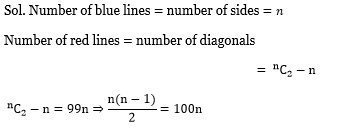
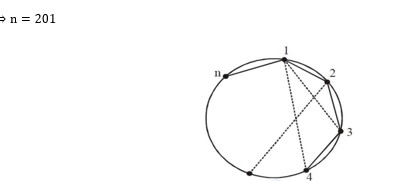
Upvote Let n > 2 be an integer. Suppose that there are n Metro stations in a city located along a circular path. Each pair of stations is connected by a straight track only. Further, each pair of nearest stations is connected by blue line, whereas all remaining pairs of stations are connected by red line. If the number of red lines is 99 times the number of blue lines, then the value of n is
<!-- [if !supportLineBreakNewLine]-->
<!--[endif]-->
Let n > 2 be an integer. Suppose that there are n Metro stations in a city located along a circular path. Each pair of stations is connected by a straight track only. Further, each pair of nearest stations is connected by blue line, whereas all remaining pairs of stations are connected by red line. If the number of red lines is 99 times the number of blue lines, then the value of n is
<!-- [if !supportLineBreakNewLine]-->
<!--[endif]-->
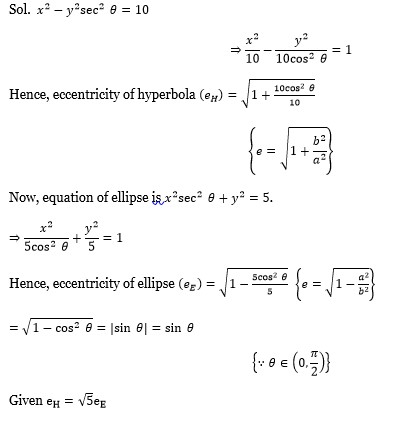
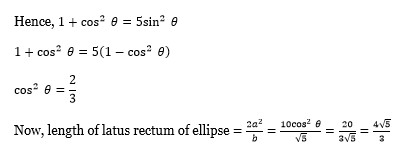
lim(x→0) (tan(π/4 + x))¹/? is equal to
<!-- [if !supportLineBreakNewLine]-->
<!--[endif]-->
lim(x→0) (tan(π/4 + x))¹/? is equal to
<!-- [if !supportLineBreakNewLine]-->
<!--[endif]-->
lim (x?0) (tan (? /4+x)¹/? = e^ (lim (x?0) (tan (? /4+x)-1)/x)
= e^ (lim (x?0) (2tanx/ (1-tanx)/x) = e².
Upvote If the sum of first 11 terms of an A.P. a?, a?, a?, . is 0 (a? ≠ 0), then the sum of the A.P. a?, a?, a?, ., a? is ka?, where k is equal to
If the sum of first 11 terms of an A.P. a?, a?, a?, . is 0 (a? ≠ 0), then the sum of the A.P. a?, a?, a?, ., a? is ka?, where k is equal to
S? =0 ⇒ (a? +a? ) (11/2)=0 ⇒ a? =-a?
2a? +10d=0 ⇒ a? =-5d.
Sum = a? +a? +.+a? = (a? +a? ) (12/2) = 6 (2a? +22d)
= 6 (2a? +22 (-a? /5) = 6 (2a? -22a? /5) = 6 (-12a? /5)=-72a? /5. k=-72/5.
Upvote