
Ncert Solutions Maths class 11th
Get insights from 1.6k questions on Ncert Solutions Maths class 11th, answered by students, alumni, and experts. You may also ask and answer any question you like about Ncert Solutions Maths class 11th
- 1.6k
Questions
- 0
Discussions
- 0
Active Users
- 83
Followers
Have a question about Ncert Solutions Maths class 11th? Ask our experts
Keep it short & simple. Type complete word. Avoid abusive language.
If the sum of the first 20 terms of the series log₇(₁/₂)x + log₇(₁/₃)x + log₇(₁/₄)x + . is 460, then x is equal to:
If the sum of the first 20 terms of the series log₇(₁/₂)x + log₇(₁/₃)x + log₇(₁/₄)x + . is 460, then x is equal to:
Given log?/? x + log?/? x + log?/? x + . 20 times = 460
⇒ (2+3+4+.+21)log?x = 460
⇒ (20/2)(2+21)log?x = 460
⇒ log?x = 2
⇒ x = 49
 Upvote

Let . be a G.P. such that and . If , then is equal to:
Let . be a G.P. such that and . If , then is equal to:
a? + a? = 4 ⇒ a? + a?r = 4
a? + a? = 16 ⇒ a?r² + a?r³ = 16
⇒ r = ±2
r = 2 ⇒ a? = 4/3
r = -2 ⇒ a? = -4
Σ(i=1 to 9) a? = (a(r?-1))/(r-1) = (-4)((-2)? - 1)/(-2-1)
= 4/3 (-513) = 4λ
⇒ λ = -171
Upvote There are 3 sections in a question paper and each section contains 5 questions. A candidate has to answer a total of 5 questions, choosing at least one question from each section. Then the number of ways, in which the candidate can choose the questions, is:
There are 3 sections in a question paper and each section contains 5 questions. A candidate has to answer a total of 5 questions, choosing at least one question from each section. Then the number of ways, in which the candidate can choose the questions, is:
A → 5Q; B → 5Q; C → 5QA
A?, A?, A?, A?, A?; B?, B?, B?, B?, B?; C?, C?, C?, C?, C?
A?A?A?B?C? → ?C? × ?C? × ?C? = 750
A?A?B?B?C? → ³C? × ?C? × ?C? = 1500
∴ Total = 2250
Upvote The locus of the mid - points of the perpendiculars drawn from points on the line, to the line is:
<!-- [if !supportLineBreakNewLine]-->
<!--[endif]-->
The locus of the mid - points of the perpendiculars drawn from points on the line, to the line is:
<!-- [if !supportLineBreakNewLine]-->
<!--[endif]-->
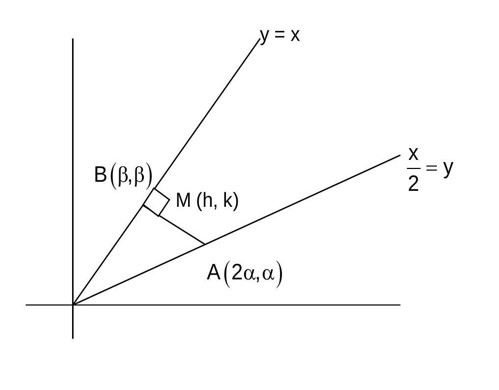
Slope AB = (k-α)/(h-2α) = -1
⇒ α = (k+h)/3
also (β+2α)/2 = h, (β+α)/2 = k
α = 2h - 2k
From (1) and (2)
(h+k)/3 = 2h - 2k
⇒ 5h = 7k
⇒ 5x = 7y
Upvote If the length of the chord of the circle, x²+y²=r²(r>0) along the line y-2x=3 is r, the r² is equal to:
<!-- [if !supportLineBreakNewLine]-->
<!--[endif]-->
If the length of the chord of the circle, x²+y²=r²(r>0) along the line y-2x=3 is r, the r² is equal to:
<!-- [if !supportLineBreakNewLine]-->
<!--[endif]-->
AB = r, AD = r/2
CD = rsin60° = √3r/2
|0+0-3|/√ (1²+2²) = √3r/2 ⇒ 3/√5 = √3r/2 ⇒ r = 2√3/√5 ⇒ r² = 12/5
Upvote If α and β are the roots of the equation, 7x²-3x-2=0, then the value of α/(1-α²) + β/(1-β²) is equal to:
If α and β are the roots of the equation, 7x²-3x-2=0, then the value of α/(1-α²) + β/(1-β²) is equal to:
α+β = 3/7, αβ = -2/7
α/ (1-α²) + β/ (1-β²) = (α+β) - αβ (α+β) / (1-α²) (1-β²)
= (α+β) - αβ (α+β) / (1 + (αβ)² - (α+β)² - 2αβ)
= (3/7) + (2/7) (3/7) / (1 + (-2/7)² - (3/7)² - 2 (-2/7) = 27/16
Upvote If the sum of the second, third and fourth terms of a positive term G.P. is 3 and the sum of its sixth, seventh and eighths terms is 243, then the sum of the first 50 terms of this G.P. is:
<!-- [if !supportLineBreakNewLine]-->
<!--[endif]-->
If the sum of the second, third and fourth terms of a positive term G.P. is 3 and the sum of its sixth, seventh and eighths terms is 243, then the sum of the first 50 terms of this G.P. is:
<!-- [if !supportLineBreakNewLine]-->
<!--[endif]-->
Let a, ar, ar² . G.P.
T? + T? + T? = 3 ⇒ ar (1+r+r²) = 3
T? + T? + T? = 243 ⇒ ar? (1+r+r²) = 243
by (i) and (ii)
r? = 81 ⇒ r=3
∴ a = 1/13
S? = a (r? -1)/ (r-1) = (3? -1)/26
Upvote The derivation of tan?¹((√(1+x²)-1)/x) with respect to tan?¹((2x√(1-x²))/(1-2x²)) at x=1/2 is:
<!-- [if !supportLineBreakNewLine]-->
<!--[endif]-->
The derivation of tan?¹((√(1+x²)-1)/x) with respect to tan?¹((2x√(1-x²))/(1-2x²)) at x=1/2 is:
<!-- [if !supportLineBreakNewLine]-->
<!--[endif]-->
Let x = tanθ
y? = tan? ¹ (secθ-1)/tanθ) = tan? ¹ (tan (θ/2) = θ/2 = (1/2)tan? ¹x
x = sinφ, y? = tan? ¹ (2sinφcosφ)/cos2φ)
= tan? ¹ (tan2φ) = 2φ = 2sin? ¹x
dy? /dy? = (dy? /dx)/ (dy? /dx) = (1/2) (1/ (1+x²) / (2/√ (1-x²)
= (√ (1-x²) / (4 (1+x²) = (√ (1-1/4) / (4 (1+1/4) = √3 / 10
Upvote 
If L = sin²(π/16) - sin²(π/8) and M = cos²(π/16) - sin²(π/8), then:
<!-- [if !supportLineBreakNewLine]-->
<!--[endif]-->
If L = sin²(π/16) - sin²(π/8) and M = cos²(π/16) - sin²(π/8), then:
<!-- [if !supportLineBreakNewLine]-->
<!--[endif]-->
L = sin (3π/16)sin (-π/16)
= (1/2) (cos (π/4) - cos (π/8)
= (1/2) (1/√2 - cos (π/8)
M = cos (3π/16)cos (-π/16)
= (1/2) (cos (π/4) + cos (π/8)
= (1/2) (1/√2 + cos (π/8)
Upvote