

Ncert Solutions Maths class 11th
Get insights from 1.6k questions on Ncert Solutions Maths class 11th, answered by students, alumni, and experts. You may also ask and answer any question you like about Ncert Solutions Maths class 11th
Follow Ask QuestionQuestions
Discussions
Active Users
Followers
New answer posted
a year agoContributor-Level 10
Truth table analysis shows that (P ∨ Q) ∧ (¬P) is equivalent to Q ∧ ¬P.
Then (Q ∧ ¬P) ⇒ Q. This is a tautology.
The provided solution seems to have an error.
Let's check the options. (P ∨ Q) is a tautology. (P ∧ ¬Q) is a contradiction.
~ (P ⇒ Q) ⇔ P ∧ ¬Q is true.
New answer posted
a year agoContributor-Level 10
sinθ + cosθ = 1/2
16 (sin (2θ) + cos (4θ) + sin (6θ)
= 16 [2sin (4θ)cos (2θ) + cos (4θ)]
= 16 [4sin (2θ)cos² (2θ) + 2cos² (2θ) - 1] . (i)
Now, sinθ + cosθ = 1/2, squaring on both sides, we get
1 + sin (2θ) = 1/4
sin (2θ) = -3/4
cos² (2θ) = 1 - sin² (2θ) = 1 - 9/16 = 7/16
From equation (i)
16 [4 (-3/4) (7/16) + 2 (7/16) - 1]
16 [-21/16 + 14/16 - 16/16] = 16 [-23/16] = -23
New answer posted
a year agoContributor-Level 10
S? : |z - 3 - 2i|² = 8
|z - (3 + 2i)| = 2√2
(x - 3)² + (y - 2)² = (2√2)²
S? : Re (z) ≥ 5
x ≥ 5
S? : |z - z? | ≥ 8
|2iy| ≥ 8
2|y| ≥ 8
|y| ≥ 4
y ≥ 4 or y ≤ -4
From the graph of the circle (S? ) and the regions (S? and S? ), we can see that there is one point of intersection at (5, 4).
∴ n (S? ∩ S? ∩ S? ) = 1
New answer posted
a year agoContributor-Level 10
x² - |x| - 12 = 0
Case 1: x ≥ 0, |x| = x
x² - x - 12 = 0
(x-4) (x+3) = 0, x=4 (x=-3 is rejected)
Case 2: x < 0, |x| = -x
x² + x - 12 = 0
(x+4) (x-3) = 0, x=-4 (x=3 is rejected)
Two real solutions: 4 and -4.
New answer posted
a year agoContributor-Level 10
x² - 4xy – 5y² = 0
Equation of pair of straight line bisectors is (x²-y²)/ (a-b) = xy/h
(x²-y²)/ (1- (-5) = xy/ (-2)
(x²-y²)/6 = xy/ (-2)
x²-y² = -3xy
x² + 3xy - y² = 0
New answer posted
a year agoContributor-Level 10
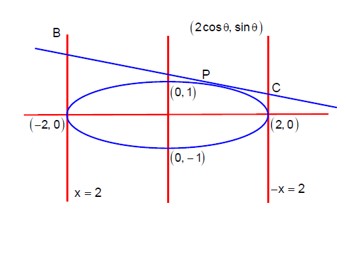
Equation of tangent of P (2cosθ, sinθ) is
(cosθ)x + (2sinθ)y = 4
Solving equation of tangent with equation of tangents at major axis ends, i.e. x = -2 and x = 2
For point 'B' (at x=-2):
-2cosθ + 2sinθ y = 4 ⇒ y = (2+cosθ)/sinθ
B (-2, (2+cosθ)/sinθ)
For point 'C' (at x=2):
2cosθ + 2sinθ y = 4 ⇒ y = (2-cosθ)/sinθ
C (2, (2-cosθ)/sinθ)
Now BC is the diameter of circle
Equation of circle: (x+2) (x-2) + (y - (2+cosθ)/sinθ) (y - (2-cosθ)/sinθ) = 0
x²-4 + y² - (4/sinθ)y + (4-cos²θ)/sin²θ = 0
Check if (√3, 0) satisfies this:
(√3)²-4 + 0 - 0 + (4-cos²θ)/sin²θ = -1 + (3+sin²θ)/sin²θ = -1 + 3/sin²θ + 1 = 3/sin²
New answer posted
a year agoContributor-Level 10
Given
OR a + b = 1 – ab .(ii)
Now,
log (1 + a) + log(1 + b) = log (1 + a) (1 + b) = log {1 + a + b + ab} = loge2
New answer posted
a year agoContributor-Level 10
= 2 cos2 θ + 2 sin2 θ + 6 sin q + 45
= 6 sin θ + 47
for maximum of PA2 + PB2, sin θ = 1
then P (1, 2)
Hence P, A & B will lie on a straight line.
New answer posted
a year agoContributor-Level 10
Given n = 2x. 3y. 5z . (i)
On solving we get y = 3, z = 2
So, n = 2x. 33. 52
So that no. of odd divisor = (3 + 1) (2 + 1) = 12
Hence no. of divisors including 1 = 12
Taking an Exam? Selecting a College?
Get authentic answers from experts, students and alumni that you won't find anywhere else
Sign Up on ShikshaOn Shiksha, get access to
- 67k Colleges
- 1.2k Exams
- 716k Reviews
- 1850k Answers