
Ncert Solutions Maths class 12th
Get insights from 2.5k questions on Ncert Solutions Maths class 12th, answered by students, alumni, and experts. You may also ask and answer any question you like about Ncert Solutions Maths class 12th
- 2.5k
Questions
- 0
Discussions
- 1
Active Users
- 65
Followers
Have a question about Ncert Solutions Maths class 12th? Ask our experts
Keep it short & simple. Type complete word. Avoid abusive language.
70. If the radius of a sphere is measured as 7 m with an error of 0.02 m, then find the approximate error in calculating its volume.
70. If the radius of a sphere is measured as 7 m with an error of 0.02 m, then find the approximate error in calculating its volume.
Let x be the radius of the sphere & Δπ be the error in measuring the radius.
Then, π = 7m and Δr = 0.02m.
Now, volume v of sphere is
So,
dv = 4π (7)2 (.0.02) = 3.92 πm3
∴The appropriate error is calculating the volume is 3.92πm3.
 Upvote

69. Find the approximate change in the surface area of a cube of side x metres caused by decreasing the side by 1%
69. Find the approximate change in the surface area of a cube of side x metres caused by decreasing the side by 1%
We know that, the surface area 5 of a ‘x’ when length cube, is S = 6x2.
So,
Given decrease in side,
Upvote 68. Find the approximate change in the volume V of a cube of side x metres caused by increasing the side by 1%.
68. Find the approximate change in the volume V of a cube of side x metres caused by increasing the side by 1%.
We know that, the volume v of side ‘a’ mete of cube is v = x3.
So,
Given that, increase in side = 1% of x.
Upvote 67. Find the approximate value of f (5.001), where f(x) = x3 – 7x2 + 15.
67. Find the approximate value of f (5.001), where f(x) = x3 – 7x2 + 15.
Given, y = f (x) = x3- 7x2 + 15.
So,
dy = (3x2- 14x) dx.
Δy = (3x2- 14x) Δx.
Let, x = 5 and Δx = 0.001. Then,
Δy = f (x + Δx) f (x).
f (x + Δx) = f (x) + Δy = f (x) + (3x2- 4x) Δx.
f (5 + 0.001) = 53- 7 (5)2 + 15 + [3 (5)2 - 14 (5)]. (0.001).
f (5.001) = 125 - 175 + 15 + (75 - 70) (0.001)
= -35
Upvote 66. Find the approximate value of f(2.01), where f (x) = 4x2 + 5x + 2.
66. Find the approximate value of f(2.01), where f (x) = 4x2 + 5x + 2.
Given, y = f (x) = 4x2 + 5x + 2.
So, f (x) = 8x + 5. = 8x + 5 dy = (8x + 5) dx.
Let x = 2 and Δx = 0.01.Then,
f (x + Δx) = f (2 + 0.01) = f (2.01).
Δy = f. (x + Δx) f (Δx).
f (x +Δx) = f (x) +Δy.
= f (x) + dy = f (x) + (8x + 5) dx.
= f (2.01) = f (2) + (8 x 2 + 5). Δx {∴dx = Δx}
= 4 (2)2 + 5 (2)
Upvote 65. Using differentials, find the approximate value of each of the following up to 3 places of decimal.
65. Using differentials, find the approximate value of each of the following up to 3 places of decimal.
(i) Let y= ?x : Let x = 25 and x = 0. 3.
Then, ?y = ?x+?x
= 5 + dy
=
= 5 + 0.03
(ii) ?49.5
A.(ii)
Let y = ?x Let x = 49 and x = 0.5.
Then,
= 7 + 0.0357.
(iii) ?0.6
A.(iii)
Let y = ?x Let x = 0.64 and ?x = 0.04.
Then,
= 0.8 - 0.025.
= 0.775.
(iv)
A.(iv)
Let Let x = 0.0
Upvote 64. The line y = x + 1 is a tangent to the curve y2 = 4x at the point (A) (1, 2) (B) (2, 1) (C) (1, – 2) (D) (– 1, 2)
64. The line y = x + 1 is a tangent to the curve y2 = 4x at the point (A) (1, 2) (B) (2, 1) (C) (1, – 2) (D) (– 1, 2)
The given eqn of curve is .
Then, differentiating wrt x we get,
which is the slope of the tangent to the curve.
The line compared to gives slope of line = 1.
Since, tangent is the line we have,
Putting y = 2 in we get,
Hence, the required point is
Upvote 63. The slope of the normal to the curve y = 2x2 + 3 sin x at x = 0 is
(A) 3 (B) (C) -3 (D) -
63. The slope of the normal to the curve y = 2x2 + 3 sin x at x = 0 is
(A) 3 (B) (C) -3 (D) -
Given,
Slope of tangent,
So, slope of normal
Option (D) is correct.
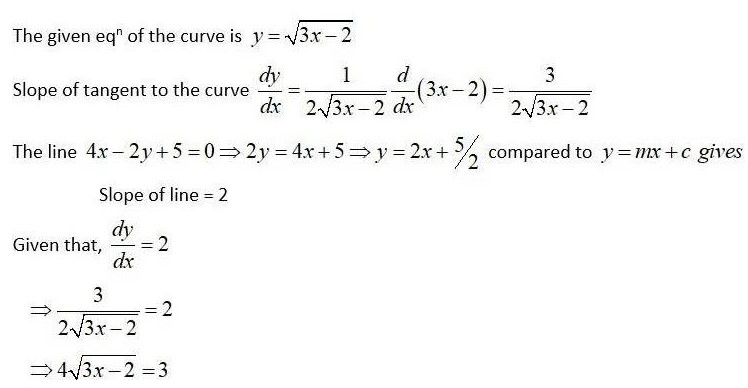
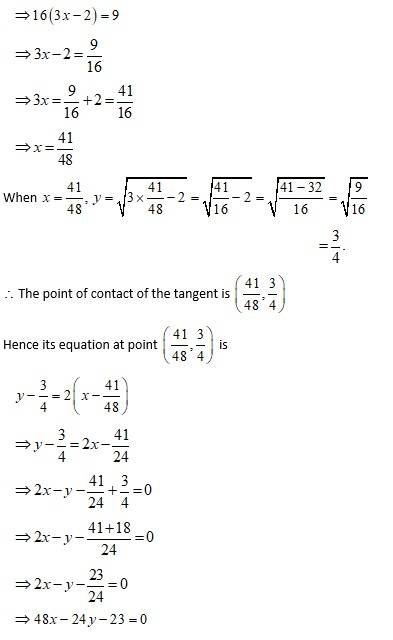
Upvote 62. Find the equation of the tangent to the curve y = √3x - 2 which is parallel to the line 4x - 2y + 5 = 0.
62. Find the equation of the tangent to the curve y = √3x - 2 which is parallel to the line 4x - 2y + 5 = 0.
61. Find the equations of the tangent and normal to the hyperbola
at the point
61. Find the equations of the tangent and normal to the hyperbola
at the point
The given eqn of the hyperbola is ______(1)
Differentiating eqn (1) wrt ‘x’ we get,
is the reqd slope of tangent to the curve
So, eqn of tangent at point is
As lies on the parabola given by eqn (1) we write,
Hence,
Upvote