
Ncert Solutions Maths class 12th
Get insights from 2.5k questions on Ncert Solutions Maths class 12th, answered by students, alumni, and experts. You may also ask and answer any question you like about Ncert Solutions Maths class 12th
- 2.5k
Questions
- 0
Discussions
- 0
Active Users
- 65
Followers
Have a question about Ncert Solutions Maths class 12th? Ask our experts
Keep it short & simple. Type complete word. Avoid abusive language.
Let f: (-1, ∞) → R be defined by f(0) = 1 and f(x) = (1/x)log?(1+x), x≠0. Then the function f:
Let f: (-1, ∞) → R be defined by f(0) = 1 and f(x) = (1/x)log?(1+x), x≠0. Then the function f:
f' (x)= (x- (1+x)ln (1+x)/ (x² (1+x). Let h (x)=x- (1+x)ln (1+x).
h' (x)=-ln (1+x). h' (x)>0 for x∈ (-1,0), <0 for x∈ (0, ∞).
h (0)=0, so h (x)≤0. f' (x)≤0. f is decreasing.
 Upvote

A plane passing through the point (3,1,1) contains two lines whose direction ratios are 1, -2, 2 and 2, 3, -1 respectively. If this plane also passes through the point (α, -3, 5), then α is equal to
<!-- [if !supportLineBreakNewLine]-->
<!--[endif]-->
A plane passing through the point (3,1,1) contains two lines whose direction ratios are 1, -2, 2 and 2, 3, -1 respectively. If this plane also passes through the point (α, -3, 5), then α is equal to
<!-- [if !supportLineBreakNewLine]-->
<!--[endif]-->
Normal to plane is n= (-4i+5j+7k).
Plane: -4 (x-3)+5 (y-1)+7 (z-1)=0 ⇒ -4x+5y+7z=0.
Passes through (α, -3,5) ⇒ -4α-15+35=0 ⇒ α=5.
Upvote Box I contains 30 cards numbered 1 to 30 and Box II contains 20 cards numbered 31 to 50. A box is selected at random and a card is drawn from it. The number on the card is found to be a non-prime number. The probability that the card was drawn from Box I is:
<!-- [if !supportLineBreakNewLine]-->
<!--[endif]-->
Box I contains 30 cards numbered 1 to 30 and Box II contains 20 cards numbered 31 to 50. A box is selected at random and a card is drawn from it. The number on the card is found to be a non-prime number. The probability that the card was drawn from Box I is:
<!-- [if !supportLineBreakNewLine]-->
<!--[endif]-->
Let B? be the event where Box-I is selected and B? →where box-II selected
P (B? )=P (B? )=1/2
Let E be the event where selected card is non prime.
For B? : Prime numbers: {2,3,5,7,11,13,17,19,23,29}
For B? : Prime numbers: {31,37,41,43,47}
P (E)=P (B? )×P (E/B? )+P (B? )P (E/B? )
= 1/2×20/30+1/2×15/20
Requ
Upvote The plane passing through the points (1,2,1), (2,1,2) and parallel to the line, 2x = 3y, z = 1 also passes through the point:
<!-- [if !supportLineBreakNewLine]-->
<!--[endif]-->
The plane passing through the points (1,2,1), (2,1,2) and parallel to the line, 2x = 3y, z = 1 also passes through the point:
<!-- [if !supportLineBreakNewLine]-->
<!--[endif]-->
Two points on the line (say) x/3 = y/2, z=1 are (0,0,1) and (3,2,1)
So dr's of the line is (3,2,0)
Line passing through (1,2,1), parallel to L and coplanar with given plane is r = i+2j+k + t (3i+2j), t∈R (-2,0,1) satisfies the line (for t=-1)
⇒ (-2,0,1) lies on given plane.
Answer of the question is (B)
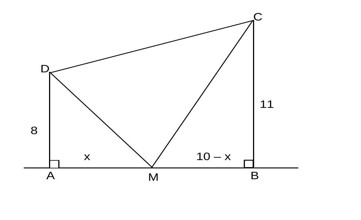
Upvote Let AD and BC be two vertical poles at A and B respectively on a horizontal ground. If AD=8m, BC=11m and AB=10m; then the distance (in meters) of a point M on AB from the point A such that MD²+MC² is minimum is [numerical value].
Let AD and BC be two vertical poles at A and B respectively on a horizontal ground. If AD=8m, BC=11m and AB=10m; then the distance (in meters) of a point M on AB from the point A such that MD²+MC² is minimum is [numerical value].
MD²+MC² is minimum when M is the midpoint of projection of CD on AB.
Upvote