
Ncert Solutions Maths class 12th
Get insights from 2.5k questions on Ncert Solutions Maths class 12th, answered by students, alumni, and experts. You may also ask and answer any question you like about Ncert Solutions Maths class 12th
- 2.5k
Questions
- 0
Discussions
- 0
Active Users
- 65
Followers
Have a question about Ncert Solutions Maths class 12th? Ask our experts
Keep it short & simple. Type complete word. Avoid abusive language.
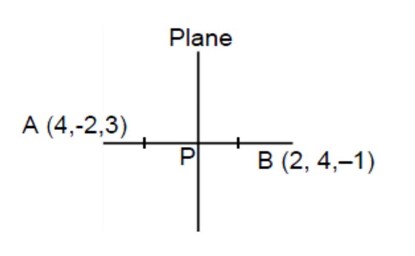
The plane which bisects the line joining the points (4, −2,3) and (2,4, -1) at right angles also passes through the point:
<!-- [if !supportLineBreakNewLine]-->
<!--[endif]-->
The plane which bisects the line joining the points (4, −2,3) and (2,4, -1) at right angles also passes through the point:
<!-- [if !supportLineBreakNewLine]-->
<!--[endif]-->
Mid point P = (3,1,1)
Normal of plane is along the line AB.
D.R.'s of normal = 4-2, -2-4, 3-1 (-1) = 2, -6, 4
= 1, -3, 2
Plane -> 1 (x-3) - 3 (y-1) + 2 (z-1) = 0
=> x - 3y + 2z - 2 = 0
 Upvote

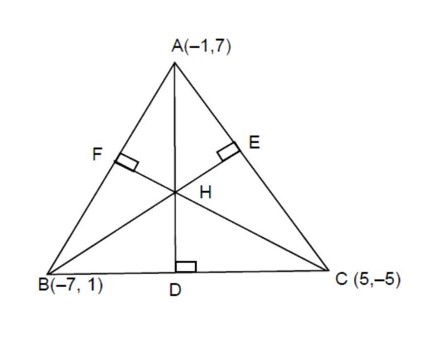
If a △ ABC have vertices A(−1,7), B(−7,1) and C(5, −5), then its orthocenter has coordinates:
If a △ ABC have vertices A(−1,7), B(−7,1) and C(5, −5), then its orthocenter has coordinates:
m? = 6/-12 = -1/2
∴ Equation of AD is y-7 = 2 (x+1)
y = 2x+9
m? = 12/-6 = -2
∴ Equation of BE is y-1 = 1/2 (x+7)y
y = x/2 + 9/2
by (1) and (2)
2x+9 = (x+9)/2
=> 4x+18 = x+9
=> 3x = 9 => x=-3
∴ y=3
Upvote The probability that a randomly chosen 5 - digit number is made from exactly two digits is:
<!-- [if !supportLineBreakNewLine]-->
<!--[endif]-->
The probability that a randomly chosen 5 - digit number is made from exactly two digits is:
<!-- [if !supportLineBreakNewLine]-->
<!--[endif]-->
Total = 9 (10? )
Fav. Way =? C? (2? -2) +? C? (2? -1) = 36 (30) + 9 (15) = 1080 + 135
Probability = (36x30+9x15)/ (9x10? ) = (4x30+15)/10? = 135/10?
Upvote A die is thrown two times and the sum of the scorers appearing on the die is observed to be a multiple of 4. Then the conditional probability that the score 4 has appeared at least once is
<!-- [if !supportLineBreakNewLine]-->
<!--[endif]-->
A die is thrown two times and the sum of the scorers appearing on the die is observed to be a multiple of 4. Then the conditional probability that the score 4 has appeared at least once is
<!-- [if !supportLineBreakNewLine]-->
<!--[endif]-->
Sum obtained is a multiple of 4.
A = { (1,3), (2,2), (3,1), (2,6), (3,5), (4,4), (5,3) (6,2), (6,6)}
B: Score of 4 has appeared at least once.
B = { (1,4), (2,4), (3,4), (4,4), (5,4), (6,4), (4,1), (4,2), (4,3), (4,5), (4,6)}
Required probability = P (B/A) = P (B? A)/P (A)
= (1/36) / (9/36) = 1/9
Upvote The foot of the perpendicular drawn from the point (4,2,3) to the line joining the points (1, −2,3) and (1,1,0) lies on the plane:
<!-- [if !supportLineBreakNewLine]-->
<!--[endif]-->
The foot of the perpendicular drawn from the point (4,2,3) to the line joining the points (1, −2,3) and (1,1,0) lies on the plane:
<!-- [if !supportLineBreakNewLine]-->
<!--[endif]-->
Equation of
AB = r = (î + j) + λ (3j - 3k)
Let coordinates of M
= (1, (1 + 3λ), -3λ).
PM = -3î + (3λ - 1)j - 3 (λ + 1)k
AB = 3j - 3k
? PM ⊥ AB ⇒ PM · AB = 0
⇒ 3 (3λ - 1) + 9 (λ + 1) = 0
⇒ λ = -1/3
∴ M = (1,0,1)
Clearly M lies on 2x + y - z = 1.
Upvote The lines
r = (î − ĵ) + l(2î + k) and
r = (2î – ĵ) + m(î + ĵ – k)
The lines
r = (î − ĵ) + l(2î + k) and
r = (2î – ĵ) + m(î + ĵ – k)
r = î (1 + 12l) + j (-1) + k (l)
r = î (2 + m) + j (m - 1) + k (-m)
For intersection
1 + 2l = 2 + m
-1 = m - 1
l = -m
from (ii) m = 0
from (iii) l = 0
These values of m and l do not satisfy equation (1).
Hence the two lines do not intersect for any values of l and m.
Upvote