
Ncert Solutions Maths class 12th
Get insights from 2.5k questions on Ncert Solutions Maths class 12th, answered by students, alumni, and experts. You may also ask and answer any question you like about Ncert Solutions Maths class 12th
- 2.5k
Questions
- 0
Discussions
- 0
Active Users
- 65
Followers
Have a question about Ncert Solutions Maths class 12th? Ask our experts
Keep it short & simple. Type complete word. Avoid abusive language.
The negation of the Boolean expression p∨(¬p∧q) is equivalent to:
<!-- [if !supportLineBreakNewLine]-->
<!--[endif]-->
The negation of the Boolean expression p∨(¬p∧q) is equivalent to:
<!-- [if !supportLineBreakNewLine]-->
<!--[endif]-->
p∨ (¬p∧q) = (p∨¬p)∧ (p∨q)=T∧ (p∨q)=p∨q. Negation is ¬p∧¬q.
 Upvote

If {p} denotes the fractional part of the number p, then {3²⁰⁰/8}, is equal to
If {p} denotes the fractional part of the number p, then {3²⁰⁰/8}, is equal to
(80+1)? /8 = (¹C?80? +.+¹C? )/8. Remainder is 1/8.
Upvote If the value of (1 + 2/3 + 6/3² + 10/3³ + .upto ∞) / (log?.?(1/3 + 1/3² + 1/3³ + .upto ∞)) is l, then l² is equal to……….
If the value of (1 + 2/3 + 6/3² + 10/3³ + .upto ∞) / (log?.?(1/3 + 1/3² + 1/3³ + .upto ∞)) is l, then l² is equal to……….
The expression inside log is a GP sum: (1/3)/ (1-1/3) = 1/2.
log? (1/2) = 1/2.
The series S = 1+2/3+6/3²+.
S - S/3 = 1 + 4/3² + 4/3³ + . = 1 + (4/9)/ (1-1/3) = 1+2/3=5/3.
(2/3)S = 5/3 ⇒ S=5/2.
l = (5/2)/ (1/2)=5. l²=25.
Upvote Let S = {n ∈ N | [n,i;0,1][a,b;c,d] = [a,b;c,d] ∀ a,b,c,d ∈ R}, where i = √-1. Then the number of 2-digit numbers in the set S is …….
Let S = {n ∈ N | [n,i;0,1][a,b;c,d] = [a,b;c,d] ∀ a,b,c,d ∈ R}, where i = √-1. Then the number of 2-digit numbers in the set S is …….
S = {n ∈ N | [n i; 0 1] [a b; c d] = [a b; c d] ∀a, b, c, d ∈ R}
[na+ic, nb+id; c, d] = [a, b;c, d]
This must be an identity matrix. n=1. The question seems to have typos. Let's follow the solution logic.
The solution implies the matrix must be [1 0; 0 1] or [-1 0; 0 -1]. And n must be a multiple of 8
Upvote Out of 11 consecutive natural numbers if three numbers are selected at random (without repetition), then the probability that they are in A.P. with positive common difference, is:
<!-- [if !supportLineBreakNewLine]-->
<!--[endif]-->
Out of 11 consecutive natural numbers if three numbers are selected at random (without repetition), then the probability that they are in A.P. with positive common difference, is:
<!-- [if !supportLineBreakNewLine]-->
<!--[endif]-->
Required probability = (? C? +? C? )/¹¹C? = 25/165=5/33.
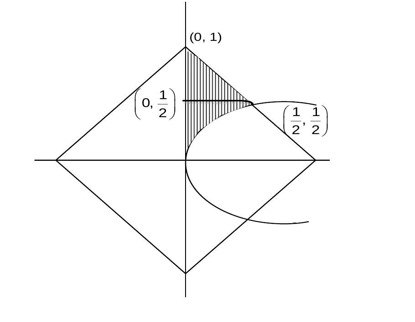
Upvote The area (in sq. units) of the region A={(x,y): |x|+|y|≤1, 2y²≥|x|} is:
<!-- [if !supportLineBreakNewLine]-->
<!--[endif]-->
The area (in sq. units) of the region A={(x,y): |x|+|y|≤1, 2y²≥|x|} is:
<!-- [if !supportLineBreakNewLine]-->
<!--[endif]-->
Required area = 4 [∫? ¹/² 2y²dy + ½×½×1] = 5/6.
Upvote If α and β be two roots of the equation x² - 64x + 256 = 0. Then the value of (α³/β⁵)¹/⁸ + (β³/α⁵)¹/⁸ is:
If α and β be two roots of the equation x² - 64x + 256 = 0. Then the value of (α³/β⁵)¹/⁸ + (β³/α⁵)¹/⁸ is:
α+β=64; αβ=256=2?
(α³/β? )¹/? + (β³/α? )¹/? = (α+β)/ (αβ)? /? = 64/32=2.
Upvote Let the foot of perpendicular from a point P(1,2,-1) to the straight line L: x/1 = y/0 = (z-1)/-1 be N. Let a line be drawn from P parallel to the plane x+y+2z = 0 which meets L at point Q. If α is the acute angle between the lines PN and PQ, then cosα is equal to……
<!-- [if !supportLineBreakNewLine]-->
<!--[endif]-->
Let the foot of perpendicular from a point P(1,2,-1) to the straight line L: x/1 = y/0 = (z-1)/-1 be N. Let a line be drawn from P parallel to the plane x+y+2z = 0 which meets L at point Q. If α is the acute angle between the lines PN and PQ, then cosα is equal to……
<!-- [if !supportLineBreakNewLine]-->
<!--[endif]-->
L: x/1=y/0=z/-1. Let a point on L be (r,0, -r).
Direction ratio of PN is (r-1, -2, -r+1).
PN is perpendicular to L, so (r-1) (1)+ (-2) (0)+ (-r+1) (-1)=0 ⇒ 2r-2=0 ⇒ r=1. N (1,0, -1).
Let Q be (s,0, -s). Direction ratio of PQ is (s-1, -2, -s+1).
PQ is parallel to plane x+y+2z=0, so normal to plane is per
Upvote The number of real roots of the equation e? - e? - 2e³? - 12e²? + e? + 1 = 0 is:
<!-- [if !supportLineBreakNewLine]-->
<!--[endif]-->
The number of real roots of the equation e? - e? - 2e³? - 12e²? + e? + 1 = 0 is:
<!-- [if !supportLineBreakNewLine]-->
<!--[endif]-->
e? - e? - 2e³? - 12e²? + e? + 1 = 0
e³? - 2 + e? ³? - e? [e³? + 12e? - 1] = 0
Let y=e? y? -y? -2y³-12y²+y+1=0.
The solution breaks the equation into (e³? - 4e? - 1) (e³? - 1 + 3e? ) = 0
Either e³? = 4e? + 1 (One Solution)
OR e³? = 1 - 3e? (One Solution)
∴ the equation has total 2 solutions.
Upvote Let 9 distinct balls be distributed among 4 boxes, B?, B?, B? and B?. If the probability that B? contains exactly 3 balls is k(3/4)? then k lies in the set:
Let 9 distinct balls be distributed among 4 boxes, B?, B?, B? and B?. If the probability that B? contains exactly 3 balls is k(3/4)? then k lies in the set:
Three balls can be given to B? in? C? ways. Now remaining 6 balls can be distributed into 3 boxes in 3? ways.
Total no. of favourable events =? C? × 3? = 28 × 3?
Total no. of events = 9 balls distributed into 4 boxes in 4? ways.
probability = 28 × 3? /4? = 28/9 × (3/4)? ⇒ k = 28/9
k ∈ |x-3|<1
Upvote