
Ncert Solutions Maths class 12th
Get insights from 2.5k questions on Ncert Solutions Maths class 12th, answered by students, alumni, and experts. You may also ask and answer any question you like about Ncert Solutions Maths class 12th
- 2.5k
Questions
- 0
Discussions
- 0
Active Users
- 65
Followers
Have a question about Ncert Solutions Maths class 12th? Ask our experts
Keep it short & simple. Type complete word. Avoid abusive language.
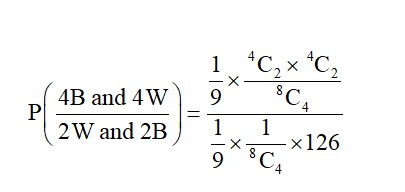
A bag contains 8 balls (black and white). If four balls are chosen without replacement then 2W and 2B are found then the probability that number of white and black balls are same in bag is equal to
A bag contains 8 balls (black and white). If four balls are chosen without replacement then 2W and 2B are found then the probability that number of white and black balls are same in bag is equal to
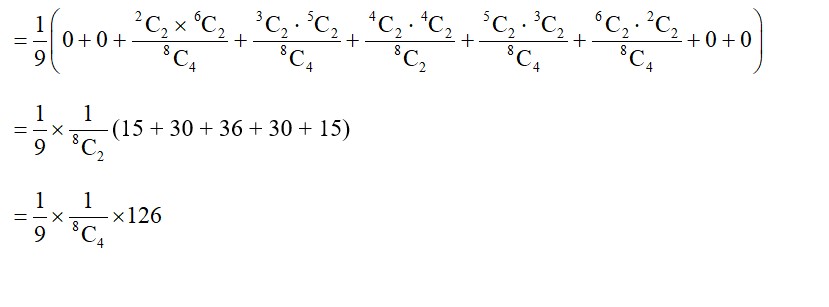
P (2W and 2B) = P (2B, 6W) × P (2W and 2B)
+ P (3B, 5W) × P (2W and 2B)
+ P (4B, 4W) × P (2W and 2B)
+ P (5B, 3W) × P (2W and 2B)
+ P (6B, 2W) × P (2W and 2B)
(15 + 30 + 36 + 30 + 15)
 Upvote

If A = {1, 2, 3, … 100}, R = {(x, y) | 2x = 3y, x, y ∈ A} is symmetric relation on A and the number of elements in R is n, the smallest integer value of n is
If A = {1, 2, 3, … 100}, R = {(x, y) | 2x = 3y, x, y ∈ A} is symmetric relation on A and the number of elements in R is n, the smallest integer value of n is
⇒ (y, x) ∈ R V (x, y) ∈ R
(x, y) ∈ R ⇒ 2x = 3y and (y, x) ∈ R ⇒ 3x = 2y
Which holds only for (0, 0)
Which does not belongs to R.
∴ Value of n = 0
Upvote If (α, β, γ) is mirror image of the point (2, 3, 4) with respect to the line <!-- [if gte mso 9]><xml>
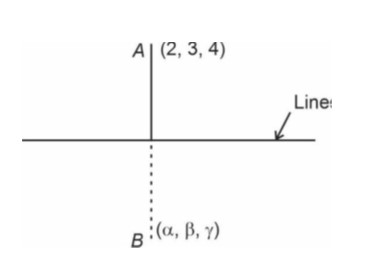
If (α, β, γ) is mirror image of the point (2, 3, 4) with respect to the line <!-- [if gte mso 9]><xml>
Take
x = 2λ + 1, y = 3λ + 2, z = 4λ + 3
= (α − 2)
Now,
(α − 2) ⋅ 2 + (β − 3) ⋅3 + (γ − 4) ⋅ 4 = 0
2α − 4 + 3β − 9 + 4γ −16 = 0
⇒ 2α + 3β + 4γ = 29
Upvote The number of solutions of equation esin x − 2e– sin x = 2 is
The number of solutions of equation esin x − 2e– sin x = 2 is
Take esinx = t (t > 0)
⇒
⇒
->t2 – 2t – 2 = 0
->t2 – 2t + 1 = 3
⇒ (t −1)2 = 3
⇒ t = 1 ±
⇒ t = 1 ± 1.73
⇒ t = 2.73 or –0.73 (rejected as t > 0)
⇒ esin x = 2.73
->loge esin x = loge 2.73
⇒ sin x = loge 2.73 > 1
So no solution.
Upvote Let : f(0, R)->∞ be increasing function such that <!-- [if gte mso 9]><xml>
Let : f(0, R)->∞ be increasing function such that <!-- [if gte mso 9]><xml>
f is increasing function
x < 5x < 7x
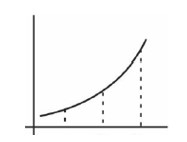
f (x) < f (5x) < f (7x)
->
Upvote A coin is biased such that head has two chances than tails, what is the probability of getting 2 heads and 1 tail?
A coin is biased such that head has two chances than tails, what is the probability of getting 2 heads and 1 tail?
Let probability of tail is
⇒ Probability of getting head =
∴ Probability of getting 2 heads and 1 tail
Upvote Le tf(x) be a polynomial of degree 6 in x, in which the coefficient of x6 is unity and it has extrema at x = -1 and x = 1. If then 5 f(2) is equal to……………….
Le tf(x) be a polynomial of degree 6 in x, in which the coefficient of x6 is unity and it has extrema at x = -1 and x = 1. If then 5 f(2) is equal to……………….
Let f (x) = x6 + ax5 + bx4 + ax3 + dx2 + ex + f
Non zero finite
So, d = e = f = 0
f (x) = x6 + ax5 + bx4 + cx3
Non zero finite
f’ (x) =
f’ (1) = 0
6 + 5a + 4b + 3 = 0
5a + 4b = - 9 . (i)
f’ (-1) = 0
-6 + 5a – 4b + 3 = 0 . (ii)
Solving (i) and (ii)
a -3/5, b = -3/2
Upvote Let be an integer. IF the shortest distance between the lines and , then the value of
Let be an integer. IF the shortest distance between the lines and , then the value of
The equation of the line through the point (0, 1, 2) perpendicular to the line
The equation of the line through the point (0, 1, 2) perpendicular to the line
For ‘B’, x = 2r + 1, y = 3r – 1, z = -2r + 1
As AB is perpendicular to the line,
direction ratios of AB
(2r + 1, 3r – 2, -2r – 1)
Equation of AB
Upvote The coefficients a, b and c of the quadratic equation, ax2 + bx + c = 0 are obtained by throwing a dice three times. The probability that this equation has equal roots is:
The coefficients a, b and c of the quadratic equation, ax2 + bx + c = 0 are obtained by throwing a dice three times. The probability that this equation has equal roots is:
ax2 + bx + c = 0
D = b2 – 4ac
D = 0
b2 – 4ac = 0
b2 = 4ac
(i) AC = 1, b = 2 (1, 2, 1) is one way
(ii) AC = 4, b = 4
(iii) AC = 9, b = 6, a = 3, c = 3 is one way
1 + 3 + 1 = 5 way
Required probability =
Upvote