
Physics Electrostatic Potential and Capacitance
Get insights from 131 questions on Physics Electrostatic Potential and Capacitance, answered by students, alumni, and experts. You may also ask and answer any question you like about Physics Electrostatic Potential and Capacitance
- 131
Questions
- 0
Discussions
- 0
Active Users
- 0
Followers
Have a question about Physics Electrostatic Potential and Capacitance? Ask our experts
Keep it short & simple. Type complete word. Avoid abusive language.
Five metallic plates each of area A and separated from adjacent plate by a distance d as shown in figure. The capacitance of the system across A and B is:

Five metallic plates each of area A and separated from adjacent plate by a distance d as shown in figure. The capacitance of the system across A and B is:

C = 3Aε0/d
d
 Upvote

Electric field in a region is E = 3 ˆj N/ C . Equipotential surfaces are parallel to
Electric field in a region is E = 3 ˆj N/ C . Equipotential surfaces are parallel to
Direction of E is perpendicular to equipotential surface.
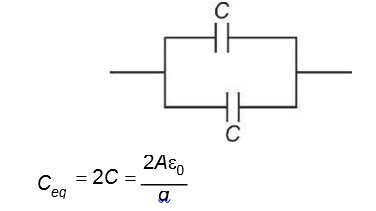
Upvote Figure shows four plates each of area A and separated from another by a distance d. What is the capacitance between P and Q?
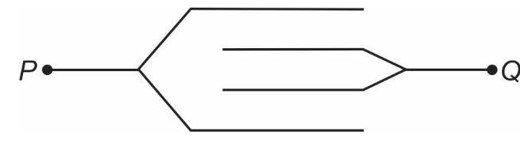
Figure shows four plates each of area A and separated from another by a distance d. What is the capacitance between P and Q?
A capacitor is charged by supply. It is then disconnected from the supply and is connected to another uncharged capacitor. The percentage of energy lost in form of heat and electromagnetic radiation is
A capacitor is charged by supply. It is then disconnected from the supply and is connected to another uncharged capacitor. The percentage of energy lost in form of heat and electromagnetic radiation is
, common potential
Final electrostatic energy stored in both the capacitors.
Upvote In the diagram shown below, the block has charge and is attached at one end of the light spring. The surface is smooth and horizontal and spring is in its natural length. If the electric field is switched on, the maximum elongation in the spring will be
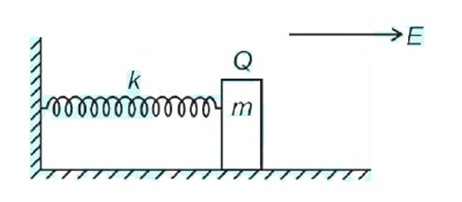
In the diagram shown below, the block has charge and is attached at one end of the light spring. The surface is smooth and horizontal and spring is in its natural length. If the electric field is switched on, the maximum elongation in the spring will be
For a region of constant electric potential, which of the following statements is incorrect?
For a region of constant electric potential, which of the following statements is incorrect?
(Explanation can be elaborate)
For a region of constant electric potential
(1) The electric field may be uniform
(2) The electric field may be zero
(3) There can be no charge inside the region
Upvote Before connecting the circuit shown in figure all capacitors were uncharged. The circuit now is in steady state. Now the switch is closed. During the time the steady state is reached again:

Column?I
Column?II
i. Charge on C1
p. increases
ii. Charge on C2
q. decreases
iii. Charge on C3
r. remains same
iv. Charge on C4
s. becomes zero
Now, match the given columns and select the correct option from the codes given below.
Codes:
Before connecting the circuit shown in figure all capacitors were uncharged. The circuit now is in steady state. Now the switch is closed. During the time the steady state is reached again:
|
Column?I |
Column?II |
|
i. Charge on C1 |
p. increases |
|
ii. Charge on C2 |
q. decreases |
|
iii. Charge on C3 |
r. remains same |
|
iv. Charge on C4 |
s. becomes zero |
Now, match the given columns and select the correct option from the codes given below.
Codes:
Before closing the switch

After closing the switch
So charge on C1
Upvote As shown in the figure below, a charge +2 C is situated at the origin O and another charge +5C is on the x?axis at the pint A. The latter charge from the point A is then brought to a point B on the y?axis. The work done is <!-- [if gte vml 1]>

<!--[endif]--><!-- [if gte mso 9]><xml>
As shown in the figure below, a charge +2 C is situated at the origin O and another charge +5C is on the x?axis at the pint A. The latter charge from the point A is then brought to a point B on the y?axis. The work done is <!-- [if gte vml 1]>
<!--[endif]--><!-- [if gte mso 9]><xml>