/Tags/Physics Electrostatic Potential and Capacitance
Physics Electrostatic Potential and Capacitance
Get insights from 131 questions on Physics Electrostatic Potential and Capacitance, answered by students, alumni, and experts. You may also ask and answer any question you like about Physics Electrostatic Potential and Capacitance
131
Questions
0
Discussions
0
Active Users
0
Followers
Have a question about Physics Electrostatic Potential and Capacitance? Ask our experts
Ask Your Question
Keep it short & simple. Type complete word. Avoid abusive language.
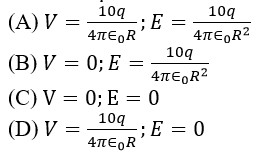
Potential of centre, = V = Vc = K (Σq)/R Vc = K (0)/R = 0 Electric field at centre E_B = E_B = ΣE Let E be electric field produced by each
charge at the centre, then resultant electric field will be Ec = 0, since equal electric field vectors are acting at equal angle so their resultant is equal to zero.


 Upvote