Physics Nuclei
Get insights from 85 questions on Physics Nuclei, answered by students, alumni, and experts. You may also ask and answer any question you like about Physics Nuclei
- 85
Questions
- 0
Discussions
- 0
Active Users
- 0
Followers
Have a question about Physics Nuclei? Ask our experts
Keep it short & simple. Type complete word. Avoid abusive language.
Mass of Bromine, Selenium and Krypton are given as:-
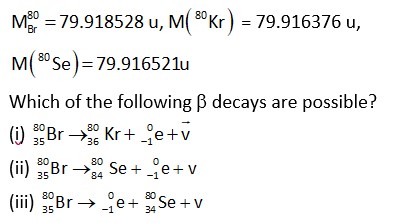
Mass of Bromine, Selenium and Krypton are given as:-
The rest mass of the deuteron, proton and neutron is equivalent to energy of 1877MeV, 939MeV, 940MeV respectively. A deuteron may disintegrate to a proton and neutron if it.
<!-- [if !supportLineBreakNewLine]-->
<!--[endif]-->
The rest mass of the deuteron, proton and neutron is equivalent to energy of 1877MeV, 939MeV, 940MeV respectively. A deuteron may disintegrate to a proton and neutron if it.
<!-- [if !supportLineBreakNewLine]-->
<!--[endif]-->
Energy of products = 939 + 940 = 1879
ΔE + E_reactions – E_productor = 1877 – 1879 = -2MeV.
Hence it must capture a γ - ray photon of energy 2MeV.
 Upvote

The binding energy (in MeV) of a nitrogen nucleus is :
(Given mass of nucleus , mass of proton , mass of neutron and )
<!-- [if !supportLineBreakNewLine]-->
<!--[endif]-->
The binding energy (in MeV) of a nitrogen nucleus is :
(Given mass of nucleus , mass of proton , mass of neutron and )
<!-- [if !supportLineBreakNewLine]-->
<!--[endif]-->
contains 7 protons and 7 neutrons.
Mass defect,
Binding energy
Upvote A radioactive sample decays with a constant of (1/3)logₑ2 s⁻¹. If initially there are 200 nuclei present, find the number of nuclei decayed during the first 9 seconds.
A radioactive sample decays with a constant of (1/3)logₑ2 s⁻¹. If initially there are 200 nuclei present, find the number of nuclei decayed during the first 9 seconds.
t? , half life = (log?2)/λ = 3 s
Initially 200 nuclei were there
After 3 half-lives, 9 seconds,
No. of nuclei = (1/2³) (200) = 25
Therefore, the number of nuclei that decayed = 200 – 25 = 175
Upvote A radioactive β –emission. A detector records n β –particles in 2s and by next 2s (accumulatively) it records 1.1 n β –particle. Number of β –particles recorded by detector after a long time, is
A radioactive β –emission. A detector records n β –particles in 2s and by next 2s (accumulatively) it records 1.1 n β –particle. Number of β –particles recorded by detector after a long time, is
N = [n + n/10 + n/100 + .]
= n/ (1 - 1/10) = 10/9
Upvote