

Physics
Get insights from 5.6k questions on Physics, answered by students, alumni, and experts. You may also ask and answer any question you like about Physics
Follow Ask QuestionQuestions
Discussions
Active Users
Followers
New answer posted
a year agoContributor-Level 10
U = U? + U? = (n? /N_A) (F? R/2)T? + (n? /N_A) (F? R/2)T?
For the mixture: U = (n? +n? )/N_A * (FR/2)T
F = (n? F? + n? F? ) / (n? + n? )
Equating the expressions for U and solving for T gives:
T = (n? F? T? + n? F? T? ) / (n? F? + n? F? )
New answer posted
a year agoContributor-Level 10
I = I? sin (ωt) + I? cos (ωt)
This can be written as I = I? sin (ωt + φ), where I? = √ (I? ² + I? ²)
A hot wire ammeter reads the rms value of the current.
I_rms = I? /√2 = √ (I? ² + I? ²)/√2
New answer posted
a year agoContributor-Level 10
P? - P? = 4T/a
P? - P? = 4T/b
P? - P? = 4T (1/a - 1/b)
Also, P? - P? = 4T/r
4T/r = 4T (1/a - 1/b)
1/r = (b-a)/ab
r = ab / (b-a)
New answer posted
a year agoContributor-Level 10
η = 1 - T_C / T_H
η = 1 - 400/800 = 1 - ½ = ½
η = W/Q_H ⇒ ½ = W/Q_H ⇒ Q_H = 2W = 2 * 1200 = 2400 J
New answer posted
a year agoContributor-Level 10
f = f_Translational + f_Rotational + f_Vibrational
f = 3 + 3 + 48 = 54 (Since each vibrational mode has two degrees of freedom)
γ = 1 + 2/f = 1 + 2/54 = 1 + 1/27 = 28/27 ≈ 1.03
New answer posted
a year ago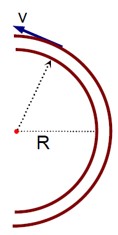
Contributor-Level 10
N = mg - F_L
f_s = mv²/R ≤ μsN = μs (mg - F_L)
F_L = m (v²/μsR - g)
New answer posted
a year agoContributor-Level 10
E_ground (H-atom) = -13.6 eV
E_carbon = E_ground (H-atom) * Z²/n²
For carbon, Z=6.
-13.6 eV = -13.6 eV * (6²/n²)
1 = 36/n²
n² = 36
n = 6
Taking an Exam? Selecting a College?
Get authentic answers from experts, students and alumni that you won't find anywhere else
Sign Up on ShikshaOn Shiksha, get access to
- 67k Colleges
- 1.2k Exams
- 718k Reviews
- 1850k Answers