

Physics
Get insights from 5.6k questions on Physics, answered by students, alumni, and experts. You may also ask and answer any question you like about Physics
Follow Ask QuestionQuestions
Discussions
Active Users
Followers
New answer posted
a year agoContributor-Level 10
The Balmer series lies in the visible region of the electromagnetic spectrum.
New answer posted
a year agoContributor-Level 10
In an LCR series AC circuit, the phase difference φ between current and voltage is: φ = tan? ¹ (X? - X? ) / R)
If each vibrational mode contributes two degrees of freedom and the total degrees of freedom f = 3 + 3 + 4 = 10, then:
β = 1 + 2/f = 1 + 2/10 = 1.2
New answer posted
a year agoContributor-Level 9
From Radioactive Decay Law,
dN/dt = λ? N + λ? N = λ_eff N
⇒ λ_eff = λ? + λ? ⇒ ln (2)/T = ln (2)/T? + ln (2)/T? ⇒ T = (T? ) / (T? + T? )
(where T, T? , and T? are half-lives)
New answer posted
a year agoContributor-Level 9
Direction of E is perpendicular to the direction of propagation and that of B.
E = cB = 3 * 10? * 2 * 10? = 6 V/m
New answer posted
a year agoContributor-Level 10
In a purely resistive AC circuit, if V = V? sin (ωt), then the current I is:
I = (V? / X? ) * sin (ωt - π/2)
New answer posted
a year agoContributor-Level 9
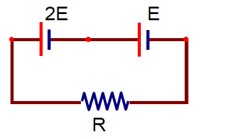
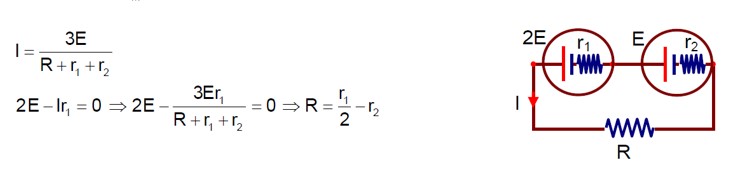
Magnetic field at centre of a solenoid is proportional to the current through it. Current through C will be one-third of the current through A. So
Magnetic field at the centre of C = 3/3 = 1T.
New answer posted
a year agoContributor-Level 9
According to principle of equi-partition of Energy, the average energy per molecules associated with each degree of freedom is (1/2)kT.
New answer posted
a year agoContributor-Level 9
m (dv/dt) = P ⇒ ∫v dv = ∫ (P/m) dt ⇒ v = (2Pt/m)¹/²
⇒ ∫dx = ∫ (2P/m)¹/² t¹/² dt ⇒ x = (2P/m)¹/² (2/3)t³/² ⇒ x ∝ t³/²
Taking an Exam? Selecting a College?
Get authentic answers from experts, students and alumni that you won't find anywhere else
Sign Up on ShikshaOn Shiksha, get access to
- 67k Colleges
- 1.2k Exams
- 718k Reviews
- 1850k Answers