

Physics
Get insights from 5.6k questions on Physics, answered by students, alumni, and experts. You may also ask and answer any question you like about Physics
Follow Ask QuestionQuestions
Discussions
Active Users
Followers
New answer posted
a year agoContributor-Level 9
From ohm's Law, V = IR = I (ρl / A) = I (ρl / (πd²/4) ⇒ ρ = (πd²V) / (4lI)
Relative error in resistivity,
Δρ/ρ = 2 (Δd/d) + ΔV/V + Δl/l + ΔI/I = 2 * (0.01/5.00) + (0.1/5.0) + (0.1/10.0) + (0.01/2000) = 0.039
Percentage error = (Δρ/ρ) * 100 = 3.9%
New answer posted
a year agoContributor-Level 9
For constant acceleration, a,
x = ut + (1/2)at² ⇒ x-t graph is parabola.
v = u + at ⇒ v-t graph is straight line with positive slope.
New answer posted
a year ago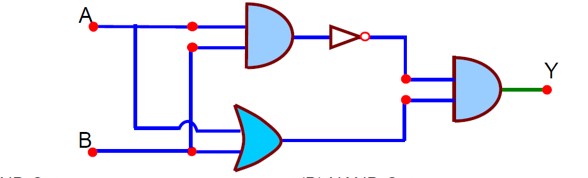
Contributor-Level 10
The circuit diagram represents an XOR Gate. The output Y is derived as:
Y = (A? B? ) (A + B) = (A? + B? ) (A + B) = A? B + AB? (XOR Gate)
New answer posted
a year agoContributor-Level 9
Layers of atmosphere are in order of (from bottom) troposphere, stratosphere, mesosphere, thermosphere.
New answer posted
a year agoContributor-Level 9
Fringe width, β = (λD) / d = (5890 * 10? ¹? * 0.5) / (0.5 * 10? ³) = 589 * 10? m
Distance between first and third bright fringe = 2β = 1178 * 10? m.
New answer posted
a year agoContributor-Level 9
For adiabatic process CD,
W = (P? V? - P? V? ) / (γ - 1) = (100 * 4 - 200 * 3) / (1.4 - 1) = -500J
New answer posted
a year agoContributor-Level 9
qE = mg ⇒ neE = (4/3)πr³ρg
⇒ n = (4πr³ρg) / (3eE) = (4 * 3.14 * (2 * 10? ³ )³ * 3 * 10³ * 9.81) / (3 * 1.6 * 10? ¹? * 3.55 * 10? ) = 1.73 * 10¹?
New question posted
a year ago
Taking an Exam? Selecting a College?
Get authentic answers from experts, students and alumni that you won't find anywhere else
Sign Up on ShikshaOn Shiksha, get access to
- 67k Colleges
- 1.2k Exams
- 718k Reviews
- 1850k Answers