

Physics
Get insights from 5.6k questions on Physics, answered by students, alumni, and experts. You may also ask and answer any question you like about Physics
Follow Ask QuestionQuestions
Discussions
Active Users
Followers
New answer posted
a year agoContributor-Level 10
Frequency of message signal, f? = (1.57 * 10? ) / (2 * 3.14) = 2.5 * 10? Hz
Bandwidth = 2f? = 5 * 10? Hz = 50MHz
New answer posted
a year agoContributor-Level 9
An eye with defect of myopia can not see distant objects clearly, while that of astigmatism sees objects non-uniform and distorted.
New answer posted
a year ago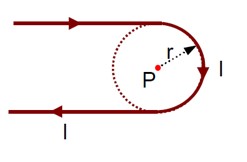
Contributor-Level 10
The magnetic field B is calculated as:
B = 2 * (μ? I / 4πr) + (μ? I / 4πr) = (μ? I / 4πr) * (2 + π)
New answer posted
a year agoContributor-Level 10
For a bouncing object with initial height h = 5m and coefficient of restitution e = 0.9 (so e² =0.81):
Total distance traveled, d = h + 2e²h + 2e? h + . = h * (1 + e²) / (1 - e²)
Total time taken, t = √* (2h/g)* + 2√* (2e²h/g)* + 2√* (2e? h/g)* + . = √* (2h/g)* * (1 + e) / (1 - e)
Average speed = d/t = √* (gh/2)* * (1 + e²) / (1 + e)² = 5 * (1.81) / (1.9)² = 2.50 m/s
New answer posted
a year agoContributor-Level 9
Using conservation of Angular momentum along axis of rotation, we can write
Mr²ω = (Mr² + 2mr²)ω? ⇒ ω? = Mω / (M + 2m)
New answer posted
a year agoContributor-Level 10
The equation representing the photoelectric effect is given as:
(1/2)mv? ² = hf? - φ . (1)
This continues the solution from number 6 on the previous page.
(1/2)mv? ² = hf? - φ . (2)
With the help of equations (1) and (2), we can write:
v? ² - v? ² = (2h/m) (f? - f? )
New answer posted
a year agoContributor-Level 10
Given the initial relationships:
X? = ωL and i? = V? / (ωL)
If the angular frequency ω is halved, the inductive reactance X? is halved, while the peak current i? is doubled.
New answer posted
a year agoContributor-Level 10
The displacement S is calculated by integrating the velocity function:
S = x - x? = ∫? ¹ v dt = ∫? ¹ (v? + gt + Ft²) dt = v? + g/2 + F/3
New answer posted
a year ago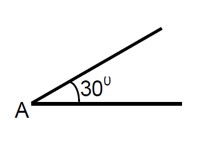
Contributor-Level 10
The acceleration 'a' is calculated as:
a = (g sinθ) / (1 + I/mr²) = (10 * sin30°) / (1 + 2/5) = 25/7 m/s²
The time 't' is calculated as:
t = 2v / a = (2 * 1) / (25/7) = 0.57 s
New answer posted
a year ago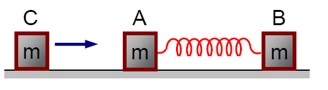
Contributor-Level 10
For an elastic collision where C comes to rest, and the compression in the spring is maximum, the velocities of A and B are equal (v). Using the conservation of mechanical energy:
(1/2)mv? ² = 2 * (1/2)mv² + (1/2)kx²
This gives the maximum compression x as:
x = v? * √* (m / 2k)*
Taking an Exam? Selecting a College?
Get authentic answers from experts, students and alumni that you won't find anywhere else
Sign Up on ShikshaOn Shiksha, get access to
- 67k Colleges
- 1.2k Exams
- 718k Reviews
- 1850k Answers