Physics
Get insights from 5.6k questions on Physics, answered by students, alumni, and experts. You may also ask and answer any question you like about Physics
Follow Ask QuestionQuestions
Discussions
Active Users
Followers
New answer posted
5 months agoContributor-Level 10
The graph of? vs I is a parabola-like curve with a minimum at i=e. So (B) is the correct representation.
New answer posted
5 months agoContributor-Level 10
ME = PE + KE = 8J
At x? , PE=4J, so KE = 8-4=4J. (A is correct)
At x>x? , PE=6J, so KE=2J, which is constant. (B is correct)
At x
At x? , PE=0J, so KE=8J, which is maximum. (D is correct)
New answer posted
5 months agoContributor-Level 10
Tsinθ = qE
Tcosθ = mg
tanθ = qE/mg
E = V/d_eff. V = V? - (-V? ) = V? +V?
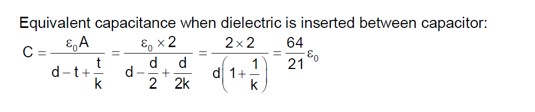
C? =kε? A/t, C? =ε? A/ (d-t).
Capacitors are in series. Q=C_eqV. E inside dielectric = σ/ (kε? ) = Q/ (Akε? ).
E in air = σ/ε? = Q/Aε?
Let's follow the solution.
Q = (C? / (C? +C? ) (V? +V? ).
E = E_air = Q/ (Aε? )
tanθ = qQ/ (Aε? mg) = q/ (Aε? mg) * (C? / (C? +C? ) (V? +V? )
Substitute C? and C?
This is getting complicated. The solution directly uses an expression for E. E = Q/C? Aε?
New answer posted
5 months agoContributor-Level 10
P = Fv = (ma)v = m (dv/dt)v
P dt = mv dv
∫P dt = ∫mv dv
Pt = ½mv²
v = √ (2Pt/m)
dx/dt = √ (2P/m) t¹/²
x = √ (2P/m) ∫t¹/² dt = √ (2P/m) * (2/3)t³/²
Squaring to match options:
x² = (8P/9m) t³
This does not match. Let's re-examine the options.
Position x is proportional to t³/².
x = (8P/9m)¹/² t³/²
New answer posted
5 months agoContributor-Level 10
ω = 2πf = 1/√ (LC)
L = 1/ (4π²f²C) = 1/ (4π² * 60² * 0.1*10? ) = 70.3 mH
New answer posted
5 months agoContributor-Level 10
E? (due to A and G) = 2 * (kq/l²)cos (45) = √2 kq/l² (downwards)
E? (due to B and F) = 2 * (kq/l²)cos (45) = √2 kq/l² (towards left)
E? (due to C and H) = 0
E? (due to D and E) = 0
Resultant E = √ (E? ²+E? ²) = √ (2 (kq/l²)²+2 (kq/l²)²) = 2kq/l²
(Solution in the image seems to be different.)
New answer posted
5 months agoContributor-Level 10
T = 2π√ (m/k)
0.2 = 2π√ (0.5/k)
k = (0.5) (2π/0.2)² = 50π² ≈ 500
x = A sin (ωt) = 5 sin (2π/T * t)
At t=T/4, x = 5 sin (π/2) = 5cm
PE = ½kx² = ½ * 500 * (0.05)² = 250 * 0.0025 = 0.625 J
New answer posted
5 months agoContributor-Level 10
Energy of electron = 3 eV
It forms H atom in n=3 state. Energy released E = 3 - (-13.6/9) = 3 + 1.51 = 4.51 eV.
Photon Energy = 4.51 eV
Threshold energy = hc/λ = 12400eVÅ / 4000Å = 3.1 eV.
kE_max = 4.51 - 3.1 = 1.41 eV
Taking an Exam? Selecting a College?
Get authentic answers from experts, students and alumni that you won't find anywhere else
Sign Up on ShikshaOn Shiksha, get access to
- 66k Colleges
- 1.2k Exams
- 681k Reviews
- 1800k Answers