Physics

Get insights from 5.6k questions on Physics, answered by students, alumni, and experts. You may also ask and answer any question you like about Physics

Follow Ask Question
5.6k

Questions

0

Discussions

28

Active Users

0

Followers

New answer posted

5 months ago

0 Follower 3 Views

R
Raj Pandey

Contributor-Level 9

Given: Power in R_B = 200 W, R_B = 50 Ω, V_source = 200 V
I² R_B = 200
I² (50) = 200
I² = 4 ⇒ I = 2A
Also, I = V_source / (R + R_B)
2 = 200 / (R + 50)
2 (R + 50) = 200
R + 50 = 100
R = 50Ω

New answer posted

5 months ago

0 Follower 3 Views

R
Raj Pandey

Contributor-Level 9

From conservation of momentum:
2*4 = 2v? + mv?
Given v? = 1 m/s (interpreted from intermediate steps)
8 = 2 (1) + mv?
mv? = 6 . (i)
From coefficient of restitution (e=1 for elastic collision):
e = (v? - v? )/ (u? - u? )
1 = (v? - v? )/ (4 - 0)
-1 = (v? - v? )/ (0 - 4)  (as written in the image)
⇒ 4 = v? - 1
⇒ v? = 5 . (ii)
Put (2) in (1), m (5) = 6
m = 1.2kg

New answer posted

5 months ago

0 Follower 3 Views

V
Vishal Baghel

Contributor-Level 10

E = ½mω²a² . (i)
When KE = 3E/4, PE = E - KE = E/4
E/4 = ½mω²y² . (ii)
Divide eq? (i) by eq? (ii) we get
4 = a²/y² => y = a/2

New answer posted

5 months ago

0 Follower 6 Views

V
Vishal Baghel

Contributor-Level 10

h = u²/2g, u = √2gh
Now, S = h/3
S = ut + ½at²
h/3 = √2ght - ½gt²
t² - 2√ (2h/g)t + 2h/3g = 0
Using quadratic formula for t:
t = ( 2√ (2h/g) ± √ (8h/g) - 4 (2h/3g) / 2
t = √ (2h/g) ± √ (2h/g - 2h/3g) = √ (2h/g) ± √ (4h/3g)
t? /t? = (√ (2h/g) - √ (4h/3g) / (√ (2h/g) + √ (4h/3g)
t? /t? = (√2 - √ (4/3) / (√2 + √ (4/3) = (√6 - 2)/ (√6 + 2)
(Note: There is a calculation error in the provided solution. Re-evaluating the physics.)
h/3 = (√2gh)t - ½gt²
(g/2)t² - (√2gh)t + h/3 = 0
t = (√2gh ± √ (2gh - 4 (g/2) (h/3)/g = (√2gh ± √ (4gh/3)/g
t? /t? = (√2gh - 2√gh/√3)/ (√2gh + 2√gh/√3)

...more

New answer posted

5 months ago

0 Follower 5 Views

R
Raj Pandey

Contributor-Level 9

(1/2)mu² = (1/2)mv² + mgl (1-cosθ)
⇒ v² = u² - 2gl (1-cosθ)
⇒ v² = 3² - 2*10*0.5* (1 - 1/2)
⇒ v² = 9 - 5 = 4
v = 2m/s


New answer posted

5 months ago

0 Follower 7 Views

R
Raj Pandey

Contributor-Level 9

I = I? e? /?
= (20/10000) e^- (1*10? / 10*10? ³)
= 2 * 10? ³ e? ¹
The provided solution calculates as:
= 2 * 10? ³ e? ¹
= 2e? ¹ mA
= 2 * 0.37mA
= 0.74 mA = 74/100 mA
(Note: There seems to be a calculation discrepancy in the source image, the steps shown lead to I = 2e? ¹ mA)

New answer posted

5 months ago

0 Follower 2 Views

V
Vishal Baghel

Contributor-Level 10

β = λD/d or β ∝ λ
Also, we know that λ_blue < _orange
So, β_orange > β_blue
So, dist b/w consecutive fringes will decrease.

New answer posted

5 months ago

0 Follower 9 Views

R
Raj Pandey

Contributor-Level 9

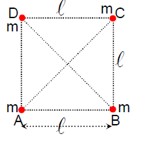
F_net = -kq²/ (l+x)² + kq²/ (l-x)²
= kq² [ (l+x)² - (l-x)² / (l²-x²)² ]
= kq² [ 4lx / (l²-x²)² ]
For x << l,
ma ≈ -4kq²x / l³
a = - (4kq²/ml³)x
ω² = 4kq²/ml³
ω = √ (4kq²/ml³)
= √ (4 * 9*10? * 10 / (1*10? * 1)
= 6 * 10? rad/s
= 6000 * 10? rad/s


New answer posted

5 months ago

0 Follower 2 Views

V
Vishal Baghel

Contributor-Level 10

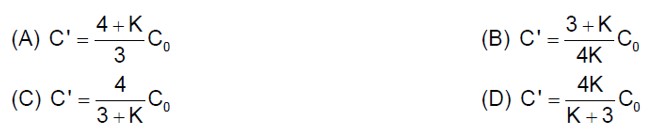
As charge remains same. So,
Initial total charge Q = (2C)V + CV = 3CV
When dielectric is inserted in C, its new capacitance is KC.
The capacitors 2C and KC are in parallel.
Equivalent capacitance C_eq = 2C + KC = (K+2)C
New potential Vc = Q/C_eq = 3CV/ (K+2)C) = 3V/ (K+2)

New answer posted

5 months ago

0 Follower 11 Views

R
Raj Pandey

Contributor-Level 9

ω = √k_eq/μ [μ = (m? )/ (m? +m? ) (Reduced mass)]
k_eq = (k * 4k)/ (k+4k) = 4k/5
ω = √ (4k/5) / (m? / (m? +m? )
= √ (4*20/5) / (0.2*0.8)/ (0.2+0.8)
= √ (16/0.16)
= 10 rad/s

Get authentic answers from experts, students and alumni that you won't find anywhere else

Sign Up on Shiksha

On Shiksha, get access to

  • 66k Colleges
  • 1.2k Exams
  • 681k Reviews
  • 1800k Answers

Share Your College Life Experience

×
×

This website uses Cookies and related technologies for the site to function correctly and securely, improve & personalise your browsing experience, analyse traffic, and support our marketing efforts and serve the Core Purpose. By continuing to browse the site, you agree to Privacy Policy and Cookie Policy.