Physics

Get insights from 5.6k questions on Physics, answered by students, alumni, and experts. You may also ask and answer any question you like about Physics

Follow Ask Question
5.6k

Questions

0

Discussions

24

Active Users

0

Followers

New answer posted

a year ago

0 Follower 4 Views

V
Vishal Baghel

Contributor-Level 10

mg – T = ma. (1)

T * R = l . (2)

a = R. (3)

With the help of equations (1), (2) and (3), we get
a = m g m + l R 2

v = 2 a h = ω R

⇒ ω 2 = 2 m g h l + m R 2

New answer posted

a year ago

0 Follower 2 Views

P
Payal Gupta

Contributor-Level 10

T1=2πmk

keq=k*kk+k=k2

T2=2πm (k/2)=2π2mk

⇒T2T1=2  and  k2k1=12

New answer posted

a year ago

0 Follower 14 Views

P
Payal Gupta

Contributor-Level 10

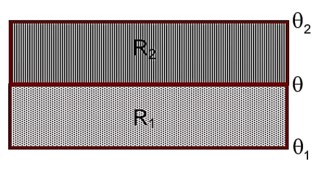
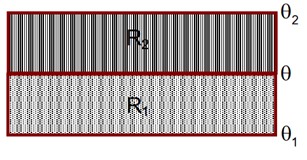
taking θ1 > θ2

Heat current = θ1−θR1=θ−θ2R2⇒θ1R1+θ2R2=θ (1R1+1R2)

⇒θ=θ1R2+θ2R1R1+R2


New answer posted

a year ago

0 Follower 13 Views

P
Payal Gupta

Contributor-Level 10

λ=hcE=6.63*10−34*3*1081.9*1.6*10−19 = 654 nm (red)

New answer posted

a year ago

0 Follower 2 Views

P
Payal Gupta

Contributor-Level 10

I A B = 2 5 m a 2 * 2 + ( 2 5 m a 2 + m b 2 ) * 2 = 8 m a 2 5 + 2 m b 2

New answer posted

a year ago

0 Follower 5 Views

P
Payal Gupta

Contributor-Level 10

According question, we can write

C1*C2C1+C2=154 (C1+C2)⇒4C1C2=15 (C12+C22+2C1C2)

⇒4 (C2C1)=15 (C2C1)2+30 (C2C1)+15⇒15x2+26x+15=0,  where x = C2C1

⇒x=−26±676−90030

Since x cannot be real, so this Question has been dropped by NTA

New answer posted

a year ago

0 Follower 4 Views

P
Payal Gupta

Contributor-Level 10

From volume conservation

n*43πr3=43πR3⇒R3=nr3.........(1)

Decrease in surface area = n*4πr2−4πR2

(ΔA)=4π[nr2−R2]=4π[n*r3r−R2]=4π[R3r−R2]=4πR3[1r−1R]

Energy released (W) = T*ΔA=4πR3T[1r−1R]

Heat produced (Q) = WJ=4πTR3J[1r−1R]

Now,Q=msΔθ

⇒4πR3TJ[1r−1R]=(43πR3)*|x|*Δθ=3TJ[1r−1R]

New answer posted

a year ago

0 Follower 13 Views

P
Payal Gupta

Contributor-Level 10

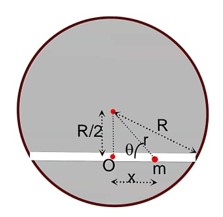
F = m E cos θ

 =m (GMR3*r)*xr ma=mgR*⇒a=gRx

⇒ T = 2 π R g


New answer posted

a year ago

0 Follower 10 Views

P
Payal Gupta

Contributor-Level 10

Mass m will acquire velocity 2u. Total momentum of system will be conserved but total kinetic energy is not conserved during collision.

New answer posted

a year ago

0 Follower 5 Views

P
Payal Gupta

Contributor-Level 10

F=kR3=mv2R⇒v=kmR2=km*1R

T=2πRv=2πRkm* (1R)⇒TαR2

Get authentic answers from experts, students and alumni that you won't find anywhere else

Sign Up on Shiksha

On Shiksha, get access to

  • 67k Colleges
  • 1.2k Exams
  • 718k Reviews
  • 1850k Answers

Share Your College Life Experience

×
×

This website uses Cookies and related technologies for the site to function correctly and securely, improve & personalise your browsing experience, analyse traffic, and support our marketing efforts and serve the Core Purpose. By continuing to browse the site, you agree to Privacy Policy and Cookie Policy.